
This post links with two of my previous posts –
Did Mary Sidney write Shakespeare’s Plays?
It has to do with the 1584 edition of The History of Wales.
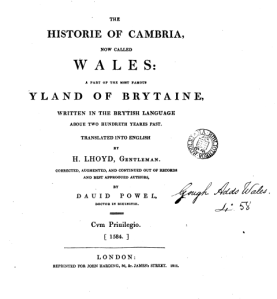
I was stunned to see Mr David Powell’s dedication of this book that he helped finish after the death of the original author H. Lhoyd. It says…
To the Right worshipfull
SIR PHILIP SYDNEY, KNIGHT.
This is Sir Philip Sidney, brother to Mary Sidney and Robert Sidney who married Barbara Gamage of Coety Castle, Glamorgan.
I speculate that Queen Elizabeth I had asked for this book to be written because of her grandfather, Henry VII, who had seized the throne of Britain on 22 August 1485 and thereby created the Royal House of Tudor.
Henry VII was born at Pembroke Castle in Wales, the son of Edmund Tudor and grandson of the Welshman Owen Tudor who had married Catherine of Valois after the death of her first husband Henry V. This family of Tudor take their names from Rhys ap Tewdwr, father of my Ravens and descendent of King Arthur (of illustrious fame) and also Beli Mawr and Anna (the daughter of Joseph of Arimathea.)
SIDE NOTE:
Few understand that the above named are the
Ancient and Rightful Royal family of these British Isles.
So the publication of this book on the History of Wales at this point in time (1584) makes sense. Elizabeth was cementing her absolute right to sit on the throne of England, even if her grandfather had ‘usurped’ it.
I spoke about the Sidney family in the post cited above – Did Mary Sidney write Shakespeare’s Plays? – and their links to my ongoing research, and I find the following lines that Powell wrote in his dedication to Sir Philip most interesting…
“For the putting of these things in practise, I am to lay down two
examples for you to imitate, the which (because they are domestical!)
ought to move you to be the more willing to follow them. The one
in your own noble father, who always hath been and yet is more
inclined and bent to do good to his country, than to benefit or enrich
himself, as Wales and Ireland, beside his own can bear him witness.
The other in your honorable father in law, Sir Francis Walsingham,
hir Maiesties cheefe Secretarie, a man for his zeal of Gods glory, and
love towards them that fear God unfainedlie, well known to the
world. Follow their steps, with the remembrance of that noble house,
out of the which you are descended by your honourable mother, and.
then you cannot do amiss.”
SIDE NOTE:
Lady Mary Dudley, Sir Philip’s ‘honourable mother’ was
a direct descendent of Owain Gwynedd, brother-in-law
and cousin to my Main Raven Gruffydd ap Rhys, son of Rhys ap Tewdwr.
Oh – the links are wonderful.
And also these lines from later on…
“…The second thing that moved me thereunto, is the slanderous report
of such writers, as in their books do enforce everything that is done
by the Welshmen to their discredit, leaving out all the causes and cir-
cumstances of the same: which do most commonly not only levate
or dissemble all the injuries and wrongs offered and done to the Welsh
men, but also conceal or deface all the acts worthy of commendation
achieved by them.
Search the common Chronicles touching the Welshmen, and commonly thou shalt find
that the King sendeth some nobleman or other with an army to Wales,
to withstand the rebellious attempts, the proud stomachs, the presumptuous pride, stir, trouble and rebellion
of the fierce, unquiet, cracking, fickle and unconstant Welshmen, and no open fact laid down to charge them
withall, why war should be levied against them, nor yet they swarving abroad out
of their own country to trouble other men.
Now this history doth shew the cause and circumstances of most of those wars, whereby the quality of the
action may be judged…
Whereupon the inhabitants of England favouring their countrymen
and freinds, reported not the best of the Welshmen.
This hatred and disliking was so increased by the stir and rebellion of
Owen Glyndoure, that it brought forth such grievous laws, as few
Christian kings ever gave or published the like to their subjects.”
SIDE NOTE:
Well said, that man.
Again…
…”The Normans having conquered England, and gotten all the lands
of the Saxon nobility, would faine have had the lands of the
Welshmen also, whereupon divers of them entered Wales with
an army, so that the Welshmen were driven for their own defense to
put themselves in armour: for the which fact they are by some writers
accused of rebellion, whereas by the law of Nature it is lawfull for all
men to withstand force by force.
They were in their own country, the land was theirs by inheritance and lawfull possession :
might they not therefore defend themselves from violence and wrong, if they could ?
What right or lawful title had the Earle of Chester to Ryuonioc and
Tegengl ? or the Earle of Salope to Dyuet, Caerdigan, and Powys ? or
Rob. Fitzhamon to Glamorgan ? or Barnard Newmarch to Brechnoke ?
or Ralph Mortimer to Eluel ? or Hugh Lacy to the land of Ewyas ?
or any other of them to any country in Wales ?
By what reason was it more lawfull for those men to dispossess them of these countries
with violence and wrong, than for them to defend and keep their own ?”
SIDE NOTE:
Those bloody Normans!
In an early post, linked above – Did you know…? – I wrote very briefly about the consistent destruction of Welsh history over the centuries. It is known that when the Welsh were imprisoned in England, they were allowed to take their libraries with them to gaol. And once all these works had come to England, they rarely travelled home to Wales.
Aha…PROOF
“I had also the British books of petegrees, Castoreus, and Sylvester Giral. Cambrensis,
which with divers other rare monuments of antiquity, I received at the hands of
the Right Honorable the Lord Burghley high treasurer of England,
who also directed me by his letters to all the offices where the Records of
this realm are kept, out of the which I have gathered a great part of
this history, and more would have done, if the time had permitted.”
The Welsh have, so often, been depicted as an ignorant, barbaric race but this is not true. And this is a subject that I will return to many times.
Until then…
 Hidden History Research
One thought on “The History of Wales – 1584”