Part 2
Zodiac Henry Percy.
“Elizabethan portrait” of the XX century
A.V. Lantratov
2 “Symbolic horoscope” in the portrait of Henry Percy
So let us turn to the recently published edition [of Nesterov], and more specifically to its head, eloquently entitled “Artists, Poets, Stargazers…” and dedicated, as you might guess, to astrological practices of Elizabethan England. It gives another interpretation of the picture we are interested in:
“A miniature of Nicholas Hilliard, depicting Henry Percy, the 9th Earl of Northumberland, can serve as a kind of illustration of the attitude of a person of that era to his horoscope. Among his contemporaries, he received the nickname “Count the Tynnograt” for his fascination with sealants, magic, alchemy. The owner of perhaps the best book collection in England, a friend of the astrologer and alchemist Dr. Dee, the mathematician Robert Hughes, the geographer Thomas Herriot, one of the patrons of Christopher Marlowe, Henry Percy was a very extraordinary person. …
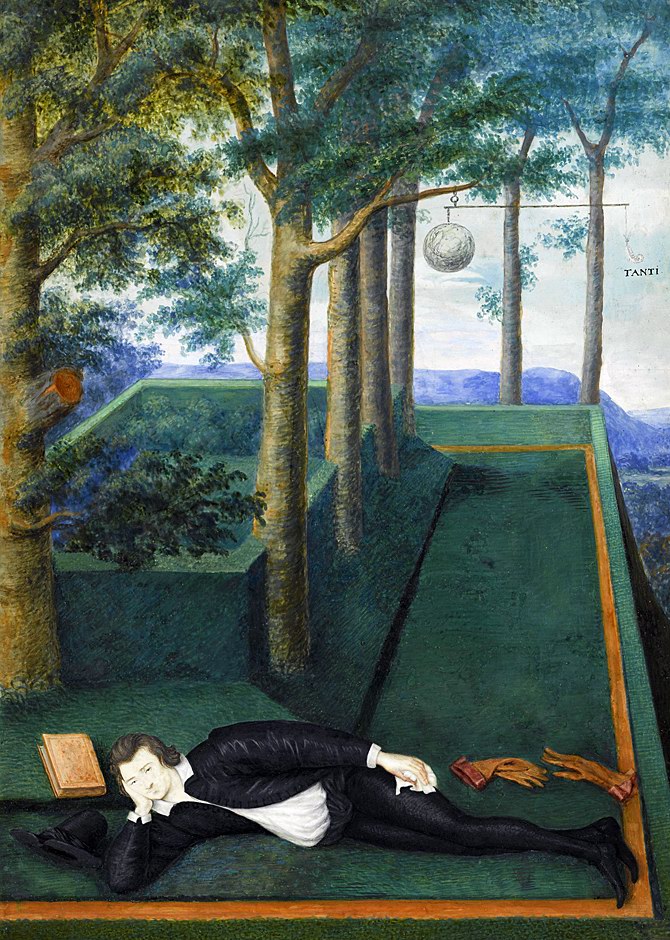
In miniature Hilliard ( Fig. 1 – A.) The graph is depicted lying on the grass in a kind of garden, enclosed by a square of hedge. To the left of the count the book and hat are carelessly thrown to the ground, to the right are leather gloves. The dark garb of the graph suggests the “colors of Saturn” associated with melancholy. The seven trees that the viewer sees are lined up in a very unusual order: four trees are located on the central line of the image and go deep into perspective, while a strange balancer hangs on the branch of the nearest one, where a heavy silver ball is either a lead casting or some the planetary globe (a relief is affixed on the ball) is balanced by a bird feather, next to which the Latin inscription TANTI is given – “equal”; two trees are visible in the background, parallel to the bottom edge of the miniature and taken out of the green fence; in the foreground,
Trying to find an interpretation for this miniature, Roy Strong pointed out that “Northumberland’s acquaintance with the art of mathematics, especially in that aspect associated with diagrams and geometric forms understood as loaded with symbolic and Pythagorean meanings, had a clear effect here. and enriched with Renaissance occultism, in its hermetic and kabalistic izvod. ” A number of researchers have attempted to decipher the Hermetic symbolism implied in this miniature by associating the “rows of trees” shown in the picture with Agrippa’s magic proportions and “number squares”. And yet astrological symbolism is clearly dominant in miniature. The number of trees – seven – clearly indicates their relationship with the planets, the same is underlined by the sphere suspended from the balance. ”
Let’s stop. Indeed, the correlation of seven trees with seven planets in this case suggests itself. Moreover, although the representation of planets in the form of trees (shrubs, flowers, individual branches / leaves) cannot be regarded as standard, it was actually practiced, at least in the alchemical tradition, fig. 9-11.
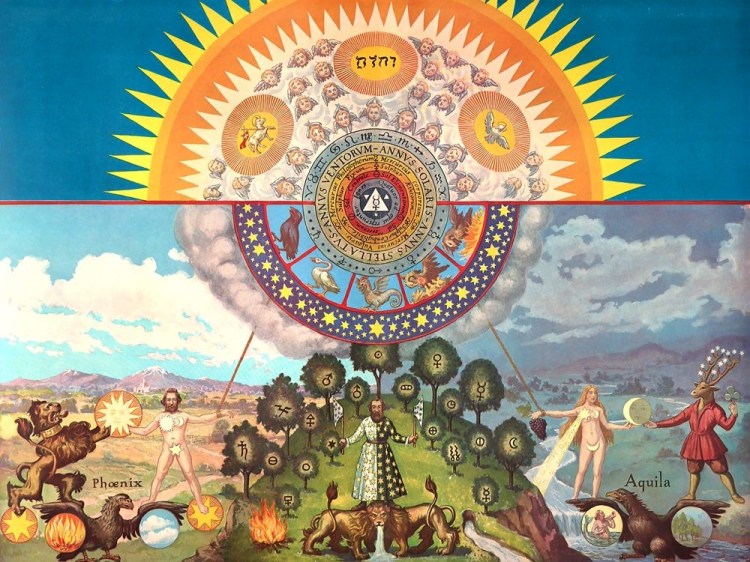
Fig. 9. “The Great Work” of the Alchemists. The upper part of the illustration is
an esoteric diagram of the triple spiritual sun or Holy Trinity:
Father (tetragrammaton), Son (Lamb) and Holy Spirit (Dove) surrounded by angels.
In the lower part there is a hill with trees growing on it, each of which
carries the symbol of one or another alchemical substance. Engraving from the treatise:
Matthaeus Merian, Musaeum Hermeticum, Reformatum et Amplificatum, Frankfurt, 1678

Fig. 10. A hill with nineteen trees, the seven largest of which personify the seven main alchemical metals, correlated with seven planets. Enlarged fragment of fig. 9

Fig. 11. Seven alchemical metal planets represented as
bindweed (Venus / copper, Saturn / lead, Jupiter / tin), a flower (Mercury / mercury)
and a tree (Mars / iron). Illustration from the alchemical manuscript “Clavis Artis”
(“Keys of Art”), published in Germany at the end of the XVII or beginning of the XVIII century
In it, by the way, one can find a much more exotic symbolism. For example, the correlation of planets with wheel spokes, fig. 12.

Fig. 12. Wheel of planets and virtues. On the seven spokes connecting the wheel axis with the rim,
there are scrolls with the names of the seven virtues; and on the rim – their respective
planets: Saturn correlates with Moderation (Sobrietas), Jupiter – Chastity (Castitas),
Mars – Humility (Humilitas), Sun – Purity (Puritas), Venus – Piety (Pietas),
Mercury – Sanctity , Moon – Love (Cantos). The same correspondences of the planets
and virtues are repeated twice to the left and right of the wheel. An illustration from one of the manuscripts of
the Book of the Holy Trinity (Buch der heiligen Dreifaltigkeit) is a treatise written, it is believed,
at the beginning of the 15th century and setting forth the alchemical teaching in Christianized form by
religious-mystical allegories (the philosopher’s stone appears as the Holy Trinity, the
alchemical process is the Passion of Christ, the Resurrection of Christ corresponds to the
completion of the Great Work, and the attributes of the Evangelists are four sub-lunar elements)
But we will continue quoting: “The location of the trees is able to push the researcher to the idea that there is a certain time moment associated with the so-called parade of the planets when they line up — however, at the moment of interest to us, starting with the birth of Henry Percy , between 1590–1595, a similar astronomical event does not occur.
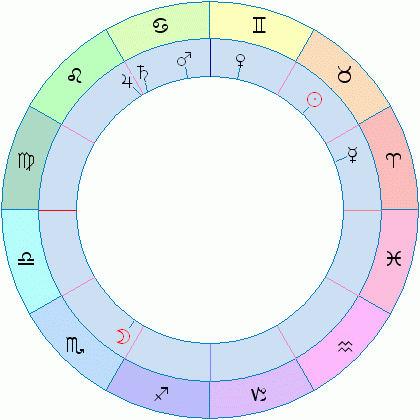
Astrologer A. Matveyev kindly helped the author of this text to solve the puzzle by building a natal chart (that is, a diagram of the location of the planets at the time of birth – A. ) Henry Percy, the configuration of the planets in which very closely corresponded to the arrangement of the trees, which is represented on the miniature of Hilliard. The date of birth of the 9th Earl of Northumberland is April 27, 1564. On the map (Fig. 13 – A. ) we see that Mercury is in Aries, the Sun is in Taurus, Venus is in Gemini, Mars is in Cancer, Jupiter and Saturn are also located there, and the last two planets are in conjunction. The moon at the same time stands in Scorpio, apart.
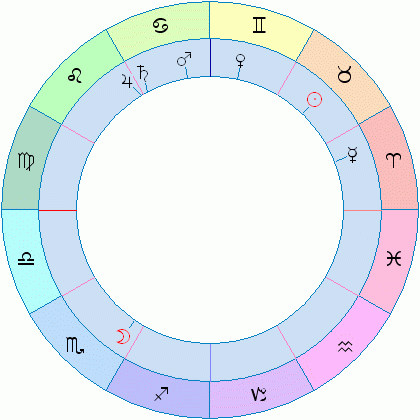
Fig. 13. The layout of the planets on April 27, 1564. Figure
obtained using the ZET 9 program (the zodiac is tropical,
the coordinate system is ecliptic geocentric)
Given this information, a tree with a balance bar corresponds to Mercury, and the silver color of the ball refers to mercury, in alchemy, the corresponding Mercury. Then the trees standing further and going into the depths of the perspectives are the Sun, Venus and Mars. Two trees behind the fence – Jupiter and Saturn, which are in conjunction. And the tree from the left edge of the picture is the Moon, whose position in the sky is opposed to the rest of the planets, which is emphasized by shifting the outermost tree closer to the viewer compared to the tree symbolizing Mercury. Thus, on the miniature of Hilliard, the date of birth of Henry Percy is clearly recorded, and this symbolic horoscope itself refers to the fundamental properties and traits of the graph, in this horoscope “prescribed”. The end of the quote.
Thus, we see that the Scaligerian historians, if necessary, are fully capable of revealing the horoscope even in such an intricate plot as shown in Fig. 1 . And, having revealed, to support their assertions with astronomy (or, as in this case, astrology). But only when it is profitable for them. That is, when the date obtained when calculating such a horoscope is completely satisfactory (most often, for obvious reasons, from the point of view of HX, for reasons, this happens if a Renaissance or even later zodiac comes into their field of vision).
Otherwise, they either shy away from accurate and unbiased dating in every way, stubbornly “not noticing” the astronomical content of this or that ancient monument, however obvious it may be, or go to all imaginable tricks in order to “draw out” at least somehow. from it a date that fits into their usual, but incorrect chronology. For example, by “dating” on two or three fast moving planets (and in some cases, according to the position of the Sun alone), completely ignoring all the others. And if neither one nor the other succeeds, vague discussions of “religious beliefs” and the like are set in motion, designed to divert the thought of readers as far as possible from unwanted and dangerous in their consequences questions.
But back to the “symbolic horoscope” Fig. 1 and proposed in [Nesterov] its interpretation.
At the very first, superficial glance, in the text quoted above, we were presented with a rare example of the quite honest dating of an ancient zodiac performed by Scaligerian historians themselves. However, upon closer examination it becomes obvious that the situation with the horoscope described above is not at all as simple and straightforward as the author of [Nesterov] presents it, and the interpretation given to him by fig. 1 obviously extremely doubtful and, at least in part, simply wrong
Indeed, it would be possible to agree with this interpretation (with a special reservation), if it were not for the striking tension. Namely, it is not difficult to guess that if the image in fig. 1 is a very unusual in artistic terms, but still some quite specific horoscope, then on it – in one form or another, but in a completely mandatory manner! – at least one constellation (or sign, if the horoscope is a sign) of the zodiac must be represented. Even if this horoscope is incomplete. Otherwise, its decoding will turn, at best, into a fortune telling on the coffee grounds. But rather in a clean fit for a predetermined answer. Actually, it is the latter in the most overt form and is shown in the above fragment from [Nesterov].
And the fact that the location of the symbols of the planets on the astrological chart, made on the adopted date of birth of Henry Percy, Fig. 13 , in its interpretation given by the author [Nesterov], it seems that the truth looks quite nicely corresponding to the arrangement of trees in the picture, does not speak at all about anything, since it is not even necessary to carry out verification calculations to understand that, if desired, almost with the same words (with the transposition of the names of the planets) can be interpreted – and solemnly issued for “independent confirmation” – countless other horoscopes, as more or less similar to fig. 13, and fundamentally different from it. By and large, it only requires that the two planets in such a horoscope be in close proximity, and even one – at a noticeable distance from all others. In short, the “puzzle resolution” cited above is witty but unsubstantiated.
Nevertheless, the author’s [Nesterov] main idea, “the number of trees is seven, clearly indicates their connection with the planets,” as mentioned above, fig.9 , fig. 10 , fig. 11 , is quite fair and does not cause objections. Therefore, having closed our eyes for a moment on the nature of the arguments that followed this thought, we take, as a starting point, the conclusion based on it and see if it can be supported by more convincing than the author himself made with arguments. In other words, let’s see, first, whether there are in fig.one some other, besides the equality of the number of trees, the number of planets known in ancient astronomy, details that would indicate that we are really dealing with a certain horoscope. And, secondly, can the date of April 27, 1564, at least theoretically, be recorded on this horoscope?
Attentive study of a picture, fig. 1 , gives affirmative answers to both of these questions. True, the horoscope detected by this turns out to be not at all calculating and symbolic, as the author [Nesterov] considered (and the astrologer who helped him), but the observational-stellar one.
Let’s start with the fact that we look closely at pic. 1 and ask ourselves a question: if there is at least something on it that can represent a sign (for the time being a sign, since at this stage we only check the basic validity of the Zodiac given in [Nesterov])? The answer to it, in essence, is already available in finished form in the description above: “The seven trees that the viewer sees are lined up in a very unusual order: … while on the branch of the nearest one hangs a strange balance weight, where a heavy silver ball … balanced by a bird feather, next to which is the Latin inscription TANTI – “Equal” ”, fig. 5 . That is, we are clearly nothing more than a rather unusual image of Libra, which corresponds to the essence of the matter, fig. 14.

Fig. 14. Balance-Libra (enlarged fragment of Fig. 1, left).
On the right, for comparison, shows the real scales, found
during excavations in the “ancient” Roman Pompeii
Come on. The question is, why, in fact, Scales are presented in Fig. 1 in such an atypical form? After all, it is clear that if we are dealing with an artistic image of a horoscope (that is, with the zodiac), then in each of its details a certain astronomical (or, if you wish, astrological) meaning should be traced. So what exactly is a silver ball and a bird feather? The author [Nesterov] does not explain this in any way, and in his presentation it turns out that the feather with a ball was a sort of reason that allowed the artist to shine with his erudition, attributing to them a “very clever” Latin word. Frankly, not too convincing.
Take the next step. If the balancer in Fig. 1 depicts Libra, how do they relate to the horoscope? From the interpretation proposed by the author [Nesterov], it turns out that, again, there is absolutely no one, since none of the planets known to medieval astronomers (astrologers) was in Libra on the date given to them: “Mercury is in Aries, the Sun is in Taurus, Venus in Gemini, Mars in Cancer, Jupiter and Saturn are also located there … The moon stands in Scorpio (and at its very end, on the border of the latter with Sagittarius, A. ) ”, fig. 13 . In a word, hang these Scales and hang. For beauty.
So, on April 27, 1564, the author of [Nesterov] proposes to consider this date as recorded in the “symbolic” horoscope depicted in fig. 1, – none of the seven planets of antiquity was not in the sign of Libra, or at least in its immediate vicinity. So, now we can not only, but must also assume that Libra in this case may have not a sign, but a stellar meaning, that is, to symbolize exactly the same zodiacal constellation, and not obtained by mechanical division into twelve equal parts (counting from the spring point equinox for the desired year) segment of the ecliptic.
Turning now to the picture of the location of the planets in the starry sky on a specified date (for which you can use the HOR_SCAN program or any computer planetarium) we immediately see that in the constellation Scorpio, almost at its very border with Libra, that night was the Moon (and if the count The new day was introduced not strictly from midnight, but from the onset of evening twilight, as was widespread earlier, then the Moon was in Libra without any reservations). And immediately everything falls into place. In particular, the symbolism of the balance weights-Libra, which seemed to this moment to be strange, receives a simple explanation.
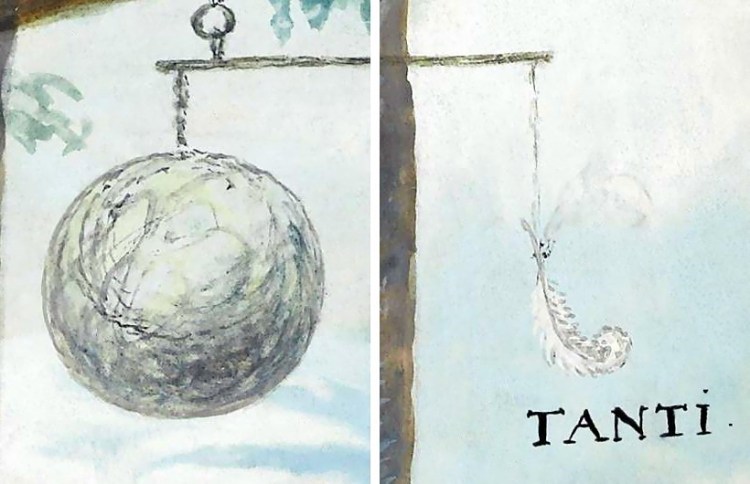
Indeed. At the left end of the balance bar is suspended silver ball. But silver is the color of the moon just visible to the earthly observer. Moreover, the ball is underlined non-smooth, and the author himself [Nesterov] writes about it, that this is “either a lead casting, or some kind of planetary globe (some relief is applied on the ball)”. Everything is absolutely correct here. This is the planetary globe of the moon, and the relief applied to it imitates the lunar surface, dotted with countless craters from the fall of asteroids and meteorites.
And, curiously, in [Stepanov], to which the author [Nesterov] gives a link, speaking of attempts to “decipher the hermetic symbolism implied in this miniature by linking the” rows of trees “shown in the picture with magic proportions and” number squares “of Agrippa “, As we already know, it is written, including, literally, the following:” The prospect leads our eyes upwards, where the balance weight is suspended on the bitch of a tree, … on the short arm [of which] hangs the moon globe … “.
So, it is asked, it prevented the author [Nesterov] to make the identification of the balancer with Libra lying directly on the surface and frankly appearing, and the ball on it with the Moon? The answer, obviously, there can be only one – it was prevented by the fact that on the date “found” by them, as already mentioned, not one of the planets was in Libra, and such an identification would not allow “to solve the puzzle” successfully. However, in fairness it should be said that, perhaps, this “inattention” lies on the conscience of not the named author himself, but the astrologer who helped him.
As for the feather ball hanging from the right end, one glance at it is enough to understand that it is the same Moon, but presented in the form of a crescent. Consequently, the inscription “TANTI” placed under it turns out to be completely relevant, that is, “equal”. Indeed, the ball, that is, the full moon, and the feather-crescent are just two different visible phases of the same – equal to itself – the moon, fig. 15.

Fig. 15. Moon Globe (left) and moon crescent feather (right).
As for a feather, then, besides the fact that it itself is very
similar to a crescent, carefully looked closer, you will notice
that in the same thread is suspended one more, subtle, feather,
almost a mirror to the first and forming together with him all
the same crescent. Enlarged fragments of fig. 14
Well, as for the other six planets, it is quite clear that during the transition from the sign Zodiac, in which, according to (as it is now becoming clear, wrong) the opinion of the author [Nesterov], the allegedly depicted figure in fig. one horoscope, – to the star’s zodiac, their relative position relative to each other will not change (figuratively speaking, from the unfit, in this case, astrological “feet,” we will only move to the “correct” astronomical “meters”. This means that their correlation with certain trees will remain: “the tree with the balance bar corresponds to Mercury, … the trees standing further and going into the depths of perspectives are the Sun, Venus and Mars. Two trees behind the fence – Jupiter and Saturn, which are in conjunction. And the tree from the left edge of the picture is the Moon, whose position in the sky is opposed to the rest of the planets, which is emphasized by the shift of the outermost tree closer to the viewer compared to the tree symbolizing Mercury ”, [Nesterov].
* * *
Thus, summarizing the above analysis, we can say the following. If the image in fig. 1 really represents a horoscope – and the number of trees equal to seven, that is, the number of planets known in ancient astronomy, and, especially, the symbolism of the balance weights with two images of the moon, speak precisely for this, then it is quite possible, if desired “See” the location of the planets, indicating, as stated by the author [Nesterov], on the date of April 27, 1564 AD True, the zodiac in this case turns out not to be a sign-significant, but observational-stellar,
At the same time, it is clear that the acceptable correspondence of the interpretation given in [Nesterov] of fig. 1 , – taking into account the correction made above, – the real astronomical picture for the specified date, in this case, is not (and in no way can be) proof that it is this date recorded on it. After all, this interpretation itself was not initially obtained as a result of calculations, but by reasoning around a predetermined one — taken from the Scaligerian “textbook” on history — dates. That is, calling things by their proper names, was nothing but the result of an ordinary fitting of the solution to the required answer. And, therefore, its own value is small.
In the light of the above, the need to perform a formal interpretation of the horoscope placed on fig. 1 , based only on its very image, without regard to what kind of date should (or can) be recorded in it.
To Be Continued….
 Hidden History Research