I have just given myself a crash course in Linguistics – a subject that does my head in at the best of times – by looking into several languages i.e. Altaic, Tungusic, Yakutic and Evenkis.
Yes….I thought that too.
WTF?
Anyhoo. it would seem that these languages above are just fancy-pant names for the divisions of the Tartarian Language. I’ll go into this further in the future but the article below is a bit of a taster.
The Turkish Online Journal of Design, Art and Communication – TOJDAC
ISSN: 2146-5193, September 2018 Special Edition, p.1840-1845
THE COLOR WORLD IMAGE IN GERMAN, RUSSIAN AND TATAR
SET EXPRESSIONS
Albina F. Mukhamadiarova1, Mariya A. Kulkova1, Juri W. Kobenko2, Nataliia E. Merkish3
1Kazan Federal University
2 Tomsk Polytechnic University
3Moscow State Institute of International Relations (University)
liliana_muhamad@mail.ru
ABSTRACT
This article deals with the study of phraseological and paremiological units with coloronyms blau/
синий/голубой/зəңгəр/күк (blue) on the basis of the material of German, Russian and Tatar in
respect of the comparative aspect. The article gives an etymological description of the color names
being analyzed, reveals their symbolic meanings and their role in the specificity of the linguistic color
image of the world of the German, Russian and Tatar peoples. As a result of the analysis of
phraseological and paroemiological units containing coloronyms blau/синий/голубой/зəңгəр/күк
(blue), a classification of 12 groups has been made, the similarities and differences in the perception of
these color names by different peoples have been revealed. In Russian and Tatar, two lexemes синий/
голубой/зəңгəр/күк are used to designate dark blue and blue colors. The ambivalence of the analyzed
colors is noted. The high frequency of the explication of the meanings of ‘unknown, action without
purpose’ and ‘lie, deception, illusion’ in German has been revealed. It has been established that the
symbolic meanings of ‘intensity’ and ‘aristocratic origin’ are characteristic only of phraseological and
paroemiological units of the German and Russian languages. The symbolic meanings ‘lie, deceit,
illusion’ and ‘beauty’ are inherent in German and Tatar. We have concluded that the symbolic meaning
of ‘dream wish, happiness’ is present in all three languages.
Keywords: coloronym, paroemiological unit, phraseological unit, the German language, the Russian
language, the Tatar language.
INTRODUCTION
Phraseological and paroemiological units (hereinafter PhU and PU) store the information about
mentality of the people, a considerable contribution into the study of which has been made by W.
Mieder [1], Cs.Földes [2], B.Wotjak [3], E.Piirainen, D.О.Dobrovolsky [4], G.L. Permyakov [5], Z.К.
Tarlanov [6], N.F. Alefirenko [7], Е.F. Arsent’yeva, R.А. Ayupova [8], Т.G. Bochina [9], R.R.
Zamaletdinov [10]. The characteristic features of world outlook of the speech community under
consideration are illustrated by the examples with the component of a color name.
Color symbolism is clearly comprehended in the PhU and PU, rituals, myths and religious rites. To
date, there is extensive information on color symbolism. There is a traditional classification of colors
proposed by optics and experimental psychology according to which colors are divided into two
groups: warm, “stimulating”, and cold [11]. Color names remain to be in the scope of studying by
psycholinguistics [12], cognitive linguistics [13], cultural linguistics [14]. Of particular importance are
the works concerning the comparative study of phraseological and paroemiological units with a
coloronym component, and also the detailed analysis of symbolic meanings of the colors [15].
METHODS
The material of the study was PhU and PU with the component blau/синий/голубой/зəңгəр/күк (blue)
in German, Russian and Tatar, which were collected by the method of continuous sampling from the
phraseological, etymological, explanatory dictionaries of the three languages. The insight has been
provided into 52 PhU and PU with the component blau/синий/голубой/зəңгəр/күк (blue), including 26
PhU and PU in German, 21 in Russian and 3 in Tatar.
RESULTS AND DISCUSSION
Let us address the etymological characteristics of the analyzed color names. According to German
etymological dictionary blau goes back to Indo-European roots *bhel- ‘glänzen(d),
weiß’ (‘блестящий, белый’ / glittering, white ), *bhlēu̯os ‘blau, gelb, blond’ (‘синий, желтый,
светло-русый’ / dark blue, yellow, blondish) and cognate to flāvus ‘goldgelb, rotgelb,
blond’ (‘золотисто-желтый, красно-желтый, светло-русый’ / golden yellow, red-yellow, blondish)
und lat. fulvus ‘rotgelb, braungelb’ (‘красно-желтый, коричнево-желтый’ / red-yellow, brownyellow)
[16]. The Etymological Dictionaries by M. Fasmer and Semenov treat the origin of the
coloronym blue as follows: it goes back to the common Slavonic sinjь sinj and is related to the words
сиять (shine) or сивый (grey). It is noted that the word синий in the meaning of “темно-голубой
цвет” / “dark blue color” has been known since the 11th century and is the epithet of lightning and
occurs in “The Song of Prince Igor” [17]. R.G. Akhmet’yanov in the concise historical and
etymological dictionary of the Tatar language suggests that зəңгəр can go back to both Farsi
“зангари” in the meaning of тутык (‘rusty’) and the Turkic “чəңкəр” with the meaning “blue,
whitish”. The analysis has showed that the investigated coloronyms blau and синий (dark blue) are
related to glänzen (d) (‘glittering’), to glitter. The German color blau, like the Tatar зəңгəр, are directly
cognate with the Latin root and Farsi, respectively, with the meaning ‘golden yellow, red-yellow,
brown-yellow’.
In the German Dictionary “Wahrig. Deutsches Wörterbuch” blau is treated as “von blauer Farbe, von
der Farbe des Himmels” (“color of the sky”), in addition to the main lexical meaning, blau has also a
figurative meaning, namely: scherzh. betrunken, übermäßig alkoholisiert (‘drunk’) [18]. In Russianlanguage
dictionary entries, the adjective синий (dark blue) is explained as «имеющий окраску
одного из основных цветов спектра – среднего между фиолетовым и зелёным» (“having a color
of one of the primary colors of the spectrum – the middle between violet and green”), and голубой
(blue) is «светло-синий, цвета незабудки» (“light-blue, the color of forget-me-not”) [19]. The
explanatory dictionary of the Tatar language explains зəңгəр as “спектрдагы төп төслəрнең берсе:
аяз күк йөзе аңлата” (“one of the primary colors in the spectrum, the color of the clear sky” [20]. It
should be noted that the treatment of the lexical meaning of the German and the Tatar languages is
practically the same, the sky is a natural prototype, there is an associative relation of this coloronym
and the concept of sky.
Based on the sampling from lexicographic sources, it should be noted that the dark blue color is
represented by a single lexeme blau. Having compared the system of coloronyms of the German,
Russian and Tatar languages, it should be noted the fact that two color names exist in Russian and
Tatar to designate the dark blue color – синий and голубой, зəңгəр and күк (dark blue and blue). But
the coloronym күк can designate “bluish”, “grey (dialect) about color”. Синий (dark blue) is cognate
with the words ‘сиять or сивый’ (‘shine or grey’), ‘черный, темный’ (‘black, dark’) [17]. As A.F.
Sitdykova notes, semantics of dark blue came to the culture of the Tatar people from pagan beliefs.
Синий (dark blue) is the color of the sky, theTengri, the use of this color designation means beauty,
happiness, dream [21].
After having analyzed PhU and PU, based on the symbolic meaning of the colornym blau, one can
divide them into the following groups:
1) uncertainty, action without purpose: eine Fahrt ins Blaue ‘trip without a definite goal, leap into
the unknown’ [22], ins Blaue hineinfahren – ‘without a definite goal, at random, on a miracle’ [22].
2) lie, deception, illusion: ins Blaue hineinreden – ‘городить вздор, молоть чушь; говорить наобум’
(to talk nonsense, talk rubbish, talk at large), er lügt das Blaue vom Himmel herunter – ‘рассказывать
небылицы; наговорить с три короба’ (to tell tall stories, to talk nineteen to the dozen) [23], jmdm.
das Blaue vom Himmel versprechen – ‘сулить золотые горы’ (to promise the earth) [22], Von blauen
Enten predigen [23], Er macht uns blaue Blümchen weis [24], Weiberlieb und Herrengunst sind nicht
mehr als blauer Dunst [25]. The Tatar language has the phraseological unit зəңгəр күзлек аша карау
– to see everything through rose-colored glasses. The meaning of the phraseological unit ‘seeing
everything in a positive way’ is conveyed via various color names, in the Tatar language – via dark
blue, in Russian – via rosy, as well as in the German language – durch die rosarote Brille sehen.
3) dream wish, happiness: die blaue Blume, голубая мечта, зəңгəр хыял (wild dream). As noted by
M. Pasturo, in the symbolism of the early Western European Middle Ages, dark blue was an
unimportant and unreasonable color [26]. But in the era of Romanticism, since the 1780s, dark blue
and blue became popular, especially in German Romanticism, these colors were poetized. Blau
acquired the symbolic meaning of ‘dream wish, an unrealizable ideal’. The combination of die blaue
Blume (‘blue flower’) goes back to the novel of German romantic Novalis (1772-1801) ‘Henry von
Ofterdingen’ (1802), the main character of which is the famous German meistersinger (poet and
singer). The blue flower becomes a symbol of yearning of the romantics for the mystical ideal. On the
basis of the symbol created by Novalis, the meaning of the word голубой / blue in many European
languages began to be formed. As a result of the semantic calquing in phraseology голубая мечта
(blue dream) the adjective голубой (blue) acquires the meaning ‘created by the imagination, unreal’.
The figurative meaning of the coloronym синий (dark blue) appeared in the Russian language in the
20th century under the influence of the popular fairy tale by M. Maeterlinck “The Bluebird” [27]. The
blue bird is a symbol of happiness; a beautiful dream, but unfulfilled. He, who finds the bluebird, will
know everything and see everything [27]. Seek after the bluebird means to seek happiness [27].
4) be drunk: voll / blau wie eine Strandhaubitze sein – быть пьяным в стельку (be drunk as a fiddler)
[22]; Blauer Montag, volle Kröpfe, Leere Beutel, tolle Köpfe –в воскресенье веселье, в понедельник
похмелье(on Sunday – merriment, on Monday – hangover). Не то спасенье, что пьян в воскресенье
(It is not a rescue that one is drunk on Sunday). Blauer Montag means absence from work, this leads
to poverty [25], Blauer Engel – a drunk girl, the image was taken from the first German movietone
titled „Der blaue Engel“, which was made after G. Mann’s novel “Teacher Gnus”. The derivatives of
the adjective синий (dark blue) have acquired the metaphorical meaning of ‘drunk’, which we have
singled out in the Russian language as well, for example, the jargons синяк, синька (bruise)
(drunkard, alcoholic) [28]. A. A. Parfenova notes that in two Slavic languages – Slovak and Czech –
the phrase синий понедельник / blue Monday (compare der blaue Montag) occurs [28].
5) intensity: jemanden grün und blau schlagen [22] – to fiercely beat somebody. In the phraseological
unit синь порох (obsolete) with the meaning ‘little, ultimate particle’ we can trace the preserved the
common Slavic meaning ‘черный, темный’ (black, dark)[27]. The intensity, strengthening of
expressiveness can be observed in the Russian language: на блюдечке с голубой каемочкой [подать,
принести](on a silver platter [to hand smth to smb, to fetch]), that is, to present the desired to smb.
without the slightest effort on one’s part [27].
6) unpleasant surprise: sein blaues Wunder erleben (ugs.) – ‘to experience an unpleasant
surprise’ [22].
7) beauty: etwas nicht nur um jmds. schöner/blauer Augen willen tun, [22], зəңгəр кашлы йөзегем
кемдə булыр, минем күңелем шунда булыр [29], күк төймəм минем кемдəдер, минем күңелем
шундадыр [29]. Зəңгəр күзлек кигəнгə зəңгəрдер бу дөнья; / Кара күзлек кигəнгə карадыр бу
дөнья – ‘if the person wears blue glasses, then the world is blue for him, and if black glasses, the
world is black’ [29]. The meaning of this proverb is that the person himself decides what the world is.
Here we observe the opposition зəңгəр – кара (синий – черный) в значении ‘good, beautiful – bad’.
Man’s harmonious existence depends on his perception of the world and view of life.
8) warning: the phraseological unit blauer Brief (ugs.) is used in two meanings: 1) notification of
dismissal from work, 2) warning letter from school [22]. Blue paper was used in the Ottoman Empire
to write the orders for execution [30]. But the phraseological and paroemiological funds of the Tatar
language do not fix the combinations with a similar meaning, which would comprehend the
coloronym зəңгəр.
9) aristocratic origin: blaues Blut in den Adern haben, blue blood (bookish, often ironical), blue bone
(bone) – about a man of noble, aristocratic origin. It is believed that the expression implies that fairskinned
people have the veins of bluish color, and which is not observed in people with wheatish
complexion [27].
10) stupidity: In the era of the Reformation the coloronym blau was used to designate the church
leader: blauer Bischof. There are the preserved literary monuments to corroborate it, in particular the
poems “De Gelderschen in Utrecht” (1527), in which the symbolic meaning of “false, stupid” of the
coloronym blau is reflected. The following expression den blauen Enten predigen (sagen): den
dummen Menschen predigen (sagen) has the meaning of ‘preaching to stupid people’. Doctor
Paracelsus in his work “Wundarznei” uses the phraseological unit blaue Ärzte to name ignorant, bad
doctors, in the work “Pharmacology” by Aristotle, he calls blauer Philosoph (‘dark blue philosopher’)
[31].
Let us consider the symbolic meanings of the coloronym синий (dark blue), presented in the Russian
language only:
1) expanse: синее море / the dark blue sea (people-poet) – about a faraway place. It is noted that in
the folk songs, folkloric and ethnographic records, the word море (sea) is often a symbol of
uncertainty and perdition, and the combination of синее море (the dark blue sea) is used to designate a
very far place, the end of the world. The constant epithet dark blue not only conveys the essence of the
object but also serves as an original article of “being far away” [27].
2) manual labor: the example from the National corpus of the Russian language: «Линий раскола
множество: Москва/ регионы, областной город / районный центр, бюрократия / трудящиеся,
“белые воротнички”/ ” синие воротнички”» (There are a lot of lines of split: Moscow/ regions,
oblast city / capital of the region, bureaucracy / working people, white collars / blue collars). Синий
воротничок (blue collar) – is a notion implies the belonging of a hired man to the working class. The
dictionary by Ozhegov defines the word-combination «белые воротнички» (white collars) as follows:
«обиходное название учрежденческих служащих в некоторых странах» (the common name for
office workers in some countries). In German the word Blaumann is used in the meaning of ‘working
cloth, overalls’.
SUMMARY
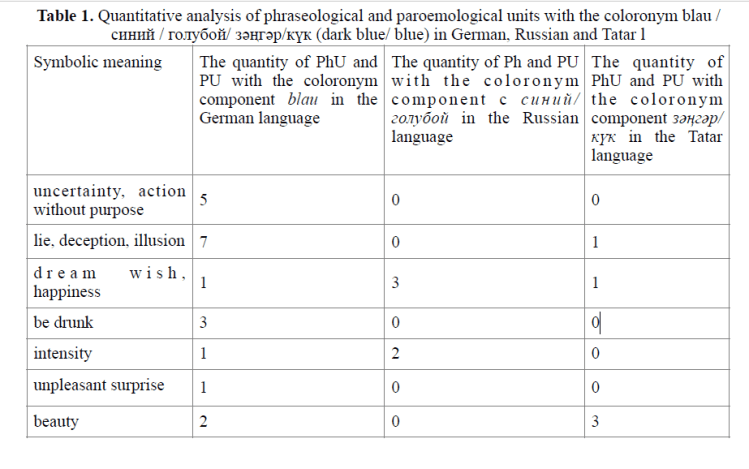
The quantitative relation of the idioms with the coloronym in its symbolic meaning fixed in the
lexicographical sources is presented in the following table:
Table 1. Quantitative analysis of phraseological and paroemological units with the coloronym blau /
синий / голубой/ зəңгəр/күк (dark blue/ blue) in German, Russian and Tatar
When compiling the systems of color naming blau/синий/ голубой/зəңгəр/күк (dark blue/blue) we
have found some similarities and differences. In Russian and Tatar two lexemes are used to designate
blue and dark blue colors. The coloronym blau acquires the figurative meanings of ‘uncertainty’, ‘be
drunk’, ‘unpleasant surprise’, ‘warning, stupidity’ in the German language, which are absent in
Russian and Tatar. The metaphoric meanings of “intensity, strengthening of expressiveness”, “mental
fuzziness, the state of being dead drunk” are presented in German and Russian images of the world.
High frequency of explications of the meanings ‘uncertainty, action without purpose’ and ‘lie,
deception, illusion’ has been revealed in the German language. It has been already established that the
symbolic meanings ‘intensity’ and ‘aristocratic origin’ are inherent only in the PhU and PU of German
and Russian. The symbolic meanings ‘lie, deception, illusion’ and ‘beauty’ are characteristic of
German and Tatar. The meaning ‘dream wish, happiness’ has been revealed in the three languages.
CONCLUSIONS
Based on the analysis of the phraseological and paroemiological units that contain the coloronyms
blau/синий/ голубой/зəңгəр/күк (dark blue / blue), we have displayed the features of linguistic color
world image of the German, Russian and Tatar peoples. The ambivalence of the analyzed color names
is worth noting.
ACKNOWLEDGEMENTS
The work is performed according to the Russian Government Program of Competitive Growth of
Kazan Federal University.
Submit Date: 05.07. 2018, Acceptance Date: 22.08.2018, DOI NO: 10.7456/1080SSE/246
Research Article – This article was checked by Turnitin
Copyright © The Turkish Online Journal of Design, Art and Communication
 Hidden History Research