

Nope…I don’t know either. But I’m beginning to realise that the Tartarians did, in fact, build some All?) of the world’s most famous Labyrinths.
I’ve been reading Herodotus, Book Two, Egypt. (Yawn!) He says of the famous Egyptian Labyrinth, which surpassed the pyramids:
“It has twelve covered courts — six in a row facing north, six south — the gates of the one range exactly fronting the gates of the other. Inside, the building is of two storeys and contains three thousand rooms, of which half are underground, and the other half directly above them. I was taken through the rooms in the upper storey, so what I shall say of them is from my own observation, but the underground ones I can speak of only from report, because the Egyptians in charge refused to let me see them, as they contain the tombs of the kings who built the labyrinth, and also the tombs of the sacred crocodiles. The upper rooms, on the contrary, I did actually see, and it is hard to believe that they are the work of men; the baffling and intricate passages from room to room and from court to court were an endless wonder to me, as we passed from a courtyard into rooms, from rooms into galleries, from galleries into more rooms and thence into yet more courtyards. The roof of every chamber, courtyard, and gallery is, like the walls, of stone. The walls are covered with carved figures, and each court is exquisitely built of white marble and surrounded by a colonnade.”
NC postulates that all these Labyrinths are modelled on the first and largest one. Under The Kremlin and much of Moscow!
Early 20th century Russian article:
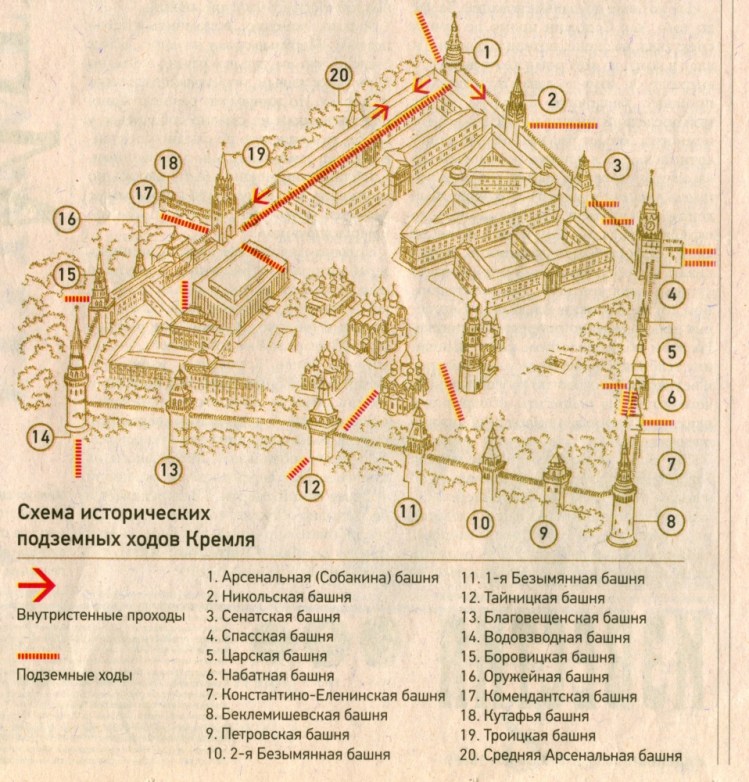
“Official Gazette” of February 24, 1912 wrote: “ancient underground tunnels in Moscow image of the whole network, not only has been investigated so far discovered underground tunnels between the Novodevichy Convent and the manufacturing factory of Albert Gunther, under the Donskoy Monastery, Golitsyn Hospital and Neskuchny garden is well researched.. the underground passage under the Borovitskaya Tower, in which two niches were found, opening tunnels to the center of the Kremlin and under Ilyinka. The underground tunnels also have the Taynitskaya, Arsenalnaya and Sukharev towers. apparently separate from the general network. “
…“The Moscow Kremlin … is an outstanding monument of military architecture of the late 15th century. Nevertheless, it remains almost unexplored to this day. This directive applies especially to the underground part of the Kremlin, which is of tremendous interest … Studies by Prince Shcherbatov show the extraordinary complexity of the underground structures of the Kremlin, the great difficulty not only of accurate research, but also of simple penetration into them. Most of the moves are immured, some are cut by the foundations of the later constructions .. . “
The German newspaper “Fossie Zeitung” July 20, 1929:
“For many centuries it has been believed that the underground city was hidden under the Kremlin. Treasures in the form of gold and silver from the times of Novgorod, which are not measurable, the library of Grozny, valuable paintings and historical relics, pearls and precious stones in enormous quantities … Only Peter I managed to launch his hand into this secret safe. “
Below is a very limited/censored picture of the underground tunnels of the Kremlin taken from NC.
Even Wikiwhatever gives away the fact that Labyrinths are connected to the Etruscans/TARTARIANS.
Is this why there is the elaborate myth about Theseus, Daedalus, Ariadne and the Minotaur?
Is every major city sitting atop a Tartarian Labyrinth and, if so, WHY?
Mmmn. I wonder :o)
 Hidden History Research