
“To know my deed, ’twere best not know myself.” – Spoken by Macbeth just after he has murdered Duncan.

SparkNotes Character Profile of Macbeth:
Before he kills Duncan, Macbeth is plagued by worry and almost aborts the crime. It takes Lady Macbeth’s steely sense of purpose to push him into the deed. After the murder, however, her powerful personality begins to disintegrate, leaving Macbeth increasingly alone.
These fluctuations reflect the tragic tension within Macbeth: he is at once too ambitious to allow his conscience to stop him from murdering his way to the top and too conscientious to be happy with himself as a murderer.
“Why should I play the Roman fool,” he asks, “and die / On mine own sword?” (5.10.1–2).

Herod Antipas. Wiki:
Early in his reign, Antipas had married the daughter of King Aretas IV of Nabatea. However, on a visit to Rome he stayed with his half-brother Herod II and there, he fell in love with his wife, Herodias, (granddaughter of Herod the Great and Mariamne I), and the two agreed to marry, after Herod Antipas had divorced his wife.[26] Aretas’ daughter learned of the plan and asked permission to travel to the frontier fortress of Machaerus, whence Nabatean forces escorted her to her father. With his daughter now safe in his custody, Aretas now could declare war on Herod.[27] It is generally agreed that the war, in which Herod was defeated, occurred in 36, a year before the death of the emperor Tiberius. A point of contention today is how long before this date Herod’s marriage to Herodias took place. Some surmise that the marriage of Antipas and Herodias took place shortly before the war in about the year 34, after the death of Philip,[28] but others have pointed to Josephus’ Antiquities of the Jews Book 18, chapter 5, paragraph 4 comment that Herodias “divorced herself from her husband while he was alive” to argue that it took place before Herod II’s death, in about the year 27, thus making it possible for Jesus to have been born in the reign of Herod the Great (as indicated by the Gospel of Matthew) and to have died in his early 30s (as indicated by the Gospel of Luke).[29]
Antipas faced more immediate problems in his own tetrarchy after John the Baptist – in 28/29 AD according to the Gospel of Luke[30] (or 27 AD, if the co-regency of Augustus and Tiberius is included in Luke’s reckoning of time, for which there is some evidence) – began a ministry of preaching and baptism by the Jordan River, which marked the western edge of Antipas’ territory of Perea. The New Testament Gospels state that John attacked the tetrarch’s marriage as contrary to Jewish law (it was incestuous, as Herodias was also Antipas’ niece, but also John criticized the fact that she was his brother’s wife in Mark 6:18, lending credence to the belief that Antipas and Herodias married while Herod II was still alive), while Josephus says that John’s public influence made Antipas fearful of rebellion.[31] John was imprisoned in Machaerus and executed.[32] According to Matthew and Mark, Herod was reluctant to order John’s death but was compelled by Herodias’ daughter (unnamed in the text but named by Josephus as Salome), to whom he had promised any reward she chose as a result of her dancing for guests at his birthday banquet.[33]
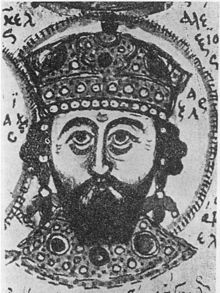
Alexios III Angelos – Wiki:
Alexios III Angelos was the second son of Andronikos Doukas Angelos and Euphrosyne Kastamonitissa. Andronikos was himself a son of Theodora Komnene, the youngest daughter of Emperor Alexios I Komnenos and Irene Doukaina. Thus Alexios Angelos was a member of the extended imperial family. Together with his father and brothers, Alexios had conspired against Emperor Andronikos I Komnenos (c. 1183), and thus he spent several years in exile in Muslim courts, including that of Saladin.
His younger brother Isaac (II Angelos) was threatened with execution under orders of Andronikos I, their first-cousin once-removed, on September 11, 1185. Isaac made a desperate attack on the imperial agents and soon killed their leader Stephen Hagiochristophorites. He then took refuge in the church of Hagia Sophia and from there appealed to the populace. His actions provoked a riot, which resulted in the deposition of Andronikos I and the proclamation of Isaac as Emperor. Alexios was now closer to the imperial throne than ever before.
By 1190 Alexios had returned to the court of his younger brother, from whom he received the elevated title of sebastokratōr. In March 1195 while Isaac II was away hunting in Thrace, Alexios was acclaimed as emperor by the troops with the covert support of Alexios’ wife Euphrosyne Doukaina Kamatera. Alexios captured Isaac at Stagira in Macedonia, put out his eyes, and thenceforth kept him a close prisoner, despite having previously been redeemed by Alexios from captivity at Antioch and showered with honours.[2]
Alexios III Angelos – Niketas Choniates, 12th C Byzantine writer:
Alexios, now on the throne, never realised that he had overthrown himself by deposing his brother.
Those who had helped him come to power he rewarded for their zealous support…Without rhyme or reason he began to hand out monies amassed by Isaac (II Angelos) for military operations to satisfy the requests of one and all.
The Emperor repudiated his patronymic of Angelos and chose that of Comnenus instead, either because he held the former in low esteem in comparison with the name Comnenus, or because he wished to have his brother’s surname disappear with him. Everyone supposed that once Alexios was proclaimed Emperor and calm had been restored to the Empire, he would appear in arms and keep the field and not shun the urgent business at hand…He however did the exact opposite, and now that he had reached the highest goal which he had worked so hard to attain, he relaxed, deeming that he was given the throne not to exercise lawful dominion over men but to supply himself with lavish luxuries and pleasures,
…A member of the Comnenus family, John by name, rebelled against the Emperor…The Emperor gathered together his kinsmen…
In the theatre they (the Imperial troops) clashed abruptly with John’s partisans, whom they dispersed easily, and with the greatest of ease they attacked and killed John, inflicted blows all over his body as if he were a fatted beast. His severed head was first brought to the Emperor, and then, still grinning horribly and spurting out blood, it was suspended from the arch of the agora in full view of the public.
 Hidden History Research