From Wikiwhatev’s:
Stephen is first mentioned in the Acts of the Apostles as one of seven deacons appointed by the Apostles to distribute food and charitable aid to poorer members of the community in the early church. According to Orthodox belief, he was the eldest and is therefore called “archdeacon”.[4] As another deacon, Nicholas of Antioch, is specifically stated to have been a convert to Judaism, it may be assumed that Stephen was born Jewish, but nothing more is known about his previous life.[2] The reason for the appointment of the deacons is stated to have been dissatisfaction among Hellenistic (that is, Greek-influenced and Greek-speaking) Jews that their widows were being slighted in preference to Hebraic ones in the daily distribution of food. Since the name “Stephanos” is Greek, it has been assumed that he was one of these Hellenistic Jews. Stephen is stated to have been full of faith and the Holy Spirit and to have performed miracles among the people.[Acts 6:5, 8]
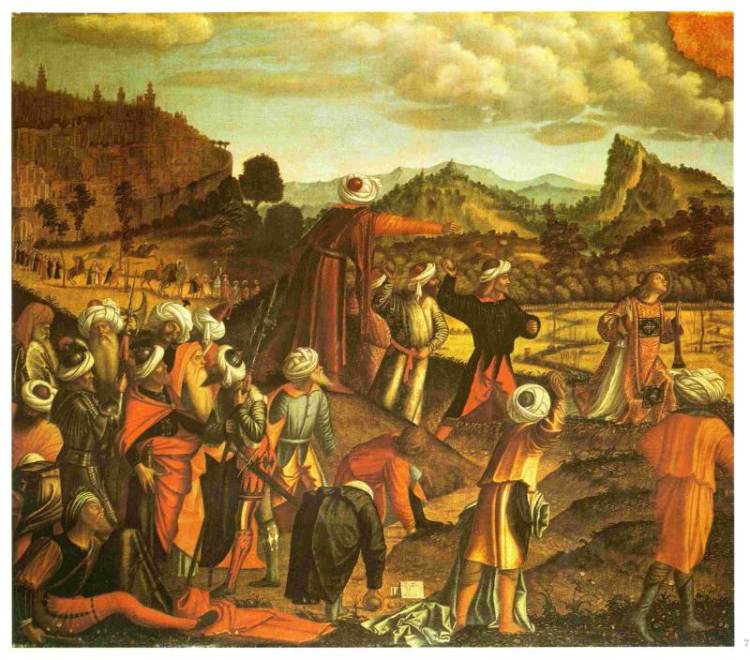
The stoning of Stephen

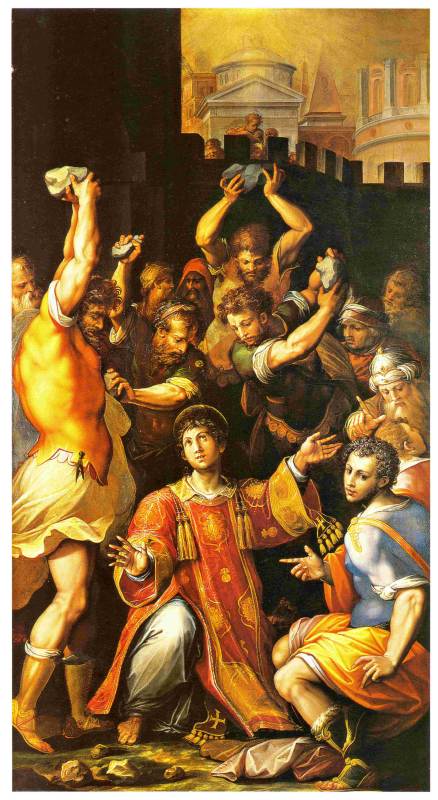
Stoning of Saint Stephen by Giovanni Battista Lucini
Thus castigated, the account is that the crowd could contain their anger no longer.[7] However, Stephen looked up and cried, “Look! I see heaven open and the Son of Man standing on the right hand of God!” He said that the recently executed Jesus was standing by the side of God.[8][Acts 7:54] The people from the crowd, who threw the first stones,[9][8] laid their coats down so as to be able to do this, at the feet of a “young man named Saul” (later known as Paul the Apostle). Stephen prayed that the Lord would receive his spirit and his killers be forgiven, sank to his knees, and “fell asleep” [Acts 7:58–60]. Saul “approved of their killing him”.[Acts 8:1] In the aftermath of Stephen’s death, the remaining disciples fled to distant lands, many to Antioch.[Acts 11:19–20][10]
Location of the martyrdom
The exact site of Stephen’s stoning is not mentioned in Acts; instead there are two different traditions. One, claimed by noted French archaeologists Louis-Hugues Vincent (1872–1960) and Félix-Marie Abel (1878–1953) to be ancient, places the event at Jerusalem’s northern gate, while another one, dated by Vincent and Abel to the Middle Ages and no earlier than the 12th century, locates it at the eastern gate.[11]
From New Chronology:
In the history of the Christian Church it is known that the FIRST martyr for Christ was Archdeacon Stephen. See for example ‘Acts’, chapters 6-7, 8:1-2; and also [153], an article ‘Stephen, the Archdeacon and Protomartyr’. In is represented one of the numerous old images of St. Stephen martyrdom.
In the biography of Andronicus the FIRST of his attendants who died during the rebellion was named as the chief of the palace guards STEPHANOS Hagiochristophorites, i.e. translated from Greek into Russian ‘Stephen Supporter of Holy Christ. This is how Choniates describes the very beginning of the rebellion.
‘The hot and hasty Stephanos Hagiochristophorites, who cared for his lord and emperor in various ways, agreed to arrest Isaakios Angelos … He arrived at the house of Isaakios … and ordered Isaakios to descend and follow him… As was to be expected Isaakios delayed, speculating that as soon as he appeared the worst of all possible evils would befall him. Hagiochristophorites was resolved to use force… Isaakios saw that he could not escape… With sword drawn (his head was bare and over his body he wore a cloak…) he mounted his horse and raised his sword hand against the head of Hagiochristophorites … ISSAKIOS BROUGHT DOWN A MORTAL BLOW AND STRUCK THE POOR WRETCH IN THE MIDDLE OF HIS SKULL. Having cleaved him in twain, he let him lie there… As for Hagiochristophorites’ attendants, he terrified the one with his bare sword, cut off the ear of another, and another flying elsewhere whereupon all fled to their homes. Then Issakios rode at full speed towards the Great Church … He shouted out to all, that with this sword … HE HAD KILLED STEPHANOS HAGIOCHRISTOPHORITES … Those of the city populace … came streaming by the thousands to the Great Church… Among the others Isaakios’ paternal uncle, John Doukas, together with his son Isaakios, came to his assistance and hailed his act of sedition… Because none of the emperor’s supporters was present … neither from among the illustrious nobility nor from among those who retained Andronikos’ favour, nor axe-bearing barbarian, nor … lictors … the assembled throng became bold and excited … Andronicus was not present in the imperial palace, but was at the palace of Meloudion, situated on the eastern side of the strait leading into the Propontis.
Near the first watch of the night, he heard of Hagiochristophorites’ death he … addressed the citizens of the capital with a brief dispatch that exhorted them to desist from attempting to foment rebellion; it began as follows: ‘He who has received, has received; punishment has ceased’. In the early dawn, Andronicus’ attendants attempted to restrain the swelling mob, and Andronicus himself arrived at the Great Palace on an imperial trireme … Isaakios (Angelos – Author) was anointed emperor and … left the Great Church accompanied by Patriarch Basil Kamateros … When Andronicus arrived at the Great Palace … he gave his attention to resisting the mob and assembled his companions to go into battle … He soon realized that he was attempting to accomplish the impossible and spoke to the people through a messenger. He agreed to lay aside his crown and deliver it to his son Manuel … But exasperated more than ever by his words, the mob heaped the most atrocious insults on both him and his designated successor … Because the multitude was now pouring inside the palace through the so-called Karea Gates, which had been broken down, Andronicus fled, taking off his purple-dyed buskins. Struck mad by God, on the way he REMOVED HIS ancient amulet and the CROSS from his neck and donned a barbarian cap that tapered to a point like a pyramid. Thus attired he boarded the same royal trireme…’ [140], p.349-354.
Thus the rebellion against Andronicus, culminating in his deposition, started exactly with the murder of Stephanos. It was him to be the first ‘martyr for Andronicus’. Besides Stephanos Hagiochristophorites was chief of the royal guards, i.e. was the chief attendant, the archdeacon in Greek. Like Stephen Protomartyr, the Christian Saint. He was the Archdeacon [153]. Therefore, the name of the first man, who died for Christ and the name of the first man who died for Andronicus are the same. It was Stephanos.
As a final point we would like to point out another solid parallel. Stephen Protomartyr was stoned [153]. The stoning mentioned above – incidentally the only one described by Nicetas Choniates – was also mentioned in connection with STEPHANOS Hagiochristophorites specifically. Though, according to Choniates it is Stephanos himself who is doing the stoning [140], p.305. But we understand that we are dealing not with the original text, but with its edited version. That is why who exactly was stoning whom depends on the affiliation of the chronicler. ‘Good people’ and the ‘evil’ ones often swapped places on the pages of the chronicles. But the very fact of stoning survived.
We will once again quote from Choniates: ‘Stephanos Hagiochristophorites …picked up a stone the size of his hand and threw it at Makrodoukas… he urged everyone to follow his example … The entire assembly picked up large stones and hurled them at the men…’ [140], p.305.
P.S. Apologies for the cut and paste kinda day. Very lazy. Not feeling 100% though. TTFN!
:o)
 Hidden History Research