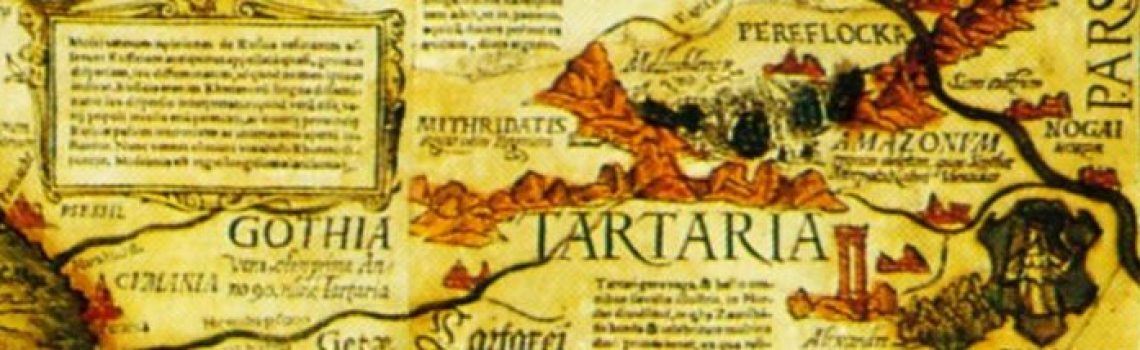
From New Chronology book, God of War:
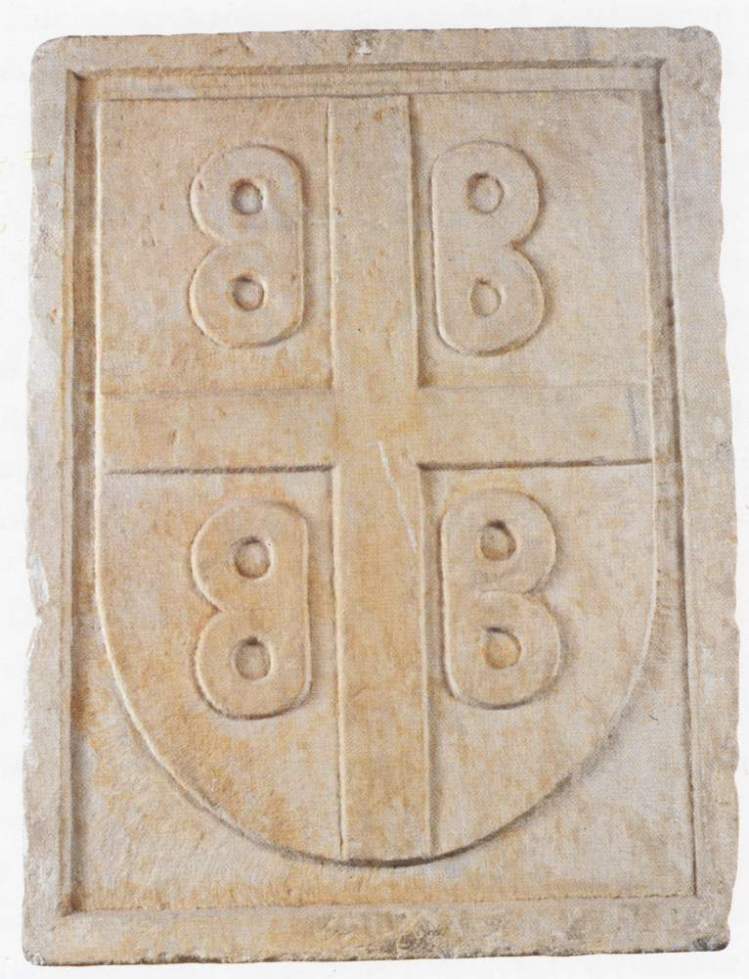
“The four letters “B” in the corners of the cross mean, in the opinion of historians, the “King of Kings of Kings of Kings”, in Greek, “basil basilion basilevon basilevonton”. However, it is possible that this is a symbolic image of the Great Russian Medieval Empire, divided into four “chets” or quarters, each of which was ruled by its king (basil), subordinate to the supreme king of the whole Empire, which was called “king of kings” or “kagan” (“Khan Khans”),
This symbol of four B’s was used by the Paleologus family, heads of the Byzantine Empire from whence came the Comnenus.
From Jordan Tabov 2010:
On the origin of the word “basil”
Yordan Tabov
Institute of Mathematics and Computer Science BAN
tabov@math.bas.bg
Recently, Milos Sidorov informed me of his hypothesis about the origin of the word “basil” (in ancient Greek  ). It seemed important to me, and so I undertook to write briefly about her, adding some additional information and comments.
Sidorov’s hypothesis is that the word basilus ( , basilius) is composite, with the components: 1. bash (s) and 2. liva, and that the constituent words bash and liva are directly related to the Turkish language.
§ 1. Basileus / basileus
According to the widespread opinion in modern science, Basileus (Greek , also Basil, Basileus, Basileus) is a monarch with hereditary power in ancient Greece, as well as the title of Byzantine emperors 1 . From the word “basileus” there are such words as basilica and basilisk, and the name of the Italian region Basilicata, which for a long time was under the control of the Byzantine emperors 2
In the Mycenaean era (XV-XI centuries BC .) the word “basileus” (at that time qa-si-re-u), judging by the clay tablets found, referred to the leader, head of the community, a person who has power below the royal 3 . Basileus was also called the military head of the tribal alliance 4 .
In antiquity, the term basileus began to mean “ruler”. In Athens in the 5th century, there was an elective post of Basileus, one of 10 archons. Aristotle defined basileus as a ruler chosen voluntarily by the people or accepted by the people 5 . For example, the Spartan kings Aristotle attributed to the basileus, because they have the power limited by the institute of ephors, and voluntarily recognized by the people.
Under the Byzantine emperor Heraclius (610-641), with the defeat of the Sassanian empire, the title basileus (more precisely, basileus basileon – “the king of kings”) became the official title of the ruler of the Byzantine empire, because it belonged to the Sassanians 6 .
In Byzantium there could be several basileus / basileus at the same time. For example, in the “Tacticon” of Beneshevich it is written: “Vasileus the autocrat sits in the middle; the rest of the basilica sit on either side.” 7 .
There are different opinions about the etymology of the word “basileus” / “basil”. One of the most common points of view is that the etymology of this word is unclear, that its Mykene style gwasileus meant a palace servant and local ruler, not a king, and that, according to most linguists, is a non-Greek word that the Greeks perceived from the local population Eastern Mediterranean 8 .
§ 2. Bash.
On the word “bash” – baş – Turkish-English dictionary 9 gives 15 meanings 10 : in the first and second place 1. head – the head; and 2. leader, chief, head – leader, chief, chief; on the twelfth and thirteenth 12. head – leader: elli baş si sir fifty steers, fifty head of cattle – ….; 13. main, head, chief, top – the main, main, leading, supreme.
From this it is clear that the basic meaning of the word “bash” is close to the meaning of the words leader, chief, chief, leader, supreme.
§ 3. Pasha
Pasha (the old pronunciation in Turkish “bash” ) is a Turkish honorary title that was previously given to officers of the highest rank 11 . Only the Ottoman Sultan of Turkey and (delegation) the Khediv of Egypt could be awarded the title of Pasha. Initially, the title was used exclusively for military leaders, but was subsequently devalued and could be applied to any high-ranking official 12 .
In English, the oldest record of the word pasha – in the form of bashaw – refers to 1530. 13 In our time, the forms pasha and pacha are used. There are different opinions about its origin:
– that the word pasha / pasha = basha / basha comes from “bash” – the leader, the head 14 . In the old Turkish language there is no clear difference between -b- and -p-, and until the fifteenth century the word “pasha” was written as başa = basha / basha; In the early European records, the first letter is -b-. The English forms bashaw, bassaw, bucha, and others, which were used in the 17th and 17th centuries, are derived through medieval Latin from the Italian word bassa. 15
– that the word pasha / pasha comes from the Persian word “padishah” (  ) 16 .
§ 4. Title Liv and region – Liv
At first, the title of Pasha was given only to military commanders. Listing the rank of military leaders with the title of Pasha and starting with the Grand Vizier (Vizier-i-Azam, Grand Vizier) 17 , i.e. The first minister, in the fourth place, the article by Pasha (English version) on Wikipedia 18 gives the title of Lebanon , explaining that it corresponds to the rank of Major General 19 . The Serbian version of the same article gives two meanings for combining peace : military – brigade general, and civilian – sanjakbeg, i.e. the governor of the area is “sanjak” 20 .
The word “Liv” in Ottoman Turkey also meant a region or district, part of a province. In the 1850s there were 32 provinces in it, and in them 125 “Liv” – regions, districts 21 .
§ 5 . Brief analysis and hypothesis
The above information suggests that:
1. The word Basileus / basileus in ancient times denoted a local ruler, leader or palace servant.
2. The word “bash” meant and means leader, chief, chief, leader, supreme.
3. The word Leba meant either a high-ranking military commander, as the modern word general, or a region or district.
From 2) and 3) it turns out that the combination of bash and livas can be interpreted as:
A) The head of the generals, the chief general, the commander in chief.
B) District governor, local ruler.
The values of A) and B) almost coincide with the values in 1), and this leads to the hypothesis of Milos Sidorov, because the bash – and – Liv:
– is written in Latin letters basiliva, which almost coincides with basilivs (so the basilius is written in the antique manner), and is pronounced in almost the same way, and
is recorded in Greek letters  , which is very close to both the recording and the pronunciation.
2 Basil (name). From Wikipedia, the free encyclopedia, http://en.wikipedia.org/wiki/Basil_(name)
3 Basileus. From Wikipedia, the free encyclopedia, op. cit.
4 ibid. Details see: Robert Drews, Basileus. The Evidence for Kingship in Geometric Greece , Yale (1983).
6 Basileus. From Wikipedia – the free encyclopedia . Op. cit.
7 I. Bozhilov, I. Bilyarsky, I. Iliev, H. Dimitrov, Byzantine Vasilevi , Abagar, Sofia, 1997, p. 31.
8 ”The etymology of basileus is unclear. It was a de-ordering of the kingdom of … It is a non-Greek word for the Eastern Mediterranean. Basileus: Encyclopedia All experts , http://en.allexperts.com/e/b/ba/basileus.htm
9 TURKISH-ENGLISH, ENGLISH-TURKISH DICTIONARY , www.turkishdiction.net/ 10 “ baş :
1. head. 2. leader, chief, head. 3. beginning. 4. basis. 5. top, summit, crest. 6. end, either of two ends.
7. naut. bow. 8. clove (of garlic); cyme; (plant) bulb. 9. head (of a pin). 10. wrestling first class. 11. agio, exchange premium. 12. head: elli başi siğir fifty steers, fifty head of cattle. 13. main, head, chief, top. 14. in many idioms self, oneself. 15. side, near, presence: sofra başında at the table. ocak bauşında near the hearth. ” http://www.turkishdictionary.net/?word=ba%FE (In: TURKISH-ENGLISH, ENGLISH-TURKISH DICTIONARY, op. cit.)
11 Online Ethymology Dictionary http: // www. etymonline.com/index.php?term=pasha 12 Pasha (title), Material from
Wikipedia, the free encyclopedia http://en.wikipedia.org/wiki/Pasha_ ( title )
13 Online Ethymology Dictionary, op. cit. 14 Online Ethymology Dictionary , op. cit. 15 “The word pasha entered English from Turkish paşa. Etymologists variously derive from the Turkish baş or baş aga, “head, chief”, or from Persian:
. Old Turkish had no fixed distinction between / b / and / p /, and the word was spelled başa still in the 15th century. As the first used in Western Europe, the title of “b”. English forms bashaw, bassaw, bachaw, etc., general, To the Ottoman of Due presence in the Arab World, the title Became Used frequently in Arabic, Though most pronounced as with the basha of due to the letter-convulsive absence of the “p” in Arabic “Pasha, the From. The Wikipedia, the free encyclopedia , http: // en .wikipedia.org / wiki / Pasha .
16 See previous footnote, as well as Pasha (title), Wikipedia entry – free encyclopedia , op. cit.
17 The Vizier-i-Azam (Grand Prime Minister, but also often taking the field of Generalissimo instead of the Sultan). Pasha, From Wikipedia, the free encyclopedia , op. cit.
18 Pasha, From Wikipedia, the free encyclopedia , op. cit.
19 Major general or Rear-admiral. Pasha, From Wikipedia, the free encyclopedia , op. cit.
20 Pasha. From Wikipedia, encyclopaedia . http://sr.wikipedia.org/wiki/%D0%9F%D0%B0%D1%88%D0%B0
21 Article “Explore Turkey”, http://www.exploreturkey.com/exptur.phtml?id = 349 .
 Hidden History Research
One thought on “Basil/Basilion/Basilevon/Basilevonton”