Great article. AmazeBalls :o)
Catalan (Gothic) story. Girona. Andorra.
V. Batarin
As I already wrote ([1.]): The combination of different eras, traditions of different nations in the architecture and customs of the Catalans is striking and raises many questions. Catalonia (“Gottalonia” – according to the well-known version of the Catalans themselves. – Auth. ) Is a place where harmoniously in cultural traditions combine the achievements of “different” eras and “very different” peoples: “ancient” Greeks, Romans, Goths, Saracen, Jews , Slavs, Bohemians, Bulgarians, Franks … It is possible that Catalonia in Spain is the most ancient outpost of Christian Spain, bordering with “Arabic” Spain. Maybe that’s why we see such an interesting combination of different eras and peoples in the culture of Catalonia, explaining the originality of the Catalans.
Girona is an ancient city and the capital of one of the provinces of Catalonia.
Get out of the train at the station, pass a small area and almost immediately get into the historic part of the city. And the farther up: to the old cathedral, the fortress wall, the Arab baths and the Jewish quarter, the older and narrower the streets, the more beautiful the view around you, the closer the ancient history.
Photo: Girona
 |
 |
 |
 |
 |
 |
|
Girona is founded by the Romans. The only question is who were the very “Romans”? In 75 AD ( date according to traditional historians ) the legionnaires of the Great Empire founded a military fortress and called it Gerunda (Sorry for the frequent repetitions in the transcripts, but it is clear that “Gerunda” is: “Ge (often used late prefix) + RNDa (without a vogue) “Horde-Orda”. That is: the “Romans” could easily have established the “Horde” city-fortress. Also, according to the authors of NC: 75 AD, it may well be 1228 AD (we calculate: 1152 AD (real date of the Nativity of the Savior) + 75 years .- Avt . What is this year: the beginning of the Sixth Crusade, Prince Yaroslav Vsevol Odovich led the regiments to Novgorod from the Vladimir-Suzdal principality,intending to go to Riga, as well as the time of military clashes in Spain-Castile . This is almost the real date preceding the Mongol-Tatar ( Russian-Horde, Gothic, Qatari – Auth. ) Campaign against Europe ( 1236-1242 – Auth). Then we can understand better who these “Romans” were. But this is only an assumption. |
 |
|
Fortification was designed to protect the Via-Augusta – the main road on the Iberian Peninsula, which stretched from Rome to Seville. It is believed that only a narrow dark street remained from this famous Roman road . Or was this “Rome” ( otherwise – a military fortification settlement — Auth. ) Was its native – Spanish, not Italian? And Girona itself was probably that “Rome”, and the nearby border with a residential settlement with Arabic Spain had the name “Seville” ( Sevilla, (or Se villa)) , and this “Seville” then meant something different than today? Other observations, often completely unexplained by traditional historians, may be inspired by such “fantastic” conclusions.
The most ancient buildings in the ancient quarters of the city so organically combine many eras and bind many nations, which captures the spirit. Jewish, Arab, Medieval and Roman cultures and traditions, Gothic styles (traditionally – this is the 12th century AD) and Baroque (traditionally – 16-17-18 century AD) “a lot in one”! Or were these kindred peoples ( or even sometimes: the same people! -Avt. ), Wholived in much closer epochs than is considered today ?!
Photo: Girona
 |
 |
 |
 |
 |
According to traditional history: the first children of Israel ( as they say, but not only Jews could have been “children of Israel!” – Auth. ) Appeared in Spain during the times of early Christianity. That is, along with the advent of the Christians themselves! Their existence was quiet and peaceful, until at the beginning of the 5th century, the Visigoths invaded the Iberian Peninsula. Over time, friction between Jews and Goths began (it could be economic friction, but not necessarily inter-ethnic or religious). It is believed that in 890 20 Jewish families arrived in Girona. They settled around the Christian Cathedral .
|
How do historians explain the traditional religious paradox? Pretty quickly, the place where the settlers settled was called the Jewish Quarter. And no contradictions! And next is also the “Arab” baths! This could only mean that the Christian Goths, Arabs and Jews in Catalonia at that time, most likely, were close to each other in cultural and other traditions, and friction then had economic rather than religious meaning. By the way, the “Arab” baths could well be early Christian objects for holy Baptism in the spirit of early “clan” Christianity. [3.]
St. Mary’s Cathedral.
It is one of Europe’s largest single-nave cathedrals (the second after St. Peter’s in the Vatican). Well, what is our Girona – not Rome Catalan! For many years, Girona even competed with Barcelona in status. The beautiful cathedral bears the imprint of antiquity. However, the facade of the Cathedral in the 17-18 century, decided for some reason to upgrade and redo it. So real antiquity should be sought, perhaps, inside the cathedral, in the stained glass windows and artifacts stored in the Cathedral. View the large square in front of the cathedral. On the one hand – the renewed facade of the cathedral, on the other – two buildings in the Gothic style. You will be sure to point out elements of Roman architecture that have unexpectedly preserved and harmoniously fit into the new Christian buildings. The cathedral began to be built supposedly in the 11th century, then an unexpected 400 year break, and after that it was completedin the 16th century, then “updated” the facade (as already mentioned) in the 18th century. ( Apparently, unlike the rest of the walls and the foundation of the alleged 11th century, the facade of the Cathedral quickly collapsed in 100-150 years. Or maybe not those sculptures and reliefs decorated the facade? – Auth. )
Girona. Photo of the Cathedral inside and out:
 |
 |
 |
 |
 |
 |
Does the Cathedral have anything from the 11th century AD? or is it still fully built in the 16-18 centuries? This requires additional study. It is important that even if all the artifacts inside the Cathedral, like the stained glass windows, are works not earlier than the 16th century AD, then they must also contain very interesting information.
Museum. Carpet “Creation of the World.”
In the museum of the cathedral, we see the “Creation of the World” carpet (the traditional date is from the 9th to the 13th century AD, most likely: no earlier than the 11th century AD – Auth.). But once, some ignoramuses who (well, of course!) Did not know anything about the value of the artifact and therefore were admitted to the shrine, tore off numerous pieces from it and let them on rags. Apparently torn off “the most insignificant.” Here is a primitive version seriously tell all the tourists. In the center of the carpet is a young Jesus. Around the image of the seasons, months, crafts, although more likely the pictures have more meaningful meanings, which are not mentioned. Here is a flax collector, a plowman- “April” with a crescent on his head (just like a samurai), with the same crescent another three- “March”, a fisherman and possibly a farmer; Here is the cart with the Helios-Sun (Dies Solis): the wheels in the form of Qatari crosses, on the cart there are crosses-lilies, which are often found on old Russian graves, on the shield is a similar cross, but tetrahedral on the head is a carriage, personifying the sun’s rays. (Dies Solis- “Day of the Sun” – Ra). In the iconography, the images of the Sun are also found. The sun is a symbolic image of Christ, the sun in Christianity is a symbol of immortality and resurrection. The sun and the moon are also depicted as attributes of the Virgin. The identification of Christ with Helios in a radiant halo in a solar chariot, surrounded by a nimbus of sunshine, is more characteristic of “early Christian” artifacts (say, in mosaics dating from the 4th century AD). This harmony, combining the beliefs of early Christianity and Greek mythology, we observe here. A number of experts who studied the carpet, claim that the themes of the drawings reflect the philosophical views of Plato and Aristotle. Again, the “ancient Greeks”, or these same Greeks – not quite ancient? Someone then decided to forget about this connection, about the worldview, referring to the time of the first apostles of Christ? And he tried to destroy and spoil the documents and holy artifacts inherent in that time. On the carpet “Annunciation” from the same Cathedral: one of the Magi – Negro or Moor, the rest are Europeans. A number of plots are connected with Hercules. The carpet, judging by the embroidery, according to experts: floor, or used as a cover. According to researchers: the carpet gives “the ability to calculate the date of Easter …”.
Photo of the carpet. (taken from available sources on the Internet and [9.])
 |
 |
 |
 |
 |
 |
From the history of carpet tapestry.
The story is quite interesting. ([9.]). If correct, it is not even a carpet, but a tapestry. The author speaks about the proximity of the tapestry with Eastern counterparts from Christian Byzantium (Turkey: Anatolia, Konya ( not really from the word “horse” as the version? – Auth.)) And Coptic Egypt, both in terms of production method and the plot. That is, perhaps the tapestry was originally brought from eastern Rome at the time of the final construction of the Girona Cathedral, as it was “completed” in the 16th century.
The tapestry is mentioned very late in the documents of the Girona Cathedral; This mention dates from the visit of Emperor Charles V to Girona, which took place from February 25 to 26, 1538 ( 16th century AD!) – Auth.). According to the authors of NC: Karl is a partial reflection of Ivan 4 the Terrible, and the Scaligerian dates coincide here. More precisely, Karl is just a title: “king”, as Ivan the Terrible was called in Western Europe. Great king “There are two entries about the presence of the monarch in the city. The first one is kept in the archives of the Cathedral of Girona, where it is told how the emperor visited the local diocese and attended the mass in the presbytery of the Cathedral, where he was shown altar treasures and, in particular, a cup, which according to ancient traditions belonged to Charlemagne. after the end of the Mass, Karl, after examining the Treasury and having lunch, returned to the Cathedral and asked him to show him the fabric of Charlemagne depicting the history of Emperor Constantine “. “Showing the emperor altar treasures in the main chapel of the Cathedral on Thursday 26 February was recorded in both records, but only the second of them stated that Charles V, returned there for the sole purpose to see the fabric of Charlemagne (ie Charles I the Great – a bus!). … “. It is assumed that this unidentified fabric may have been the Creation of the World Tapestry, which had not lost its integrity at that time and therefore included in its base a strip of fabric with the image of Constantine and the Cross, surrounded by a series of images telling the story of the discovery of the True Cross. Two points are interesting here, if the researchers are right, then the fabric can be dated to a period not earlier than the end of the 14th century AD. (According to the authors of NC: Emperor Constantine is a reflection of the Grand Duke Dmitry Donskoy.-Auth .). On the other hand, we see that many of the assumptions of Scaligerian historians are based on unsubstantiated assumptions, especially since the plot with Emperor Constantine on the tapestry has not survived. And these assumptions over time cemented into the truth. Let’s hope that, despite the lack of real evidence, in this case, historians are right. The smell did not let them down. And the plots with the emperor Constantine may have been destroyed only because on the tapestry he too resembled a Russian prince. In favor of the version with the “lost” emperor Constantine says the presence on the tapestry images of St. Helena and a number of subjects similar to the events of that time (for example: the resurrection of the dead in contact with the true Cross. – Aut. ). I will also add that according to the authors of NC: Charles I the Great is also a reflection of Ivan the Terrible and Charles V, who was unreasonably referred by historians to the depth of ages. The Girona traditions ascribe the liberation of the city and the laying of the Council to Charlemagne himself. It is possible that this happened just in the 16th century, when Ivan the Terrible in the West divided the zones of influence with the Saracens, the “Muslims,” drawing the borders along Catalonia, the last stronghold of Christianity on the peninsula at that time. Then he arrived or sent a representative to Catalonia, “completed” the Cathedral and presented OWN holy relics, including tapestry. The cult of Charlemagne, as historians say, reached its apogee in the XIV-XV centuries. (And for some reason, not in the 8th c. AD, when he lived, fought and worked. – Avt. ), which led to the fact that the number of items attributed to the monarch, has increased significantly. Or maybe it happened because Charlemagne lived at that time, therefore not attributed, but the king had a lot of real artifacts! But he himself was confused ( mostly by later historians ) with the emperor-king (“Karl”!) Ivan the Great. Although, according to the authors of NC, this is one person, with an error in chronology of almost 100 years. If this is assumed, then very much in the history of Russia and Europe falls into place. The “Cup of Charlemagne”, which was kept in the treasury as early as 1695, disappeared later ( during the Reformation and the Time of Troubles, that is, the collapse of the Horde Empire). The cup was made of gilded silver, with a figure of Charles on the outside drawn on a horse and several small dogs ( I would like to say, in the order of discussion, the oprichniki. – Auth. ) Inside the Cup, on its lid were three figures in the center and one above them.
By the end of the 19th century, the carpet-tapestry was forgotten, which was rediscovered.“To scientists from Granada, Juan Facundo Riano-i-Montero (1829 – 1901); From 1863, he taught at the Faculty of Fine Arts at Escuela Superior Diplomcitica in Madrid, and from 1870 he was responsible for purchasing Spanish antiquities at the South Kensington Museum in London. In 1872, Rianyo compiled a catalog of Spanish exhibits for this museum and a few years later, in 1879, he published a monograph in English in London. This book was published as a publication of the South Kensington Museum in the Spanish Applied Arts series; In it, perhaps for the first time, reproductions of the Carpet were placed. ”The tapestry at that time was also called the“ Byzantine carpet ”. This name is preserved in the tapestry of Carpets and later, when it was shown in Madrid at the Exhibition of European History in 1892. Such is the ambiguous story of tapestry. The tapestry was then repeatedly restored,
The iconography and composition of the Catalan tapestry are associated with “ancient Greek”, Roman and Caroline works of art. In [9.] (Chapter 3.) are given similar Roman, French, Greek and other artifacts, including the zodiacs. All of them date from Scaligerian historians very far from each other dates, but it is surprisingly similar! It is difficult to say whether the tapestry is a full-fledged zodiac from which certain historical dates could be distinguished. It is possible that the authors of tapestries simply shared with us their good astronomical knowledge.
The fortress wall.
The fortress wall is a defensive structure of Girona, hanging over the Old Town. Tall and long. The wall was built, as was the fortress of Girona-Cherunda, believed to be the Romans in 75 AD er to protect the fortress. On the wall there are observation towers from which it was possible to follow the movements in the surrounding valleys. The highest tower – Torre Gironella. Jewish families hid from pogroms there in 1391. The fortress wall was restored in 1985. One of the climbs on the wall is located near the central square of Girona. From the wall offers a beautiful view of the city. Next to the fortress wall is the monastery of Sant Domenec (XIII century). AD, one of the first Gothic cathedrals of Catalonia.
Photo: Girona
 |
 |
 |
 |
 |
 |
 |
 |
 |
There is also the Benedictine monastery of St. Peter ( de Sant Pere de Galligants, the building dates back to the 12th century AD ) – a work of Catalan Romanesque art, but its facade was completely “renovated” at a later time.
Once again about the “Arab” baths.
There are Arab baths in the city, “however, no!” They tell us, it’s rather Christian bathhouses with Arabic symbols, where Christians bathed. That is still not decided! We know from ruins in Asia Minor and Greece about the presence of Roman baths just next to the graves and theaters, Greek and Christian temples ([3.]). Something here and there does not fit in the sense of simply bathing in these baths near tombs and temples. Apparently in the “early Christian” baths, as well as in often coinciding with them: Roman or Arab, some uneasy sacrament took place (maybe even Baptism), especially since we often see Pagan and Christian temples near the buildings, which coincide in buildings, but worship services according to traditional history divorced in time. But then the one who would benefit from forgetting about the harmony of Christianity with Roman, “ancient Greek”, Arab cultures decided to find a new use for these baths (although controversial, it was apparently impossible to think of another!). Girona baths are generally the only ones in the Pyrenees. Arabs in the rest of the Pyrenees destroyed all these baths or simply did not build? If these were only “wash-down” ones that do not carry a religious meaning, then why were they absent in Arabic Spain, if their purpose is interpreted by modern historians as just sanitary facilities? Arabs also need sanitation, as well as Christians, Romans and others. why they were absent in Arab Spain, if their purpose is interpreted by modern historians as sanitary facilities only? Arabs also need sanitation, as well as Christians, Romans and others. why they were absent in Arab Spain, if their purpose is interpreted by modern historians as sanitary facilities only? Arabs also need sanitation, as well as Christians, Romans and others.
Photo “Arab” bath.
 |
 |
 |
 |
 |
 |
The truth seems to be that the Arabs, apparently, did not need such religious structures, and the Catalan Rome – Christian Girona – are needed as places for baptism, say. In the Jewish quarter, famous in the Middle Ages for its religious school, thanks to which Girona was also a famous religious center for Jews, there was also a building of public baths in the Jewish quarter, which later came under the control of a Christian (!) Cathedral.
Andorra (Horde principality). Russian tsar and the history of the Scythians-ready.
 It’s funny, but if you read the principality “Andorra”, as the Arabs do, then it immediately turns into the “Horde” principality with almost no distortion. They live in the principality of the same Catalan-Goths (or rather, they are there until the majority). The descendants of classical Goths, in particular, people from the East Slavic lands, according to many “ancient” chroniclers: the south of Russia, Little Russia and the Black Sea. Many nations consider themselves to be direct descendants ready (Swedes, for example). But the medieval version of the Swedes about Scandinavia, modern as a ready homeland, is not confirmed. And in general: the term “Scandium” among the “ancient” Greeks (where they settled is ready) could mean Crete, and even – “England” (and even England itself could mean not only modern England — Aut.). It is possible that the “Goths”, as “Cossacks”, the early “Tatars”, are not the name of a nation, but of nations, united in a kind of military structure. But, it is interesting that not only in “antiquity”, but in modern history, the Russians left their mark. More precisely, the only Tsar (King) of Andorra (and the chosen people) was the Russian Tsar Boris-1.
Photo: Andorra
 |
 |
 |
 |
 |
 |
A bit of official history.
- 778 – the first official mention, as it is considered.
- 790 – The independence of Andorra was guaranteed by the Frankish king Charlemagne . Traditionally, the foundation of Andorra is attributed to Charlemagne ( which, according to the authors of NC, immediately brings the beginning of the history of Andorra into the 15-16th century AD ), although there is no real evidence (even from traditional history).
- In 805, the King of Aquitaine, Louis I the Pious, defeated the Saracen army with the support of the inhabitants of Andorra. For his help, Charlemagne ( that is, simply: “The King the Great” – Aut .) Bestowed on the community the Magna Carta (Great Charter of Freedom) The year 805 is considered the foundation year of the principality of Andorra.
- In 988, Earl of Barcelona Borrell II transferred secular power over the valley of Andorra to the Bishop of Urgell.
- 1278 – an agreement between the Comte de Foix and the Spanish Bishop of Urgell on the establishment of the dual sovereignty of Andorra.
- In 1419, the “Council of the Land” (Consell de la Terra) was created, in fact, the Parliament of Andorra, later the General Council.
- 1479 – Count Francis Phoebe de Foy becomes King of Navarre, and thus the sovereign rights of the Counts of Foix to Andorra are transferred to the crown of Navarre.
- 1589 – King of Navarre ascended the throne of France under the name of Henry IV, sovereign rights are now transferred to the crown of France. Formally, they remain the French state until now, the nominal prince-co-regent of Andorra is considered the president of the French Republic.
- 1866 – The provisions of the Andorran constitution are developed.
- 1934 — In July, the Russian émigré Boris Skosyrev was elected King of Andorra, Boris I, with the support of the population (which then numbered 5,000), and the country itself was declared a kingdom. Further, Boris I for several days of the rules, issuing very liberal and progressive decrees (for example, issued the Constitution of the country). However, his conflict with Bishop Urhelsky led to his arrest by a specially sent detachment of the Spanish gendarmerie, expulsion and trial.
- Until 1993, it was under a double protectorate of France and the Bishop of Urgell. Adoption of a new constitution; first general election; joining the UN. Although the President of France and the Bishop of Urgell remain nominal co-rulers.
The reign of Boris I. Let us dwell in more detail.
In 1933, a Russian émigrant, staff captain Boris Skosyrev, who had vigorously started to participate in local political processes, arrived in Andorra, where riots erupted on the basis of restriction of suffrage. On July 7, 1934, Skosyrev once again addressed the General Council, offering himself as king of Andorra. Enlisting the support of the majority of the members of the Council, he declared himself the sovereign of Andorra, Boris I. Skosyrev explained this by saying that the royal sovereignty over Andorra had never passed to the French presidents, and now Boris assumed the powers of the regent of the French king. He independently wrote the country’s first constitution in the history, printed in the local information newspaper, as well as distributed through leaflets. The essence of this constitution, which counted only 17 points,
On July 8, the General Council officially approved the reforms proposed by Skosyrev and recognized him as the king of independent Andorra. The main tasks of Boris I was the discovery of Andorra to the world and the liberalization of the state. Within a few days, the new king signed a number of decrees of a liberal orientation, in particular, he introduced universal suffrage, reduced the level of taxation and, moreover, prepared a draft of a complete exemption from Andorran taxes. As Boris had promised initially, privileges for foreigners, such as the possibility of acquiring private property, advantageous purchase of resources and free organization of entrepreneurship, were canceled in favor of the indigenous population. The king proclaimed the motto of the state: “Enough of living on the margins of history!”, Calling on the Andorrans to uplift the national spirit. Boris’s big mistake was the declaration of war to one of the former Confederates of Andorra, Bishop of Urgell. After receiving the news of this, the bishop appealed to the Spanish gendarmes to arrest the king. On July 20 (or a little earlier), Skosyrev was arrested by four Spanish civil guardsmen summoned by the Bishop of Urgelia and deported from Andorra. A little later, a trial was held in Barcelona, which ended in the expulsion of Skosyrev from Spain. Further traces of the former monarch are lost. Here is such an unusual already modern “Russian” mark in the history of Andorra. caused by the bishop of Urgelia and expelled from Andorra. A little later, a trial was held in Barcelona, which ended in the expulsion of Skosyrev from Spain. Further traces of the former monarch are lost. Here is such an unusual already modern “Russian” mark in the history of Andorra. caused by the bishop of Urgelia and expelled from Andorra. A little later, a trial was held in Barcelona, which ended in the expulsion of Skosyrev from Spain. Further traces of the former monarch are lost. Here is such an unusual already modern “Russian” mark in the history of Andorra.
Andorra la Vella (category Andorra la Vella – “Old Andorra”) is the capital and largest city of Andorra. Area – 12 km ². The city is located in the Pyrenees at an altitude of 1079 m at the confluence of two rivers – Valira del Orien and Valira del Nord – forming the Valira river. Andorra la Vella is the highest mountain in Europe. The city itself is believed to have been founded at the beginning of the 9th century.
Photo Center of the capital of Andorra Church:
 |
 |
 |
This building is majestic with its history and monumentality. Built in the 9th century, the Church of St. Armengol has stood up to this day and is perfectly preserved. The architecture of the building is designed in the classic Romanesque style. In the chapel you can see a unique collection of paintings.
Casa de la Val, or “House of the Valleys” [7.] (Catalan. Casa de la Vall) is the building of the General Council (Parliament) of Andorra in the capital of this state, Andorra la Vella.
Photo from Casa de la Val :
 |
 |
 |
 |

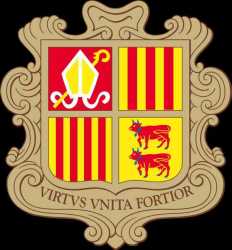
A photo. Coat of arms of Andorra. (Taken ([4.]) →
Casa de la Val with a defensive tower was built in 1580 as a family house of the aristocratic family Busquets. In 1702, it was purchased by the predecessor of the modern General Council of Andorra, the Council of the Land (Consell de la Terra).
The building has three floors. It is built of rough stone. At its two corners you can see ancient dovecotes, made in the form of turrets. On the ground floor of the Casa de la Val is the legal service of the principality and the judicial chambers. On the second floor – the General Council meeting room, the chapel of San Ermengol and the Seven Keys Repository – the state archive, which stores the most valuable documents on the history of Andorra. This room can be opened or closed only if there are seven keys – one from each of the parishes in Andorra. On the third floor is an old kitchen. Here they cooked food for members of the council, because according to the laws of the principality, they had no right to leave the building until the final decision was made on this or that case.
You’ll never see yourself anymore. Andorra is a small, but convenient and beautiful outpost of a ready-Catalan, formed at the junction (border) of the interests of early Muslim and Christian states.
Sources:
- V.A. Batarin. Collection of articles on the new chronology . Release N 5 dated February 26, 2007
http://new.chronologia.org/volume5/katalonia.html - Girona. ru.wikipedia.org/wiki/
- V.A. Batarin. Early Christian religious buildings of Byzantium, or how to culturally relax in Turkey.
Collection of articles on the new chronology. http://new.chronologia.org/volume3/batarin.html - Coat of arms of Andorra ru.wikipedia.org/wiki/
- Andorra. History of Andorra. ru.wikipedia.org/wiki ; ru.wikipedia.org/wiki/ ;
- Kingdom of Andorra. Tsar Boris. ru.wikipedia.org
- Casa de la Val ru.wikipedia.org/wiki/
- Goths http://pereformat.ru/2014/02/goths/
- Manuel Castinaires. Carpet of the creation of the world. Russian translation by Pavel Ryzhakov.
(article received 4/10/2017)
 Hidden History Research