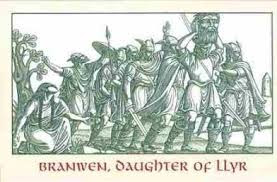
Here is Lady Charlotte Guest’s translation of Branwyn. It’s pretty long and not for those with no interest in myth and legend.
But it forms a major incident in the Welsh Mabinogi.
For me there are many similarities between Branwyn and Cordelia, the daughter of King Lear. She, too, is given away in marriage to a foreign King.
Branwen ferch Llŷr is Welsh for Branwen, the daughter of Llŷr.
And Llŷr is pronounced (with the wonderful Welsh double L …Khl) Lear :o)
BRANWEN THE DAUGHTER OF LLYR
HERE IS THE SECOND PORTION OF THE MABINOGI
BENDIGEID VRAN 369a, the son of Llyr, was the crowned king of this island, and he was exalted from the crown of London. And one afternoon he was at Harlech 369b in Ardudwy, at his Court, and he sat upon the rock of Harlech, looking over the sea. And with him were his brother Manawyddan the son of Llyr, and his brothers by the mother’s side, Nissyen and Evnissyen, and many nobles likewise, as was fitting to see around a king. His two brothers by the mother’s side were the sons of Eurosswydd 369c, by his mother, Penardun, the daughter of Beli son of Manogan 369d. And one of these youths was a good youth and of gentle nature, and would make peace between his kindred, and cause his family to be friends when their wrath was at the highest; and this one was Nissyen; but the other would cause strife between his two brothers when they were most at peace. And as they sat thus, they beheld thirteen ships coming from the south of Ireland, and making towards them, and they came with a swift motion, the wind being behind them, and they neared them rapidly. “I see ships afar,” said the king, “coming swiftly towards the land. Command the men of the Court that they equip themselves, and go and learn their intent.” So the men equipped themselves and went down towards them. And when they saw the ships near, certain were they that they had never seen ships better furnished. Beautiful flags of satin were upon them. And behold one of the ships outstripped the others, and they saw a shield lifted up above the side of the ship, and the point of the shield was upwards, in token of peace. And the men drew near that they might hold converse. Then they put out boats and came towards the land. And they saluted the king. Now the king could hear them from the place where he was, upon the rock above their heads. “Heaven prosper you,” said he, “and be ye welcome. To whom do these ships belong, and who is the chief amongst you?” “Lord,” said they, “Matholwch, king of Ireland, is here, and these ships belong to him.” “Wherefore comes he?’ asked the king, “and will he come to the land?” “He is a suitor unto thee, lord,” said they, “and he will not land unless he have his boon.” “And what may that be?” inquired the king. “He desires to ally himself with thee, lord,” said they, “and he comes to ask Branwen 370a the daughter of Llyr, that, if it seem well to thee, the Island of the Mighty 370b may be leagued with Ireland, and both become more powerful.” “Verily,” said he, “let him come to land, and we will take counsel thereupon.” And this answer was brought to Matholwch. “I will go willingly,” said he. So he landed, and they received him joyfully; and great was the throng in the palace that night, between his hosts and those of the Court; and next day they took counsel, and they resolved to bestow Branwen upon Matholwch. Now she was one of the three chief ladies of this island, and she was the fairest damsel in the world.
And they fixed upon Aberffraw as the place where she should become his bride. And they went thence, and towards Aberffraw the hosts proceeded; Matholwch and his host in their ships; Bendigeid Vran and his host by land, until they came to Aberffraw. And at Aberffraw they began the feast and sat down. And thus sat they. The King of the Island of the Mighty and Manawyddan the son of Llyr on one side, and Matholwch on the other side, and Branwen the daughter of Llyr beside him. And they were not within a house, but under tents. No house could ever contain Bendigeid Vran. And they began the banquet and caroused and discoursed. And when it was more pleasing to them to sleep than to carouse, they went to rest, and that night Branwen became Matholwch’s bride.
And next day they arose, and all they of the Court, and the officers began to equip and to range the horses and the attendants, and they ranged them in order as far as the sea.
And behold one day, Evnissyen, the quarrelsome man of whom it is spoken above, came by chance into the place, where the horses of Matholwch were, and asked whose horses they might be. “They are the horses of Matholwch king of Ireland, who is married to Branwen, thy sister; his horses are they.” “And is it thus they have done with a maiden such as she, and moreover my sister, bestowing her without my consent? They could have offered no greater insult to me than this,” said he. And thereupon he rushed under the horses and cut off their lips at the teeth, and their ears close to their heads, and their tails close to their backs, and wherever he could clutch their eyelids, he cut them to the very bone, and he disfigured the horses and rendered them useless.
And they came with these tidings unto Matholwch, saying that the horses were disfigured, and injured so that not one of them could ever be of any use again. “Verily, lord,” said one, “it was an insult unto thee, and as such was it meant.” “Of a truth, it is a marvel to me, that if they desire to insult me, they should have given me a maiden of such high rank and so much beloved of her kindred, as they have done.” “Lord,” said another, “thou seest that thus it is, and there is nothing for thee to do but to go to thy ships.” And thereupon towards his ships he set out.
And tidings came to Bendigeid Vran that Matholwch was quitting the Court without asking leave, and messengers were sent to inquire of him wherefore he did so. And the messengers that went were Iddic the son of Anarawd, and Heveydd Hir. And these overtook him and asked of him what he designed to do, and wherefore he went forth. “Of a truth,” said he, “if I had known I had not come hither. I have been altogether insulted, no one had ever worse treatment than I have had here. But one thing surprises me above all.” “What is that?” asked they. “That Branwen the daughter of Llyr, one of the three chief ladies of this island, and the daughter of the King of the Island of the Mighty, should have been given me as my bride, and that after that I should have been insulted; and I marvel that the insult was not done me before they had bestowed upon me a maiden so exalted as she.” “Truly, lord, it was not the will of any that are of the Court,” said they, “nor of any that are of the council, that thou shouldest have received this insult; and as thou hast been insulted, the dishonour is greater unto Bendigeid Vran than unto thee.” “Verily,” said he, “I think so. Nevertheless he cannot recall the insult.” These men returned with that answer to the place where Bendigeid Vran was, and they told him what reply Matholwch had given them. “Truly,” said he, “there are no means by which we may prevent his going away at enmity with us, that we will not take.” “Well, lord,” said they, “send after him another embassy.” “I will do so,” said he. “Arise, Manawyddan son of Llyr, and Heveydd Hir, and Unic Glew Ysgwyd, and go after him, and tell him that he shall have a sound horse for every one that has been injured. And beside that, as an atonement for the insult 372a, he shall have a staff of silver, as large and as tall as himself, and a plate of gold of the breadth of his face. And show unto him who it was that did this, and that it was done against my will; but that he who did it is my brother, by the mother’s side, and therefore it would be hard for me to put him to death. And let him come and meet me,” said he, “and we will make peace in any way he may desire.”
The embassy went after Matholwch, and told him all these sayings in a friendly manner, and he listened thereunto. “Men,” said he, “I will take counsel.” So to the council he went. And in the council they considered that if they should refuse this, they were likely to have more shame rather than to obtain so great an atonement. They resolved therefore to accept it, and they returned to the Court in peace.
Then the pavilions and the tents were set in order after the fashion of a hall; and they went to meat, and as they had sat at the beginning of the feast, so sat they there. And Matholwch and Bendigeid Vran began to discourse; and behold it seemed to Bendigeid Vran, while they talked, that Matholwch was not so cheerful as he had been before. And he thought that the chieftain might be sad, because of the smallness of the atonement which he had, for the wrong that had been done him. “Oh, man,” said Bendigeid Vran, “thou dost not discourse to-night so cheerfully as thou wast wont. And if it be because of the smallness of the atonement, thou shalt add thereunto whatsoever thou mayest choose, and to-morrow I will pay thee the horses.” “Lord,” said he, “Heaven reward thee.” “And I will enhance the atonement,” said Bendigeid Vran, “for I will give unto thee a cauldron, the property of which is, that if one of thy men be slain to-day, and be cast therein, to-morrow he will be as well as ever he was at the best, except that he will not regain his speech.” And thereupon he gave him great thanks, and very joyful was he for that cause.
And the next morning they paid Matholwch the horses as long as the trained horses lasted. And then they journeyed into another commot, where they paid him with colts until the whole had been paid, and from thenceforth that commot was called Talebolion.
And a second night sat they together. “My lord,” said Matholwch, “whence hadst thou the cauldron 374a which thou hast given me?” “I had it of a man who had been in thy land,” said he, “and I would not give it except to one from there.” “Who was it?” asked he. “Llassar Llaesgyvnewid; he came here from Ireland with Kymideu Kymeinvoll, his wife, who escaped from the Iron House in Ireland, when it was made red hot around them, and fled hither. And it is a marvel to me that thou shouldst know nothing concerning the matter.” “Something I do know,” said he, “and as much as I know I will tell thee. One day I was hunting in Ireland, and I came to the mound at the head of the lake, which is called the Lake of the Cauldron. And I beheld a huge yellow-haired man coming from the lake with a cauldron upon his back. And he was a man of vast size, and of horrid aspect, and a woman followed after him. And if the man was tall, twice as large as he was the woman, and they came towards me and greeted me. ‘Verily,’ asked I, ‘wherefore are you journeying?’ ‘Behold, this,’ said he to me, ‘is the cause that we journey. At the end of a month and a fortnight this woman will have a son; and the child that will be born at the end of the month and the fortnight will be a warrior fully armed.’ So I took them with me and maintained them. And they were with me for a year. And that year I had them with me not grudgingly. But thenceforth was there murmuring, because that they were with me. For, from the beginning of the fourth month they had begun to make themselves hated and to be disorderly in the land; committing outrages, and molesting and harassing the nobles and ladies; and thenceforward my people rose up and besought me to part with them, and they bade me to choose between them and my dominions. And I applied to the council of my country to know what should be done concerning them; for of their own free will they would not go, neither could they be compelled against their will, through fighting. And [the people of the country] being in this strait, they caused a chamber to be made all of iron. Now when the chamber was ready, there came there every smith that was in Ireland, and every one who owned tongs and hammer. And they caused coals to be piled up as high as the top of the chamber. And they had the man, and the woman, and the children, served with plenty of meat and drink; but when it was known that they were drunk, they began to put fire to the coals about the chamber, and they blew it with bellows until the house was red hot all around them. Then was there a council held in the centre of the floor of the chamber. And the man tarried until the plates of iron were all of a white heat; and then, by reason of the great heat, the man dashed against the plates with his shoulder and struck them out, and his wife followed him; but except him and his wife none escaped thence. And then I suppose, lord,” said Matholwch unto Bendigeid Vran, “that he came over unto thee.” “Doubtless he came here,” said he, “and gave unto me the cauldron.” “In what manner didst thou receive them?” “I dispersed them through every part of my dominions, and they have become numerous and are prospering everywhere, and they fortify the places where they are with men and arms, of the best that were ever seen.”
That night they continued to discourse as much as they would, and had minstrelsy and carousing, and when it was more pleasant to them to sleep than to sit longer, they went to rest. And thus was the banquet carried on with joyousness; and when it was finished, Matholwch journeyed towards Ireland, and Branwen with him, and they went from Aber Menei with thirteen ships, and came to Ireland. And in Ireland was there great joy because of their coming. And not one great man or noble lady visited Branwen unto whom she gave not either a clasp, or a ring, or a royal jewel to keep, such as it was honourable to be seen departing with. And in these things she spent that year in much renown, and she passed her time pleasantly, enjoying honour and friendship. And in the meanwhile it chanced that she became pregnant, and in due time a son was born unto her, and the name that they gave him was Gwern the son of Matholwch and, they put the boy out to be foster-nursed, in a place where were the best men of Ireland.
And behold in the second year a tumult arose in Ireland, on account of the insult which Matholwch had received in Cambria, and the payment made him for his horses. And his foster-brothers, and such as were nearest unto him, blamed him openly for that matter. And he might have no peace by reason of the tumult until they should revenge upon him this disgrace. And the vengeance which they took was to drive away Branwen from the same chamber with him, and to make her cook for the Court; and they caused the butcher after he had cut up the meat to come to her and give her every day a blow on the ear, and such they made her punishment.
“Verily, lord,” said his men to Matholwch, “forbid now the ships and the ferry boats and the coracles, that they go not into Cambria, and such as come over from Cambria hither, imprison them that they go not back for this thing to be known there.” And he did so; and it was thus for not less than three years.
And Branwen reared a starling in the cover of the kneading trough, and she taught it to speak, and she taught the bird what manner of man her brother was. And she wrote a letter of her woes, and the despite with which she was treated, and she bound the letter to the root of the bird’s wing, and sent it towards Britain. And the bird came to this island, and one day it found Bendigeid Vran at Caer Seiont in Arvon, conferring there, and it alighted upon his shoulder and ruffled its feathers, so that the letter was seen, and they knew that the bird had been reared in a domestic manner.
Then Bendigeid Vran took the letter and looked upon it. And when he had read the letter he grieved exceedingly at the tidings of Branwen’s woes. And immediately he began sending messengers to summon the island together. And he caused sevenscore and four countries to come unto him, and he complained to them himself of the grief that his sister endured. So they took counsel. And in the council they resolved to go to Ireland, and to leave seven men as princes here, and Caradawc, the son of Bran 377a, as the chief of them, and their seven knights. In Edeyrnion were these men left. And for this reason were the seven knights placed in the town. Now the names of these seven men were, Caradawc the son of Bran, and Heveydd Hir, and Unic Glew Ysgwyd, and Iddic the son of Anarawc Gwalltgrwn, and Fodor the son of Ervyll, and Gwlch Minascwrn, and Llassar the son of Llaesar Llaesgygwyd, and Pendaran Dyved as a young page with them. And these abode as seven ministers to take charge of this island; and Caradawc the son of Bran was the chief amongst them.
Bendigeid Vran, with the host of which we spoke, sailed towards Ireland, and it was not far across the sea, and he came to shoal water. It was caused by two rivers; the Lli and the Archan were they called; and the nations covered the sea. Then he proceeded with what provisions he had on his own back, and approached the shore of Ireland.
Now the swineherds of Matholwch were upon the seashore, and they came to Matholwch. “Lord,” said they, “greeting be unto thee.” “Heaven protect you,” said he, “have you any news?” “Lord,” said they, “we have marvellous news, a wood have we seen upon the sea, in a place where we never yet saw a single tree.” “This is indeed a marvel,” said he; “saw you aught else?” “We saw, lord,” said they, “a vast mountain beside the wood, which moved, and there was a lofty ridge on the top of the mountain, and a lake on each side of the ridge. And the wood, and the mountain, and all these things moved.” “Verily,” said he, “there is none who can know aught concerning this, unless it be Branwen.”
Messengers then went unto Branwen. “Lady,” said they, “what thinkest thou that this is?” “The men of the Island of the Mighty, who have come hither on hearing of my ill-treatment and my woes.” “What is the forest that is seen upon the sea?” asked they. “The yards and the masts of ships,” she answered. “Alas,” said they, “what is the mountain that is seen by the side of the ships?” “Bendigeid Vran, my brother,” she replied, “coming to shoal water; there is no ship that can contain him in it.” “What is the lofty ridge with the lake on each side thereof?” “On looking towards this island he is wroth, and his two eyes, one on each side of his nose, are the two lakes beside the ridge.”
The warriors and the chief men of Ireland were brought together in haste, and they took counsel. “Lord,” said the nobles unto Matholwch, “there is no other counsel than to retreat over the Linon (a river which is in Ireland), and to keep the river between thee and him, and to break down the bridge that is across the river, for there is a loadstone at the bottom of the river that neither ship nor vessel can pass over.” So they retreated across the river, and broke down the bridge.
Bendigeid Vran came to land, and the fleet with him by the bank of the river. “Lord,” said his chieftains, “knowest thou the nature of this river, that nothing can go across it, and there is no bridge over it?” “What,” said they, “is thy counsel concerning a bridge?” “There is none,” said he, “except that he who will be chief, let him be a bridge. I will be so,” said he. And then was that saying first uttered, and it is still used as a proverb. And when he had lain down across the river, hurdles were placed upon him, and the host passed over thereby.
And as he rose up, behold the messengers of Matholwch came to him, and saluted him, and gave him greeting in the name of Matholwch, his kinsman, and showed how that of his goodwill he had merited of him nothing but good. “For Matholwch has given the kingdom of Ireland to Gwern the son of Matholwch, thy nephew and thy sister’s son. And this he places before thee, as a compensation for the wrong and despite that has been done unto Branwen. And Matholwch shall be maintained wheresoever thou wilt, either here or in the Island of the Mighty.” Said Bendigeid Vran, “Shall not I myself have the kingdom? Then peradventure I may take counsel concerning your message. From this time until then no other answer will you get from me.”
“Verily,” said they, “the best message that we receive for thee, we will convey it unto thee, and do thou await our message unto him.” “I will wait,” answered he, “and do you return quickly.”
The messengers set forth and came to Matholwch. “Lord,” said they, “prepare a better message for Bendigeid Vran. He would not listen at all to the message that we bore him.” “My friends,” said Matholwch, “what may be your counsel?” “Lord,” said they, “there is no other counsel than this alone. He was never known to be within a house, make therefore a house that will contain him and the men of the Island of the Mighty on the one side, and thyself and thy host on the other; and give over thy kingdom to his will, and do him homage. So by reason of the honour thou doest him in making him a house, whereas he never before had a house to contain him, he will make peace with thee.” So the messengers went back to Bendigeid Vran, bearing him this message.
And he took counsel, and in the council it was resolved that he should accept this, and this was all done by the advice of Branwen, and lest the country should be destroyed. And this peace was made, and the house was built both vast and strong. But the Irish planned a crafty device, and the craft was that they should put brackets on each side of the hundred pillars that were in the house, and should place a leathern bag on each bracket, and an armed man in every one of them. Then Evnissyen came in before the host of the Island of the Mighty, and scanned the house with fierce and savage looks, and descried the leathern bags which were around the pillars. “What is in this bag?” asked he of one of the Irish. “Meal, good soul,” said he. And Evnissyen felt about it until he came to the man’s head, and he squeezed the head until he felt his fingers meet together in the brain through the bone. And he left that one and put his hand upon another, and asked what was therein. “Meal,” said the Irishman. So he did the like unto every one of them, until he had not left alive, of all the two hundred men, save one only; and when he came to him, he asked what was there. “Meal, good soul,” said the Irishman. And he felt about until he felt the head, and he squeezed that head as he had done the others. And, albeit he found that the head of this one was armed, he left him not until he had killed him. And then he sang an Englyn:–
“There is in this bag a different sort of meal,
The ready combatant, when the assault is made
By his fellow-warriors, prepared for battle.”
Thereupon came the hosts unto the house. The men of the Island of Ireland entered the house on the one side, and the men of the Island of the Mighty on the other. And as soon as they had sat down there was concord between them; and the sovereignty was conferred upon the boy. When the peace was concluded, Bendigeid Vran called the boy unto him, and from Bendigeid Vran the boy went unto Manawyddan, and he was beloved by all that beheld him. And from Manawyddan the boy was called by Nissyen the son of Eurosswydd, and the boy went unto him lovingly. “Wherefore,” said Evnissyen, “comes not my nephew the son of my sister unto me? Though he were not king of Ireland, yet willingly would I fondle the boy.” “Cheerfully let him go to thee,” said Bendigeid Vran, and the boy went unto him cheerfully. “By my confession to Heaven,” said Evnissyen in his heart, “unthought of by the household is the slaughter that I will this instant commit.”
Then he arose and took up the boy by the feet, and before any one in the house could seize hold of him, he thrust the boy headlong into the blazing fire. And when Branwen saw her son burning in the fire, she strove to leap into the fire also, from the place where she sat between her two brothers. But Bendigeid Vran grasped her with one hand, and his shield with the other. Then they all hurried about the house, and never was there made so great a tumult by any host in one house as was made by them, as each man armed himself. Then said Morddwydtyllyon, “The gadflies of Morddwydtyllyon’s Cow!” And while they all sought their arms, Bendigeid Vran supported Branwen between his shield and his shoulder.
Then the Irish kindled a fire under the cauldron of renovation, and they cast the dead bodies into the cauldron until it was full, and the next day they came forth fighting-men as good as before, except that they were not able to speak. Then when Evnissyen saw the dead bodies of the men of the Island of the Mighty nowhere resuscitated, he said in his heart, “Alas! woe is me, that I should have been the cause of bringing the men of the Island of the Mighty into so great a strait. Evil betide me if I find not a deliverance therefrom.” And he cast himself among the dead bodies of the Irish, and two unshod Irishmen came to him, and, taking him to be one of the Irish, flung him into the cauldron. And he stretched himself out in the cauldron, so that he rent the cauldron into four pieces, and burst his own heart also.
In consequence of that the men of the Island of the Mighty obtained such success as they had; but they were not victorious, for only seven men of them all escaped, and Bendigeid Vran himself was wounded in the foot with a poisoned dart. Now the seven men that escaped were Pryderi, Manawyddan, Gluneu Eil Taran, Taliesin, Ynawc, Grudyen the son of Muryel, and Heilyn the son of Gwynn Hen.
And Bendigeid Vran commanded them that they should cut off his head. “And take you my head,” said he, “and bear it even unto the White Mount 381a, in London, and bury it there, with the face towards France. And a long time will you be upon the road. In Harlech you will be feasting seven years, the birds of Rhiannon singing unto you the while. And all that time the head will be to you as pleasant company as it ever was when on my body. And at Gwales in Penvro you will be fourscore years, and you may remain there, and the head with you uncorrupted, until you open the door that looks towards Aber Henvelen, and towards Cornwall. And after you have opened that door, there you may no longer tarry, set forth then to London to bury the head, and go straight forward.”
So they cut off his head, and these seven went forward therewith. And Branwen was the eighth with them, and they came to land at Aber Alaw, in Talebolyon, and they sat down to rest. And Branwen looked towards Ireland and towards the Island of the Mighty, to see if she could descry them. “Alas,” said she, “woe is me that I was ever born; two islands have been destroyed because of me!” Then she uttered a loud groan, and there broke her heart. And they made her a four-sided grave, and buried her upon the banks of the Alaw.
Then the seven men journeyed forward towards Harlech, bearing the head with them; and as they went, behold there met them a multitude of men and of women. “Have you any tidings?” asked Manawyddan. “We have none,” said they, “save that Caswallawn382a the son of Beli has conquered the Island of the Mighty, and is crowned king in London.” “What has become,” said they, “of Caradawc the son of Bran, and the seven men who were left with him in this island?” “Caswallawn came upon them, and slew six of the men, and Caradawc’s heart broke for grief thereof; for he could see the sword that slew the men, but knew not who it was that wielded it. Caswallawn had flung upon him the Veil of Illusion, so that no one could see him slay the men, but the sword only could they see. And it liked him not to slay Caradawc, because he was his nephew, the son of his cousin. And now he was the third whose heart had broke through grief. Pendaran Dyved, who had remained as a young page with these men, escaped into the wood,” said they.
Then they went on to Harlech, and there stopped to rest, and they provided meat and liquor, and sat down to eat and to drink. And there came three birds, and began singing unto them a certain song, and all the songs they had ever heard were unpleasant compared thereto; and the birds seemed to them to be at a great distance from them over the sea, yet they appeared as distinct as if they were close by, and at this repast they continued seven years.
And at the close of the seventh year they went forth to Gwales in Penvro. And there they found a fair and regal spot overlooking the ocean; and a spacious hall was therein. And they went into the hall, and two of its doors were open, but the third door was closed, that which looked towards Cornwall. “See, yonder,” said Manawyddan, “is the door that we may not open.” And that night they regaled themselves and were joyful. And of all they had seen of food laid before them, and of all they had heard of, they remembered nothing; neither of that, nor of any sorrow whatsoever. And there they remained fourscore years, unconscious of having ever spent a time more joyous and mirthful. And they were not more weary than when first they came, neither did they, any of them, know the time they had been there. And it was not more irksome to them having the head with them, than if Bendigeid Vran had been with them himself. And because of these fourscore years, it was called “the Entertaining of the noble Head.” The entertaining of Branwen and Matholwch was in the time that they went to Ireland.
One day said Heilyn the son of Gwynn, “Evil betide me, if I do not open the door to know if that is true which is said concerning it.” So he opened the door and looked towards Cornwall and Aber Henvelen. And when they had looked, they were as conscious of all the evils they had ever sustained, and of all the friends and companions they had lost, and of all the misery that had befallen them, as if all had happened in that very spot; and especially of the fate of their lord. And because of their perturbation they could not rest, but journeyed forth with the head towards London. And they buried the head in the White Mount, and when it was buried, this was the third goodly concealment; and it was the third ill-fated disclosure when it was disinterred, inasmuch as no invasion from across the sea came to this island while the head was in that concealment.
And thus is the story related of those who journeyed over from Ireland.
In Ireland none were left alive, except five pregnant women in a cave in the Irish wilderness; and to these five women in the same night were born five sons, whom they nursed until they became grown-up youths. And they thought about wives, and they at the same time desired to possess them, and each took a wife of the mothers of their companions, and they governed the country and peopled it.
And these five divided it amongst them, and because of this partition are the five divisions of Ireland 384a still so termed. And they examined the land where the battles had taken place, and they found gold and silver until they became wealthy.
And thus ends this portion of the Mabinogi, concerning the blow given to Branwen, which was the third unhappy blow of this island; and concerning the entertainment of Bran, when the hosts of sevenscore countries and ten went over to Ireland to revenge the blow given to Branwen; and concerning the seven years’ banquet in Harlech, and the singing of the birds of Rhiannon, and the sojourning of the head for the space of fourscore years.
NOTES TO BRANWEN THE DAUGHTER OF LLYR.
369a BENDIGEID VRAN.
BRAN the son of Llyr Llediaith, and sovereign of Britain, derives, according to the Welsh authorities, his title of Bendigeid, or the Blessed, from the circumstance of his having introduced Christianity into this Island. They tell us that he was the father of the celebrated Caradawc (Caractacus), whose captivity he is said to have shared; and proceed to state that having embraced the Christian faith, during his seven years’ detention in Rome, he returned to his native country, and caused the Gospel to be preached there. 1 The following Triad recites these events.
“The three blissful Rulers of the Island of Britain, Bran the Blessed, the son of Llyr Llediaith, who first brought the faith of Christ to the nation of the Cymry from Rome, where he was seven years a hostage for his son Caradawc, whom the Romans made prisoner through the craft, and deceit, and treachery of Aregwedd Fôeddawg [usually supposed to be Cartismandua]. The second was Lleurig ab Coel ab Cyllyn Sant, who was called Lleufer Mawr, [the great Light], and built the ancient church at Llandaff, which was the first in Britain, and who gave the privileges of land, and of kindred, and of social rights, and of society to such as were of the faith of Christ. The third was Cadwaladyr the Blessed, who gave refuge, with his lands, and with all his goods, to the believers who fled from the Saxons without faith, and from the aliens who would have slain them.”–Tr. 35.
The benefit which Bran thus conferred upon his country procured for his family the distinction of being accounted one of the three Holy Tribes; the families of Cunedda Wledig and Brychan Brycheiniog were the other two.
All this, however, it may be observed, is much at variance with the particulars of Caradawc’s captivity, and of his family, recorded by classical writers.
Bran is ranked with Prydain ab Aedd Mawr, and Dyvnwal Moelmud as one of the three Kings who gave stability to sovereignty by the excellence of their system of government.–Tr. 36.
Various ancient Welsh documents allude to the incidents recorded of Bran in the Mabinogi of Branwen. Thus in the curious poem entitled Kerdd am Veib Llyr ab Brychwel Powys, attributed to Taliesin, are the following lines,–
I was with Bran in Ireland,
I saw when Morddwyd Tyllon was slain. 1
And there is a Triad upon the story of his head being buried under the White Tower of London, with the face towards France, intended as a charm against foreign invasion. Arthur, it appears, proudly disinterred the head, preferring to hold the Island by his own strength alone, and this is recorded as one of the fatal disclosures of Britain.
“The three Closures and Disclosures of the Island; First the head of Bendigeid Vran ab Llyr, which Owain the son of Maxen Wledig buried under the White Tower in London, and while it was go placed no invasion could be made upon this Island; the second was the bones of Gwrthevyr the Blessed [Vortimer], which were buried in the chief harbour of the Island, and while they remained there hidden all invasions were ineffectual. The third was the dragons buried by Lludd ab Beli, in the city of Pharaon, in the rocks Of Snowdon. And the three closures were made under the blessing of God and his attributes, and evil befel from the time of their disclosure. Gwrtheyrn Gwrtheneu [Vortigern], disclosed the dragons to revenge the displeasure of the Cymry against him, and he invited the Saxons in the guise of men of defence to fight against the Gwyddyl Ffychti; and after this he disclosed the bones of Gwrthevyr the Blessed, through love of Ronwen [Rowena], the daughter of the Saxon Hengist. And Arthur disclosed the head of Bendigeid Vran ab Llyr, because he chose not to hold the Island except by his own strength. And after the three disclosures came the chief invasions upon the race of the Cymry.”–Tr. 53.
The name of Bran is of frequent occurrence in the poems of Cynddelw, and other bards of the middle ages.
369b HARLECH.
MOST of the localities which occur in the Tale of Branwen are too well known to need any description; one or two, however, require a slight notice. Of Harlech, it may be remarked that it is also called Twr Bronwen, or Branwen’s Tower. The name of Caer Collwyn was also bestowed upon it after Collwyn ab Tangno, chief of one of the fifteen Noble Tribes of North Wales. It possesses the ruins of a fine castle. Harlech stands on the sea coast, on the confines of Ardudwy, one of the six districts of Merionethshire, of which the portion called Dyffryn Ardudwy is a remnant of the Cantrev y Gwaelod, inundated in the time of Gwyddno Garanhir.
Edeyrnion, mentioned a little further on in the story, is also situated in Merionethshire.
Talebolion is a Commot in Anglesey.
Aberffraw, likewise in Anglesey, was the residence of the princes of Gwynedd from the time of Roderick the Great, in 843, to that of the last Llywelyn, in 1282.
369c EUROSSWYDD.
EUROSSWYDD is beyond doubt the Roman general Ostorius, the captor of Llyr Llediaith, and his family, including Bran and Caradawc (Caractacus).
He is mentioned as such in Triad L, already quoted.
369d BELI THE SON. OF MANOGAN.
BELI, surnamed the Great, was king over Britain forty years, and was succeeded in the sovereignty by his sons, Lludd and Caswallawn, better known as Cassivelaunus. In the Armes attributed to Taliesin, Beli is thus addressed,–
“Greatly do I honour thee
Victorious Beli,
Son of Manogan the king.
Do thou preserve the glory
Of the Honey Island 1 of Beli.”
Myv. Arch. I. p. 73.
370a BRANWEN
THE beautiful Branwen (or Bronwen, the “white-bosomed,” as she is more frequently called), is one of the most popular heroines of Welsh romance. No less celebrated for her woes than for her charms, we find that her eventful story was a favourite theme with the bards and poets of her nation. Numerous instances might be adduced of the allusions to her, which their compositions contain; suffice it to refer to the words of Davydd ab Gwilym, who, in one of his odes addressed to Morvudd, compares her hue to that of Bronwen, the daughter of Llyr.
The indignities to which Branwen was subjected in Ireland are referred to in one of the Triads (49).
In 1813, a grave containing a funeral urn was discovered on the banks of the river Alaw, in Anglesey, in a spot called Ynys Bronwen. The appearance of the grave, and its remarkable locality, led to the inference that it might indeed be the “Bedd Petrual,” the four-sided place of burial, in which, according to the text, her sorrowing companions deposited the remains of the unfortunate heroine of the Mabinogion. The following account of its discovery was communicated, in 1821, to the Cambro-Briton (and printed in that publication, II. p. 71), by Sir R. C. Hoare, on the authority of Richard Fenton, Esq., of Fishguard.
“An Account of the Discovery, in 1813, of an Urn, in which, there is every reason to suppose, the ashes of Bronwen (White Bosom), the daughter of Llyr, and aunt to the great Caractacus, were deposited.
A farmer, living on the banks of the Alaw, a river in the Isle of Anglesea, having occasion for stones, to make some addition to his farm-buildings, and having observed a stone or two peeping through the turf of a circular elevation on a flat not far from the river, was induced to examine it, where, after paring off the turf, he came to a considerable heap of stones, or carnedd, covered with earth, which he removed with some degree of caution, and got to a cist formed of coarse flags canted and covered over. On removing the lid, he found it contained an urn placed with its mouth downwards, full of ashes and half-calcined fragments of bone. The report of this discovery soon went abroad, and came to the ears of the parson of the parish, and another neighbouring clergyman, both fond of, and conversant in, Welsh antiquities, who were immediately reminded of a passage in one of the early Welsh romances, called the Mabinogion (or juvenile tales), the same that is quoted in Dr. Davies’s Latin and Welsh Dictionary, as well as in Richards’s, under the word Petrual (square).
‘Bedd petrual a wnaed i Fronwen ferch Lyr ar lan Alaw, ac yno y claddwyd hi.’
A square grave was made for Bronwen, the daughter of Llyr, on the banks of the Alaw, and there she was buried.
Happening to be in Anglesea soon after this discovery, I could not resist the temptation of paying a visit to so memorable a spot, though separated from it by a distance of eighteen miles. I found it, in all local respects, exactly as described to me by the clergyman above mentioned, and as characterised by the cited passage from the romance. The tumulus, raised over the venerable deposit, was of considerable circuit, elegantly rounded, but low, about a dozen paces from the river Alaw. 1 The Urn was preserved entire, with an exception of a small bit out of its lip, was ill-baked, very rude and simple, having no other ornament than little pricked dots, in height from about a foot to fourteen inches, and nearly of the following shape. When I saw the urn, the ashes and half-calcined bones were in it.”
Branwen appears to be the Brungwaine or Brangian of romance, though the character of the Welsh heroine, and the part she sustains, differ widely from those attributed to the confidante of Tristan and Yseult la Belle. In like manner Matholwch the Irishman also seems identical with Morholt the stern king of Ireland of the Trouvères.–See the Romances of Meliadus of Leonnoys, Tristan, &c.
370b THE ISLAND OF THE MIGHTY.
YNYS Y KEDYRN, the Island of the Mighty, is one of the many names bestowed upon Britain by the Welsh. A Triad, in which several more of these ancient appellations are preserved, asserts that while yet uninhabited the Island was called Clas Merddin, but that after its colonization it bore the name of Vel Ynys, which was again changed in compliment to its conquest by Brut, into Ynys Prydain, or the Island of Brut. The same Triad states that some authorities attribute the more modern designation to its conquest by Prydain son of Aedd the Great.–Myv. Arch. II. p. 1.
372a AN ATONEMENT FOR THE INSULT.
THE compensation here offered to Matholwch, is strictly in accordance, except as regards the size of the silver rod, with what was required by the Laws of Hywel Dda, where the fine for insult to a king is fixed at a “hundred cows on account of every cantrev in the kingdom, and a silver rod with three knobs at the top, that shall reach from the ground to the king’s face, when he sits in his chair and as thick as his ring-finger; and a golden bason, which shall hold fully as much as the king drinks, of the thickness of a husbandman’s nail, who shall have followed husbandry for seven years, and a golden cover, as broad as the king’s face, equally thick as the bason.” In another MS. the payment, instead of being only partly in gold, is said to have been entirely in that metal; thus “a golden rod as long as himself, of the thickness of his little finger, and a golden tablet, as broad as his face, and as thick as a husbandman’s nail.”
374a THE CAULDRON.THE powers exercised by this family through the influence of the cauldron, bear a strong resemblance to those possessed by the Tuatha de Danann, a race of necromancers, who once invaded Ireland. This tribe, whilst sojourning in Asia, were at war with the Syrians, and were enabled to triumph through the aid of magic, as they had the art of resuscitating such of their number as fell in fight by sending demons to animate their corpses, so that the Syrians found to their dismay that those whom they had slain met them in battle the next day as vigorous as ever. In this difficulty, they had recourse to the advice of their priests, who told them to drive a stake of mountain ash through the bodies of such as they slew, and that, if they had been animated by demons, they would instantly turn into worms. This counsel was followed, and the Tuatha de Danann were compelled to quit that country.
An ancient Irish poem contains a series of Triads respecting this race which remind us of some passages in the Mabinogi of Kilhwch and Olwen.
“Blackness, obscurity, and darkness were their three cup-bearers; strength, robustness, and vigour, their three horses; indignation, pursuit and swiftness, their three bounds, &c.”–See Bunting.
377a CARADAWC THE SON OF BRAN.
THIS Prince, so well known under his Latinized name of Caractacus, is chiefly remarkable for his captivity in Rome, which, according to Welsh authorities, was shared by his father Bran, his grandfather Llyr Llediaith, and all his near kinsfolk. There are several Triads relating to this principal event of his life. 1 From one of these it seems that he was chosen by his countrymen as their general, or War-king, to repel the incursions of the Romans, and another corroborates this by styling him “One of the three Rulers of choice,” having been elected by the voice of the country and the people, although he was not an elder. There is no doubt of his having stood high in the esteem of his nation; and we are told that “the men of Britain, from the prince to the slave, became his followers in their country’s need against the progress of the foe and of destruction. And wheresoever he went in war, all the men of the Island went in his train, and none desired to remain at home.” 2
Caradawc is also extolled as one of those brave princes, who, by reason of their valour, could never be overcome save by treachery; and the treason by which he was cast into the hands of his enemies is very frequently alluded to. Avarwy ab Lludd ab Beli, and his daughter Aregwedd Foeddawg, were the traitors, and are mentioned in terms of disgust and execration. “One of the praiseworthy opposers,” is another of the titles bestowed upon Caradawc, because he resisted the invasion of the Cæsarians.
381a WHITE MOUNT IN LONDON.
UNDER the name of the Gwynvryn, or White Mount of the text, allusion is most probably intended to the Tower of London, in which the Welsh, who always regarded the capital as a city of their own foundation, appear to have felt a peculiar interest.
Llywarch ab Llewelyn (Prydydd y Moch), a poet of the twelfth and early part of the thirteenth century, speaks of it as “The White eminence of London, a place of splendid fame.”–Myv. Arch. I. p. 280.
The keep of the metropolitan fortress of England has in turn been attributed to Celts, Romans, Saxons, and Normans; now, however, the “Towers of Julius” are assigned, upon irrefragable evidence, to the early Norman period.
382a CASWALLAWN.
CASWALLAWN the son of Beli, known more generally by the name of Cassivelaunus, bestowed on him by the Romans, is a celebrated character in Welsh history. He is recorded as one of the chiefs chosen to oppose the invasion of Caesar, and was styled one of the War-kings of Britain.–Tr. 24.
It is related that Caswallawn led an army of sixty-one thousand men against Julius Caesar. The charms of Flur, the daughter of Myguach Gorr, are said to have been the cause of this incursion, She had been carried off by Mwrchan, a Gaulish prince, in alliance with Caesar, to whom he intended to present his prize. The expedition which Caswallawn headed was successful; six thousand of the partisans of Caesar were slain, and Flur was recovered. Some of the circumstances of this exploit acquired for Caswallawn the designation of “One of the Three Gold-Shoemakers” (the other two being Manawyddan mab Llyr, and Llew Llaw Gyffes, as will be detailed hereafter), and the whole achievement occasioned him to be ranked among the three faithful lovers of Britain.
The army of Caswallawn did not return with their leader, whence it is called one of the three Emigrant hosts of Britain. 1
Meinlas was the name of Caswallawn’s horse.–Trioedd y Meirch ii.
384a FIVE DIVISIONS OF IRELAND.
BEFORE the invasion of the Anglo-Normans, in Henry II.’s time, Ireland was divided into a pentarchy composed of the kingdoms of Munster, Leinster, Connaught, Ulster, and Meath.
Footnotes
385:1 For an account of Bendigeid Vran, see Professor Rees’s Welsh Saints p. 77.
386:1 Myv. Arch. I. p. 66.
388:1 An ancient name for Britain.
389:1 “This spot is still called Ynys Bronwen, or the Islet of Bronwen, which is a remarkable confirmation of the genuineness of this discovery.”
391:1 Tr. 17, 23, 24, 34, 41, 55.
391:2 In this Triad (41) he is called one of the exalted servants, and is distinguished as the son of a Bard.
393:1 The above particulars with regard to Caswallawn are related in the Triads 14,102,124, and xl.
 Hidden History Research