
Mmmmmn! OK.
Double confirmation?
Mea Culpa.

Sphinx’s broken nose and the chronology of medieval Egypt
Tyurin A.M.
Candidate of Geological and Mineralogical Sciences
Keywords: New Chronology, Chronology, Sphinx
1. Introduction
According to the actual data reviewed in the publications [Tyurin, 2007, Algorithm, Pre-Caspian region; Tyurin, 2007, Reconstruction, Caspian] from the standpoint of New Chronology A.T. Fomenko and G.V. Nosovskiy (NH FIN) [New Chronology site], two conclusions were made: over the past 1,300 years there has been one increase in the level of the Caspian Sea, which confidently dates from the boundary of the 16th and 17th centuries, and the phantom reflections of this event are shifted in the past by 333, 666, 1000 and 1145 years old. Proceeding from this, all the testimonies of geographers and historians, in which they directly or indirectly mention either the process of raising the level of the Caspian Sea, or its consequences that fell in the period of the 8th – first half and the middle of the 16th centuries, should be dated not earlier than the 17th century [Tyurin 2008, Dating geographers]. The evidence of Santo Marino, Kazvini, Baku, Kudama and Masudi is dated this way. According to the results of the generalization of dating, the following hypothesis was formulated. Accepted in the Traditional History (TI) ideas about the past of Iran and neighboring countries are based on evidence that is contained in the works of geographers and historians, written in Arabic and Persian languages. In accordance with TI, their writings date from the 9th to the 18th centuries. Most of these works were compiled in the 17th century. As part of the formation of TI, one part of them is dated with a chronological shift of 666/674 years, and the other part is of 333/337 years. Part of the works dated the real years of their preparation. written in Arabic and Persian. In accordance with TI, their writings date from the 9th to the 18th centuries. Most of these works were compiled in the 17th century. As part of the formation of TI, one part of them is dated with a chronological shift of 666/674 years, and the other part is of 333/337 years. Part of the works dated the real years of their preparation. written in Arabic and Persian. In accordance with TI, their writings date from the 9th to the 18th centuries. Most of these works were compiled in the 17th century. As part of the formation of TI, one part of them is dated with a chronological shift of 666/674 years, and the other part is of 333/337 years. Part of the works dated the real years of their preparation.
On the basis of the chronological hypothesis, one of the virtual phenomena of TI, the “frozen culture of the East”, was explained. In accordance with it, in the 9-11 centuries, the spiritual ascent of the Iranian-Arab world took place. Its peak came in the 10th century. Then, for almost 7 centuries, stagnation was observed. Scientists and poets of the 13th and 15th and 17th centuries only copied the works of their predecessors who lived in the 9-11th centuries, practically without creating new scientific and spiritual values. Based on the hypothesis, private conclusions were also made:
– testimonies of geographers and historians of Iran, as well as neighboring countries, dated to the TI of 9-11 centuries, should be transmitted with a chronological shift of 666/674, and certificates dated 13-14 centuries, to 333/337 years;
– the classical geographical school of the Caliphate of the 10th century and the emergence of the New Persian (modern Persian) language should be dated to the 17th century.
It was also concluded that the hypothesis needs further substantiation, but the algorithm for transmitting evidence created within its framework can be used to create historical reconstructions carried out within the framework of the NH FIN. The algorithm for transmitting evidence was applied by us when integrating information on the Khazars into the National Financial Instrument Institutions (Tyurin, 2008, Integration, Khazars). It turned out that the figures of 337 and 674 correspond to the general context of the events of the 17th century better than 333 and 666 years. The algorithm was also applied in the critical review of Jewish documents on Khazars and Khazaria [Tyurin, 2010, Jewish Documents].
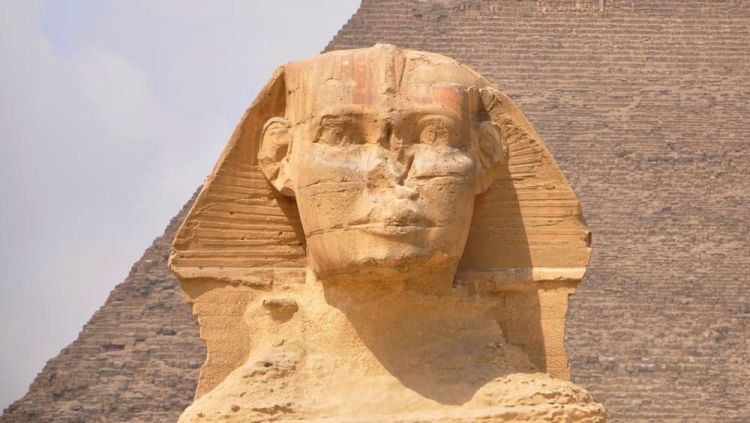
With our acquaintance with the monuments of the Giza Plateau – the Great Pyramids and the Sphinx (in nature and according to the published literature), an original opportunity was found to verify the hypothesis of a chronological shift of Arabic evidence for 337 years. With Sphinx is associated with one specific historical event – the loss of the nose. It can be chronologically located according to direct written testimony of Arabs and drawings of Europeans. The verification results are outlined below.
The Sphinx of Giza has a height of 19.8 m, a width of 14.0 m and a length of 73.2 m. The height of its head is 5.0 m. Many legends are associated with the Sphinx of the Giza Plateau. We will not consider them. We will not consider the presentation of Egyptologists about the time and methods of its construction. Geologists who have studied the Sphinx believe that it is an artificial outcrop of rocks [Gauri, 1984; Raynaud, 2010], that is, carved out of limestone. This issue is discussed in detail in the article [Tyurin, 2011, Geology, pyramids]. A particular question is the dating of the Sphinx in terms of the speed of geological processes, considered in the article [Tyurin, 2011, Dating, geology].
2. Arab Sphinx nose evidence
The testimony of Ibn Jubayr, a poet from Granada about the Great Pyramids and the Sphinx, dates back to 1183. “In the vicinity of these pyramids, in the distance of an arrow’s flight, there is a strange figure made of stone, which rises like a tower, with human features, of a frightening appearance; her face is turned toward the pyramids, and her back toward the south, toward the headwaters of the Nile; this is Abu-l-Ahval [Ibn Jubayr]. The note to the Arab text says: “Abu-l-Akhwal – letters. “Father of horror” – sphinx. The common complex of the Gizekh pyramids is organically included in the free-standing sculpture of the Sphinx, glorifying Pharaoh Khafre, as it is supposed. ” Strange, but the fact that in the Arab testimony the orientation of the Sphinx does not correspond to its current position (its face looks east) is not commented in any way.
The description of the Sphinx by the poet Ibn Jubayr is concise and “not poetic.” But the scientist Abd al-Latif (1162-1231 years) created the poetic image of the Sphinx. “These pyramids, at a distance [slightly] larger than the flight of an arrow, have an image of the head and neck protruding from the ground, [and it has] a colossal size. The people call him Abu al-Haul (Sphinx). It is said that his body is buried in the ground, and measurements show that [the length] of the body according to [the size] of the head is seventy cubits and even more. On the face of his blush. The paint [which it is covered with] is of scarlet color, it shines with fresh brilliance. It is pleasant and pretty, almost beautiful. Abu al-Haul seems to be smiling and grinning. A worthy man asked me what was the most amazing thing I had seen [in Egypt]. And I said, “The proportionality of the face of Abu al-Howl.” Really, parts of his face — nose, eyes, ears — [are] as proportional as nature makes shapes. Truly, the nose of the child, for example, suits him and is beautiful on his [face]. And if this nose were on [the face of] a man, he would be ugly there. In the same way, if the man’s nose were on the boy’s face, he would have made him ugly. And so are all the other parts of [the face]. Each part should be [its] appearance and size commensurate with a certain way and correspond to it. If there is no match, the image will be disfigured. It is amazing how the sculptor could observe the proportionality of the parts [of his face] with their enormous size. ”[Abd al-Latif]. The Arab finished his book in 1204. The baby’s nose, for example, fits him and is beautiful on his [face]. And if this nose were on [the face of] a man, he would be ugly there. In the same way, if the man’s nose were on the boy’s face, he would have made him ugly. And so are all the other parts of [the face]. Each part should be [its] appearance and size commensurate with a certain way and correspond to it. If there is no match, the image will be disfigured. It is amazing how the sculptor could observe the proportionality of the parts [of his face] with their enormous size. ”[Abd al-Latif]. The Arab finished his book in 1204. The baby’s nose, for example, fits him and is beautiful on his [face]. And if this nose were on [the face of] a man, he would be ugly there. In the same way, if the man’s nose were on the boy’s face, he would have made him ugly. And so are all the other parts of [the face]. Each part should be [its] appearance and size commensurate with a certain way and correspond to it. If there is no match, the image will be disfigured. It is amazing how the sculptor could observe the proportionality of the parts [of his face] with their enormous size. ”[Abd al-Latif]. The Arab finished his book in 1204. Each part should be [its] appearance and size commensurate with a certain way and correspond to it. If there is no match, the image will be disfigured. It is amazing how the sculptor could observe the proportionality of the parts [of his face] with their enormous size. ”[Abd al-Latif]. The Arab finished his book in 1204. Each part should be [its] appearance and size commensurate with a certain way and correspond to it. If there is no match, the image will be disfigured. It is amazing how the sculptor could observe the proportionality of the parts [of his face] with their enormous size. ”[Abd al-Latif]. The Arab finished his book in 1204.
In the dictionary entry [Great Sphinx of Giza], the reference book recites the testimony of the Egyptian historian al-Makrezi (1364-1441) about the circumstances of the loss of his nose by the Sphinx. «The Egyptian Arab historian al-Maqrizi , writing in the 15Th century AD, attributes the loss of the nose to iconoclasm by Muhammad Sa’im al-Dahr , a Sufi Muslim from the khanqah of Sa’id al-Su’ada. In AD 1378, upon finding the Egyptian peasants making offerings to the Sphinx in the hope of increasing their harvest, Sa’im al-Dahr was so outraged that he destroyed the nose, and was hanged for vandalism . Al-Maqrizi describes the Sphinx as the ” talismanof the Nile “on the cycle of depended cycle .”.
With the testimony of the Arabs everything is quite certain. Abd al-Latif saw and described the nose of the Sphinx shortly before the end of the writing of his book (1204). At the time of writing al-Makrezi (1364-1441), the Sphinx no longer had a nose (no earlier than the end of the 14th century). According to the sources used by this historian, the nose was repulsed in 1378.
3. European Sphinx Nose Certificate
The reference reference article [Great Sphinx of Giza] contains the following reference: “Sketches of the Sphinx by the Frederic Louis Norden , made in 1737 and published in 1755, illustrate the Sphinx by the Sphinx” (Figure 1). Frederick Norden (1708-1742) was a Danish captain. In an earlier figure of Cornelis de Brun ( the Cornelis de Bruijn ) Dutch artist and traveler (1652-1727 years), published in 1698, depicts the Sphinx with the nose (Figure 2). Links to the figures of Frederick Norden and Cornelis de Brun are given in the Wikipedia and search.com directories [ http://www.search.com/reference/Great_Sphinx_of_Giza ], article – Great Sphinx of Giza. The general evolution of the ideas of Europeans about the Sphinx is indicated in the publication [La evolución]. There are 10 of his drawings made in the period 1556-1799. It is clear that some of their authors did not see the Sphinx themselves. But they had ideas about him, formed on the basis of written or oral testimony. Information about the broken off nose of the Sphinx before 1755 was not cited. This is reflected in the figures of the corresponding period “not from life”. For the first time, Europeans learned about the broken sphinx nose in 1755, when Frédéric Norden‘s work “Voyage d’Egypte et de Nubie” was published. Frederick Norden painted the Sphinx in 1737 without a nose. However, in the publication of Richard Pokoki (Richard Pococke) “A description of the East and some other countries” (1743) Sphinx painted with a nose. This traveler visited Egypt in 1737 and 1738. Chronological discrepancy is resolved simply. In the publication of Richard Pokoki shown a drawing by Cornelis de Brun, published in 1698.

Figure 1.
Sphinx. Frederic Louis Norden, Voyage d’Égypte et de Nubie (1755). Inset in the upper right corner – a fragment of a photo of 2010. [Great Sphinx of Giza, Wikipedia].

Figure 2.
Sphinx. Cornelis de Bruijn , Reizen van Cornelis de Bruyn door de vermaardste Deelen van Klein Asia (1698) [Cornelis de Bruijn]. Below left is a fragment of the de Brunet’s [Great Sphinx of Giza, Wikipedia]. Below on the right – a fragment of the photo of the Sphinx (1867) [ http://www.search.com/reference/Great_Sphinx_of_Giza ].
Here is the conclusion of the geologist KL Gauri, who carried out a detailed study of the Sphinx. “The Sphinx is a relatively softer pattern. Limestone is the most common part of the limestone of the neck. ”[Gauri, 1984]. Here it is important for us that the Sphinx’s head is cut from massive limestone, the layers of which are separated by four layers of soft limestone, 10 cm thick. Today they are visible at the level of the lips of the Sphinx, its nose, lower and upper foreheads. Frederic Norden handed them the jewelery accurately ( Figure 1). Only the interlayer in the lower part of the Sphinx’s forehead in the figure is shown slightly below – at eye level. But there is one subtlety. Today, a relatively deep furrow corresponds to the lower seam. In the figure of Frederick Norden, it is shown as a layer, and in the figureCornelis de Brun corresponds to him the “dark line”. It can be stated unequivocally that here we are dealing with the usual geological process – weathering. The four images of the Sphinx, corresponding to its state as of 1698, 1755, 1867, and 2010 (Figures 1 and 2), show the different stages of destruction of a layer of soft limestone. The same applies to the seam at the level of the nose of the Sphinx. Cornelis de Brun identified it with two barely visible dashes. The layer in the lower part of the forehead is not shown in his figure. On the other hand, the upper layer is clearly shown, strongly eroded on the right side of the Sphinx’s head. It is clearly visible in the photo in 1867 (Figure 2). Drawings by Cornelis de Brun and Frederick Nordenvery accurately transfer the boundaries of the layers of limestone, from which the head of the Sphinx is cut and its general proportions. It can be almost unequivocally stated that they are made from nature. This gives a high accuracy of the dating of the period during which the Sphinx had a broken nose – 1698-1737 years. Other features of the drawings and photographs of the Sphinx are discussed in the article [Tyurin, 2011, Dating, Geology].
4. Chronological shift of the “loss of the nose” event between the Arab and European testimonies
According to Arab testimonies, the Sphinx’s nose was repulsed in 1378. In accordance with the drawings of Europeans, this happened in the period 1698-1737. The chronological shift between evidence is 320-395 years. This corresponds to our hypothesis about the presence of a chronological shift in the dates of Arabic evidence by 337 years in the past. In accordance with her nose, the Sphinx was repulsed in 1715.
5. Phenomenon al-makresi
Taking into account the chronological shift of 337 years, the Egyptian historian al-Makrezi lived in the years 1701-1784. The first publications (typographically) of his works in Arabic and European languages were made in 1797, 1798 and 1799 [Brockhaus and Efron]. These dates correspond to the dates of Napoleon’s Egyptian campaign (1798–1801) and the creation of the Egypt Institute in France (1798). Most likely, al-Makrezi is a phantom, and his works were created in the period from the end of the 18th to the mid-19th centuries by the Europeans. Rather, they created the medieval history of Egypt. Real written Arabic testimonies were integrated into it with a chronological shift of 337 years. Another part of the history of Egypt was simply made up. In the directory [Brockhaus and Efron] in the dictionary entry “Makriziy” states the following. “Sochin. him full of apt remarks are skillful and very learned compilations; sources of borrowing are not always indicated, but you can vouch for the accuracy of the information. ” This is true. For the accuracy of the information given in the writings attributed to al-Makrezi, all European science of the 19th century commissioned. It is believed that Al-Makrizi was the founder of a special historical school, “among whose representativesal-Aini , Ibn Hajar al-Askalani, Ibn Tagriberdi , al-Sahavi , al-Suyuti and Ibn Iyas. ”[Makrizi, Wikipedia]. Of course, such a TI phantom, like the history of medieval Egypt, cannot hold onto the authority of one Arab historian. Europeans solved the problem of its creation in a complex. Separate episodes of “integration” of the material part of the past of Egypt in TI are considered in the book [Nosovsky, Fomenko, 2003].
6. Strokes to the formation of Islam in Egypt
Several works by al-Makrezi are devoted to the history of the formation of Islam in Egypt [Brokgauz and Efron]. The episode associated with the loss of the Sphinx of the nose does not fully correspond to the ideas on this issue adopted in TI, including on the basis of al-Makrezi. In 1378, residents of the actual suburb of Cairo prayed to their idol, the Sphinx, the “head” of the Nile flood cycles. The ardent Muslim preacher beat off his nose and was hanged for it. That is, the triumph of Islam in Egypt in the second half of the 14th century is out of the question. According to the testimony of Abd al-Latif in the earlier period (1204), the face of the Sphinx was painted. “The paint [which it is covered with] is of scarlet color, it glows with fresh brilliance.” [Abd al-Latif]. That is, at the beginning of the 13th century, the Sphinx was carefully looked after.
According to the results of our dating, the face of the Sphinx was covered with fresh paint in 1541, and a religious conflict with it occurred in 1715. The last date characterizes the initial stage of the formation of Islam in Egypt, the stage of crushing idols with the active resistance of idolaters.
7. Instead of conclusion
The authors of the National Financial Institutions of Finland gave their opinion on the time of life of Abd al-Latif. “The Baghdad physician Abd al-Latif, allegedly of the 12th-13th centuries AD,” wrote about two large pyramids: Auth.] [Nosovsky, Fomenko, 2003]. Their dating Abd al-Latif, made according to the information given in his works, can be clarified. He lived in the years 1499-1568. That is, the information given by him about the pyramids should be attributed to the middle of the 16th century.
Information sources
- [Abd al-Latif] ‘Abd al-Latif b. Jusuf b. Muhammad al-Baghdadi. Book of notification and consideration of cases and events witnessed in the land of Egypt. M. Russian Academy of Sciences. Institute of Oriental Studies. 2004. http://www.vostlit.info/Texts/rus15/Bagdadi2/frametext14.htm Eastern Literature. http://www.vostlit.info/
- [Brockhaus and Efron] Brockhaus and Efron Encyclopedia.
- http://gatchina3000.ru/brockhaus-and-efron-encyclopedic-dictionary/index.htm
- [Ibn Jubayr] Ibn Jubayr. Journey. M. Science. 1984http: //www.vostlit.info/Texts/rus7/Jubeir/frametext1.htm Eastern Literature. http://www.vostlit.info/
- Nosovsky G.V. Fomenko A.T. New chronology of Egypt. Astronomical dating of monuments of ancient Egypt. Studies of 2000-2001 (the third, enlarged and revised edition of the book). http://www.chronologia.org/nx_egypt2003/index.html REMIS, Moscow 2003. The site of the New Chronology project. http://www.chronologia.org
- [Site New Chronology] Site of the project “New Chronology”. http://www.chronologia.org
- [Tyurin, 2007, Algorithm, Pre-Caspian Region] A. Tyurin Algorithm for creating archeology of the Caspian region. http://new.chronologia.org/volume5/tur_alg2.html Electronic collection of articles “New Chronology”. Issue 5. 2007.
- http://new.chronologia.org/volume5/ Website: New Chronology. http://www.chronologia.org/
- [Tyurin, 2007, Reconstruction, Caspian Sea] Tyurin AM Reconstruction of Caspian level fluctuations in the historical period.
- http://new.chronologia.org/volume5/tur_rec3.html Electronic collection of articles “New Chronology”. Issue 5. 2007. http://new.chronologia.org/volume5/ Website: New Chronology. http://www.chronologia.org/
- [Tyurin, 2008, Dating the geographers] A. Tyurin Dating evidence of geographers and historians of Iran and neighboring countries.
- http://new.chronologia.org/volume7/turin_iran.php 2008 Controversy. http://new.chronologia.org/polemics/turin_iran.html Website: New Chronology.
- http://www.chronologia.org/
- [Tyurin, 2008, Integration, Khazars] A. Tyurin Integration of information on the Khazars in the New Chronology of Fomenko and Nosovsky.
- http://new.chronologia.org/polemics/turin_int_hazary.html 2008. Controversy. http://new.chronologia.org/polemics/index.html Website: New Chronology.
- http://www.chronologia.org/
- [Tyurin, 2010, Jewish Documents] A. Tyurin Jewish documents on the Khazars and the Khazars. http://new.chronologia.org/volume11/turin_hazarii.php Electronic collection of articles “New Chronology”. Issue 11. 2010.
- http://new.chronologia.org/volume11/index.php Website: New Chronology.
- http://www.chronologia.org/
- [Tyurin, 2011, Geology, pyramids] A. Tyurin Mining and geological aspect of the construction technology of the pyramids of Giza.
- [Tyurin, 2011, Dating, Geology] A. Tyurin Dating man-made stone objects according to the speed of geological processes.
- Cornelis de Bruijn. http://www.livius.org/bn-bz/bruijn/cornelis_de_bruijn2.html LIVIUS Articles on Ancient History. http://www.livius.org/
- Gauri K.L. Geologic Study of the Sphinx. ARCE Newsletter, No. 127(1984) pp. 24-43.
- http://www.hallofmaat.com/modules.php?name=Articles&file=article&sid=43 The hall of maat. http://www.hallofmaat.com/
- Great Sphinx of Giza.
- http://reference.findtarget.com/search/Great%20Sphinx%20of%20Giza/ findtarget http://www.findtarget.com/
- La evolución de una imagen a lo largo del tiempo: La Esfinge de Giza. http://blogs.vandal.net/47683/tag/ilustraciones Blogs de Vandal. http://blogs.vandal.net/
- Raynaud S., Boisse H., Makroum F.M., Bertho J. Geological and Geomorphological study of the original hill at the base of Fourth Dynasty Egyptian monuments. Bulletin de la Societe Geologique de France; May 2010; v. 181; no. 3; p. 279-290.
- http://halshs.archives-ouvertes.fr/docs/00/31/95/86/PDF/PyramidsSR.pdf HAL-SHS. http://halshs.archives-ouvertes.fr/
 Hidden History Research