
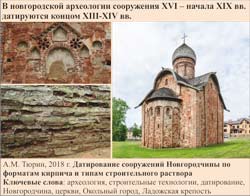
Dating buildings of Novgorod
Region according to brick formats and types of mortar
A.M. Tyurin
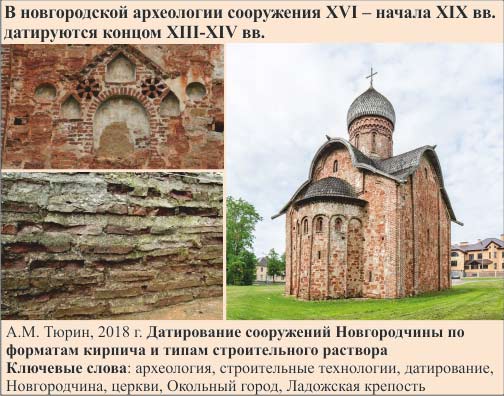
Keywords : archeology, building technologies, dating, Novgorodchina, churches, Okolny town, Ladoga fortress.
1. Statement of the problem
One of the conceptual methodological foundations of the New Chronology A.T. Fomenko and G.V. Nosovsky is the thesis: “Chronology is an independent natural science discipline.” Its component – the dating of the technologies of Civilization, is still very poorly developed. The problem is that ideas about the evolution of technology are formed within the framework of traditional history and are tied to the chronology adopted in it. But there are opportunities for the development of independent technology dating. Firstly, technologies are studied not only by historians and archaeologists, but also by specialists who may have their own ideas about the chronology of the stages of their evolution. Secondly, the technologies themselves can be dated by independent natural science methods – radiocarbon, thermoluminescent, archeomagnetic, dendrochronological.
The authors of the New Chronology substantiated the hypothesis “The Great Novgorod Russian Chronicles is Yaroslavl” [Nosovsky G.V., Fomenko AT, 2001; 2012]. For us its following elements are important. A settlement on the site of Novgorod on the Volkhov arose around the 15th century, possibly in the 16th century. In the 17th century, during the war with Sweden, a small fortress was built here. The identification of Veliky Novgorod with a settlement on the Volkhov is not an accidental mistake, it is a deliberate falsification. Its main element is the displacement of the chronological component of the archeology of Novgorod on the Volkhov by 400-500 years in an earlier period. According to our version – for the year 391 [Tyurin, 2017]. It seems reasonable to test the hypothesis on building technologies.
2. Brick Formats
Plinfa Novgorod monuments of the XI-XIII centuries. well studied and refers to the same type of molding [Yolshin, 2013]. In Russia, it was used until the XV century. In 1475, the Aristotelian brick appeared [Caddo, 2017]. Information on its size in publications is fundamentally different. The publication [Chernikova, 2011] states that the master from Italy, Aristotle, began to manufacture bricks of the “Lombardy standard” – 24 × 12 × 6 cm. Another size of the “Aristotelian brick” is given in the publications [Danilova, 1991] (29 × 11 × 7 cm ) and [Caddo, 2017] (28.9 × 18.9 × 6.7 cm).
Brick formats in subsequent epochs: Boris Godunov’s “Sovereign Brick” – 31.2 × 13.4 × 8.9 cm (proportions: 7 × 3 × 2); state-owned plants of the Peter epoch – 28 × 14 × 7 cm (proportions: 4 × 2 × 1); The “town” brick (second half of the 18th century) – 27 × 13 × 6.7 cm; 1811 standard – 26.6 × 13.3 × 6.7 cm [Caddo, 2017]. These are wooden frame formats for molding clay. After drying and firing, a brick was obtained, the dimensions of which are 5–15% smaller than the frame dimensions. It is noted that in this case the proportions of the brick are also violated. According to others, the shrinkage of clay in the manufacture of plinfs is 8-10% [Moiseev, 2013, p. 187]. In 1847, the standard of baked brick was introduced – 26.6 × 13.3 × 6.7 cm [Caddo, 2017]. The modern standard since 1927 – 25 × 12 × 6.5 cm.
In the walls and towers of the Moscow Kremlin (1485-1490s), the basic brick formats are 30 × 14 × 7 and 31 × 15 × 9 cm [Danilova, 1991]. The publication [Nosov, 2009] reports the following: “a large brick is a characteristic feature of the serf architecture of the XVI-XVII centuries. … varied greatly in size. The most typical size was 30 × 14 × 8 and 30.5 × 14.5 × 7.5 cm. By order of Boris Godunov standardization of bricks was introduced … sizes 7 × 3 × 2 heads (31.5 × 13.5 × 9 cm) … during repair work of the 18th – early 19th centuries. brick was used … (6 × 3 × 1.5 inches, or 27 × 13.5 × 6.8 cm) ”(p. 154). Here we are not talking about shrinkage. The sizes of real bricks of Russian fortresses of the XVI-XVII centuries are given.
During the excavations in 1933-1935. inside St. George’s Cathedral St. George Monastery of Novgorod, under the cast-iron floor of 1825-1827. found a pavement of bricks. Their sizes are 28 × 13 × 8 and 23 × 11 × 4 cm [Karger, 1946]. In the early 20s of the XIX century. the monastery burned to the ground (except St. George’s Cathedral). In the years 1823-1848 was rebuilt again. When laying the cast iron floor, bricks from its disassembled buildings could be used. It is important for us that such formats were produced.
Thus, there is a clear periodization of Russian brick formats:
Plinfa – until the XV century. inclusive.
Formats end of XV-XVII centuries. (excluding Aristotelian bricks): 31.2 × 13.4 × 8.9; 30 × 14 × 7-8; 30.5 × 14.5 × 7.5; 31 × 15 × 9 cm
Formats XVIII – early XIX centuries: 28 × 13-14 × 7-8; 27 × 13 × 6.7; 26.6 × 13.3 × 6.7; 27 × 13.5 × 6.8 cm.
Standard since 1847: 26.6 × 13.3 × 6.7 cm.
Standard since 1927: 25 × 12 × 6.5 cm.
The local brick format of the Novgorod region is discussed below.
3. Types of mortar
Binding mortars Novgorodchiny well studied. Four groups are distinguished [Mednikova, Rapoport, 1991]. The first was applied only in the construction of the St. Sophia Cathedral (1045-1050). In it, the ratio of lime and aggregate is 1: 1. The filler is exclusively a cemyanka. Brick battle and specially baked clay in a 1: 1 ratio. The solutions of the second group (monuments of the first quarter of the 12th century) are close in composition to the first. But the number of brick fights in the cement pane noticeably predominates over the specially baked clay. In the solutions of the third group (monuments from the 30s of the 12th century to the beginning of the 13th century), cement brick in the form of brick and crushed limestone serve as the filler. Solutions of the fourth group (monuments of the XIV-XVII centuries) are fundamentally different from the first three. The filler in them is sand. The evolution of this type of solution is not observed. The earliest monument in which this type of solution is recorded is the Church of the Archangel Michael (1300). We note two lacunae – the second half of the XI century. and XIII century. without it. The presence of the first lacuna was also noted by the author of the publication [Yolshin, 2013]: “the gap in tradition between the construction of the [Sophia] Cathedral in the middle of the XI century and the resumption of Novgorod architecture at the beginning of the XII century. obvious. ” The second lacuna is noted in the publication [Antipov, 2017]: “in conditions of almost complete cessation of construction in Novgorod in the second half of the 13th century.” and the resumption of Novgorod architecture at the beginning of the XII century. obvious. ” The second lacuna is noted in the publication [Antipov, 2017]: “in conditions of almost complete cessation of construction in Novgorod in the second half of the 13th century.” and the resumption of Novgorod architecture at the beginning of the XII century. obvious. ” The second lacuna is noted in the publication [Antipov, 2017]: “in conditions of almost complete cessation of construction in Novgorod in the second half of the 13th century.”
The specification of the lower chronological boundary of the solutions of the fourth group was made by the authors of the publication [Antipov, Gervais, 2015]. “Pp. 58, mortars with sand” (p. 58). The first monument, the construction of which used this solution – the Church of St. Nicholas on Lipne (1292, the delta of Msta). One of the authors, the above-mentioned publication reviewed the data on bricks and mortars in the context of the evolution of building technologies. “Despite the fact that the overall structure of church buildings does not fundamentally change from the pre-Mongol time, a large number of technological and structural innovations in architecture in the 1290-1310s. clearly indicates the transfer of new receptions to Novgorod from other construction centers, probably
The author of the publication [Nosov, 2009] studied building mortars of Russian fortifications of the XVI-XVII centuries: Nizhny Novgorod (1500–1517), Kolomna (1525–1531) Zaraisk (1528–1531), Serpukhov (end 1550- s), Borisov town (1598), Smolensk (1596-1602) and Vyazma (1631-1634). His conclusion: “all 13 building mortars of Russian fortresses of the XVI-XVII centuries. are lime-sandy, i.e. differ sharply from the generally calc-cement solutions of the 11th-13th centuries ”(p. 159). Note the lacuna between the XIII and XVI centuries. The first fortress, the construction of which used lime-sand mortar – the Kremlin of Nizhny Novgorod (in the Moscow Kremlin, we do not have the relevant data). The first appearance of brick in Russia – 1475. It is logical to assume that a new building technology (brick + lime-sand mortar) appeared in Russia at the end of the 15th century. In this assumption, we rely on data for the Novgorod region. Brick and lime-sand mortar appeared here simultaneously at the turn of the XIII – XIV centuries. According to the results of our dating, this happened at the turn of the XV and XVI centuries. By the lime-sand type of mortar, one of the stages of the construction of the Nikolsky Cathedral of the Old Ladoga Nikolsky Monastery is dated. “The vaults, the drum, the overlapping of the sub-church, the upper parts of the domed columns are made on a solution without cemyanka, apparently, in the XVI-XVII centuries.” [Kirpichnikov, 1976, p. 18]. By the lime-sand type of mortar, one of the stages of the construction of the Nikolsky Cathedral of the Staraya Ladoga Nikolsky Monastery is dated. “The vaults, the drum, the overlap of the sub-church, the upper parts of the domed columns are made on a solution without cemyanka, apparently, in the XVI-XVII centuries.” [Kirpichnikov, 1976, p. 18]. By the lime-sand type of mortar, one of the stages of the construction of the Nikolsky Cathedral of the Staraya Ladoga Nikolsky Monastery is dated. “The vaults, the drum, the overlapping of the sub-church, the upper parts of the domed columns are made on a solution without cemyanka, apparently, in the XVI-XVII centuries” [Kirpichnikov, 1976, p. 18].
Thus, in Russia, brick and lime-sand mortar appeared at the end of the 15th century. All structures of brick and on this type of mortar should be dated in the Moscow region – not earlier than the last quarter of the 15th century, and in the rest of Russia – not earlier than the 16th century. There is a possibility of more “narrow” dating in brick formats: XVI-XVII centuries, XVIII – beginning of XIX centuries. and XIX century.
4. Plinfa or brick?
In the formats of the Novgorod brick there is one problem. “A characteristic indicator of a brick of the middle – second half of the XV century. – its thickness is always equal to 5-5.5 cm. At the same time, the length varies from 24-25.5 cm to 29 cm, and the width from 12 to 13-14.5 cm ”[Antipov, 2005]. The format of the brick close to it, from which the friezes of the Belfry (XVI century) of the St. Sophia Cathedral are composed is 24 × 11 × 5 cm [Petrov, 2014, p. 94]. In 2011, excavations were carried out at the Nerevsky end of Novgorod. “In the filling of the buildings of the XVI century. found wastes from the production of bricks, the dimensions of which are 24.5-26 × 12-13 × 4.5-5.5 cm ”[Oleynikov, 2014, p. 234]. Above is the size of the brick from the floor of the St. George’s Cathedral of the Yuriev Monastery – 23 × 11 × 4 cm. The author of the publication [Pezhemsky, 2012] referred to the 16th-17th centuries brick format. and dated on it the tomb of the cemetery near Nikolsky Cathedral of Novgorod.
The sizes of plinths of Novgorod churches at the beginning of the XIII century: Panteleimon (1207) – 26 × 17-19 × 3.5-4.5 cm; Paraskeva Fridays on the Marketplace (1207) – 26-27 × 18-19 × 4-5 cm; St. Nicholas Cathedral in the Courtyard (window tab) (1210s) – 26-27 × 16-17 × 4.3-4.5 cm; Fridays on Bargaining (window tab) (1210s) – 24 × 11 × 4.5 cm; Michael the Archangel on Prusskaya Street (1219-1224) – 23.5 × 14.5 × 4.5 cm; Paul in the Pavlov Monastery (1224) – 27.5-28 × 13.5-14 × 5.5, 29.5-30 × 14-15 × 6-7, 24.5-26 × 18.5- 20 × 4-5.5 cm. The size of the plinths of the sarcophagi: the Church of the Annunciation Monastery on Myachin (1179) – 26-27 × 18-18.5 × 4.5, 26-27 × 18 × 4.5 cm; Panteleymon Monastery (1207) – 25-27 × 19-21 × 4-5.5 cm [Sedov, 2016]. In the last sarcophagus there was a plinth with dimensions of 25 × 21 × 6 cm.
The size of the plinths of the central dome of the St. Sophia Cathedral is 39 × 18.5-25 × 4 cm, the dome of the St. Nicholas Cathedral at the Yaroslav Yard (1113) 35-36-37 × 21-22 × 4.5-5 cm. The solution in both cases is calcified -cellulose [Trushnikova, 2015]. At the same time, in the Church of Paraskeva Pyatnitsa on Torgu (1207), a plinth of 25 × 11.5 × 4.5 cm was used. The plinth of the synthron of the Sophia Cathedral was 37 × 23 × 5 cm, the main format of the plinth of the Church of the Annunciation at the Settlement was 35 37 × 20-22 × 3.5-5 cm [Novoselov, Khrustalev, 2013]. The dimensions of the plinfs in the walls of the building and the bases of the domed columns of the Nikolsky Cathedral of the Staraya Ladoga Nikolsky Monastery are 20-29 × 13-24 × 4.5-6 cm [Kirpichnikov, 1976, p. 18]. Lime mortar with an admixture of crushed brick. According to the results of an excavation in 1988, a kiln for the production of quicklime was studied on the Rurik settlement. It is composed of plins on clay solution.
The problem is that some of the formats of products attributable to the beginning of the XIII century. It corresponds to the brick formats of the middle – second half of the 15th century. and XVI century. If they are identified as “plinf”, then it should be dated no later than the 15th century, and if they are “brick”, then it should be no earlier than the 16th century.
There is a testimony of 1617 about the Nikolskaya Church (1448) of the Mostischsky Monastery (located on the old Pskov road by the bridge across the Veriazhu River). Later it was dismantled. Its foundation was studied by the excavations of 2000-2001. The basic brick format is 29-30 × 13.5-14.5 × 5-5.5 cm, the additional one is 23-24 × 11-12.5 × 5-5.5 cm [Antipov, Bulkin, 2011]. Lime-sand mortar. By the type of mortar, the church was built no earlier than the 16th century. In 1559, the Gate Church of the Rodonezhsky Series was built above one of the entrances to Novgorod Detinets. “At the construction of the temple, a brick of 27 × 14.5 × 5.5 cm on lime-sand mortar was used” [Robezhnik, 2016, p. 123]. The solution corresponds to the date of construction of the church. The brick should be dated no earlier than the 16th century.
The information given in the previous paragraph, uniquely solves the indicated problem. On the Novgorod region there was a local brick format. Its distinguishing feature is a thickness of about 5 cm. In two sizes, this brick corresponds to other brick formats, and in height – a plinth. It began to be used, like the whole brick not earlier than the XVI century. The author of the publication [Antipov, 2005] dates it by the middle – the second half of the 15th century. The error in dating is small – about 50 years.
5. Dating by construction technology
5.1. Churches of Novgorod
Written evidence of Veliky Novgorod until the end of the XVI century. belong to Yaroslavl. We considered the technology of linking real structures of the Novgorod Region to them using the example of the Anthony Monastery [Tyurin, 2009]. We consider the testimony of 1617 about the Nikolskaya Church of the Mostischy Monastery to be authentic. When it is taken into account, the building dates from the 16th – early 17th centuries.
The publication [Antipov, Gervais, 2015] presents the results of the study of the Church of St. Nicholas on Lipno. Particular attention is paid to bricks. It is noted that “The Church of St Nicholas at Lipno is the first building [1292] in which the bar bricks were used” (p. 74). According to the early measurements (1959) the size of the bricks is 26-28 × 11.5-13.5 × 7.5-8.5 cm. According to the measurements of the authors of the publication – 28-28.5 × 13.5-14 × 7, 5-8 cm. The second possible format is 26-27 × 11.5-12.5 × 7.5 cm. Note that the results of measurements of the size of bricks differ from different authors. The main format corresponds to the standard of state-owned plants of the Peter the Great era: 28 × 14 × 7 cm. The second format is the standard of “town” brick – 27 × 13 × 6.7 cm. But the bricks of the church are slightly thicker than the bricks of these two formats. “The Church of St Nicholas at Lipno was well preserved until the Second World War” (p. 59). I.e, according to the authors of the publication, the church stood for almost 650 years. According to brick formats, the church was built in the first half of the XVIII century. Was being finished in his second half. Therefore, the building is well preserved until World War II. This church can be dated to the period of coexistence of two brick formats – the middle of the XVIII century.
The publication [Antipov, Gervais, 2015] shows the sizes of bricks of 16 churches of Novgorod region, dating from the end of the 13th – mid 14th centuries. By the lime-sand mortar all churches are dated to a period not earlier than the 16th century. We performed their identification and according to the formats of Russian brick (Table 1). The Church of St. Nicholas on Lipne is discussed above. Thirteen churches built of brick XVI-XVII centuries. Moreover, in the buildings of the churches of the Intercession of Shilov Monastery (1310), the Assumption on the Volotovo Field (1352), Michael the Archangel on the Skovorodka (1355), also in the house of Archbishop Vasil there is a brick of format XVIII – beginning of XIX. Perhaps this is the result of building renovation. The Church of the Archangel Michael and the Annunciation on the Marketplace is built of brick, the format of which is not identified by us. With some stretch you can take
Table 1. The size of the bricks of the Novgorod churches of the end of the XIII – the middle of the XIV centuries. [Antipov, Gervais, 2015, Tabl. one]

The publication [Gaidukov, 2011] shows the size of the brick of the Church of the Nativity on the Red Field of Novgorod (1381-1382) – 26-29 × 13-13,5 × 6-7 cm. This is the format of the XVIII – beginning of the XIX centuries. In the 1750s, the building of the Church of the Entry of the Lord into Jerusalem in Detinets Novgorod (1336-1337) was dismantled. The foundation was studied by the excavations of 2009. “The temple is made of slab, shell and large brick on a lime-sand mortar with coarse sand … Excavations in the interior were stopped at the level of a perfectly preserved fir-tree brick floor, previously dated XVII century.” [Gervais and et al., 2015, p. 89, 91]. He was attributed to a major repair of the church. According to the format of bricks when taking into account the given data, the church should be dated to the XVII century. Note that the authors of the publication for some reason did not give the size of the brick. “Construction of the XV century. folded from bricks of format 28-28,5 × 14-14, 5 × 5 cm on a white-gray lime-sand solution ”(p. 124). The data are given on the inside-wall stairs (XV century) of the gate temple of the Myachinsky monastery. In the gate church, the brick format is local (thickness 5-5.5 cm). Lime-sand mortar. The church dates from no earlier than the 16th century.
Thus, the brick formats and type of mortar are dated to the 18 churches of the Novgorod region, which belong to the end of the XIII-XIV centuries. and two – to the XV century. 17 churches were built in the XVI-XVII centuries. Three – in the XVIII – early XIX centuries.
Above are the churches and their individual elements, composed of plinfy. Among them are the churches of Panteleimon (1207) of Paraskeva Pyatnitsa on Torgu (1207) and Paul in the Pavlov Monastery (1224). They should be dated no later than the XV century. The same applies to churches and cathedrals built of stone and plinfs on a lime-cement mortar [Rappoport, 1982]: St. Sophia Cathedral (1045-1050), Boris and Gleb Church in Detinets (illuminated in 1173), Fyodor Church Stratelates on the Sophia Side (1115), Ivan’s Church in Opoka (1127-1130), Assumption Church in Torgu (1135), Nikolsky Cathedral (Nikolo-Dvorishchensky) in Yaroslav’s Court (1113), Elias Church on Slavna (1198), the Church of Peter and Paul on Sinichya Gora (1185), the Church of the Assumption in the Arkhozhsky Monastery (1188-1189), the Cathedral of St. George in the Yuryev Monastery (1119 .), Church of the Annunciation on the Settlement (1103), Church of the Savior Nereditsa (1198), Church of Cyril (1196), Spaso-Preobrazhensky Cathedral of the Khutynsky Monastery (1193). In our dating it is important that all these objects could be built in the XV century.
Thus, 17 churches XI-XII centuries. could be built in the period to the XV century. inclusive.
The building of the Church of the Nativity of the Virgin in the St. Anthony Monastery (1117-1119) “is composed of alternating rows of slabs and bricks. The format of bricks is 32.5–35 × 20.5–22 × 4.5–5 cm, but bricks with a width of 22.5 cm and a thickness of 7.5 cm are also widely used. In a masonry, narrow squared bricks are found – 26- 30 × І2-14 × 8-9 cm. A solution with a cossack ”[Rappoport, 1982]. That is, in the church buildings there are two plinfa formats. One standard, the second has a thickness, like bricks. There is also a brick corresponding to the format of the XVI-XVII centuries. Most likely, this is one of the first applications of bricks in the Novgorod region. The technology of building construction corresponds to that used until the 16th century. But with its implementation and used brick. This allows the church to give a narrow date – the turn of the XV-XVI centuries.
In the building of the Church of the Nativity of the Virgin in Peryn (first half of the 13th century) “The size of bricks is 24.5–26 × 18–20 × 4–5.5 cm, but there are also bricks 13 cm wide. A solution mixed with cement” [Rappoport, 1982] . Bricks with a width of 13 cm and a thickness of 4-5.5 cm are a local format used in the 16th century. This gives us a narrow date of construction of the church – the turn of the XV-XVI centuries.
The churches of Old Ladoga are discussed below.
There is one problem with our dating of churches. New building technologies appeared in the Novgorod region not necessarily at the end of the XV or the beginning of the XVI centuries. They could be first implemented in the region and at the end of the XVI century. This question needs special study.
5.2. Okolny city of Novgorod
In accordance with the views of archaeologists, the Okolny city of Novgorod is a fortification dating back to the end of the 14th century. It includes a shaft, an associated moat and more than 40 stone road towers. The twelve towers are studied by archaeological methods. The remains of another 20 structures are visible on the surface. The dimensions of the largest three towers are standard – 12.5 × 9.6 m. It is noted that “the towers were built before the shaft, and not embedded in the already existing embankment” [Gaidukov, 2011, p. 85]. There is also the absence of loopholes on their preserved ruins. The construction material is a red shell on a lime mortar with minimal use of bricks in responsible areas of the masonry (p. 78). The presence of brick towers unequivocally date to a period not earlier than the 16th century. The size of the bricks from the Konyukhovaya Tower is 26 × 14 × 7 cm, and from the Holopia – 26-29 × 13-13,5 × 6-7 cm. This is the format of the XVIII – early XIX centuries. The construction of the Okolniy town dates back to this period.
Our date of the Round City has a wonderful confirmation. This is the master plan for the construction of Novgorod, approved by Catherine II on June 16, 1778 (Fig. 1). In the caption there are projected objects. Among them, object number 6 – “trees and moats to restrict the city.” In the figure, the numbers “6” are circled in red.

Fig. 1 – General Plan for the construction of Novgorod in 1778 [Kushnir, 1991].
Information in color is applied by A.M. Tyurin. Explanations are given in the text.
We have previously reviewed the cartographic data for Novgorod [Tyurin, 2009-b]. The question is confusing. Perhaps the Swedish plans of Novgorod XVII. fabricated in the late XIX – early XX centuries. For example, the Swedish plan of 1611 was found and first published in 1911. But the plan of 1778 did not come to our attention at that time. It was compiled in accordance with the decree of 1763 “On the transaction for all cities, their structure and the streets of special plans for each province separately” [Kushnir, 1991]. The author of the publication states: “The restrictive ramparts envisaged in the plan of 1778 outside the ancient part of the city were not implemented, and they are not shown on the plan of 1834”. But the plan of 1834 is not given in the monograph. And in another publication by the author [Kushnir, 1959], the plan of Novgorod in 1778 is given in a simplified form. The projected shafts on it are not shown. Conventions are not readable. The question of building shafts in accordance with the plan in 1778 is decided unequivocally. The ramparts and towers of the Okolniy town are shown in the diagram in the publication [Gaidukov, 2012]. The actual position of the shafts corresponds to the planned.
The okolny city of Novgorod is a typical building around Russian cities of the 18th-19th centuries. The projected ramparts and moats to restrict the city are shown on plans approved in 1777-1979. for provincial and district cities: Kozelsk, Tarusa, Medyn, Pskov, Zhizdra, Meshchovsk, Borovsk, Likhvin, Maloyaroslavets, Mosalsk, Peremyshl, Tula, Serpeysk and others. The Okolny town was built according to the plan of 1778. Taking into account our dating of this object by brick format – at the end of the XVIII – beginning of the XIX centuries. What archaeologists consider to be towers are outposts. They monitored the movement of people and goods from and to the city. The plan shows only driveways. There are nine of them (marked with blue squares in the picture). Perhaps, in reality, the driveways were built on the continuations of other streets (shown in the figure with blue arrows). There are 13. of them. That is, there should be about 21 ruins of the “towers”. Archaeologists have studied twelve. Ditches behind the shafts at the same time were hydraulic structures. On the high water they “unloaded” the course of the Volkhov. The position of the “towers” is shown in the diagram in the publication [Gaidukov, 2012]. But there are no symbols on it.
Our dating and identification of what is called the Roundabout City is a killer argument, destroying the very basis of Novgorod archeology. To prove that the ramparts and moats of Novgorod were not built according to the general plan of the 18th century is impossible.
5.3. Structures on the territory of Novgorod Detinets
In 2006-2012. a large-scale restoration of the Vladychnaya (Faceted) Chamber in the territory of Novgorod Detinets was carried out. In the course of these works, archaeological excavations within it were also carried out. Found the remains of the basement floors of buildings. When building them used brick. “In the masonry arch there are two types of bricks: smooth light red bricks in 1433 (27-28 × 12-13 × 6.5 cm) and dark red bricks with sand sprinkling, by all indications – this is a brick of the first half – middle XIV century. (28-29.5 × 14-14.5 × 7.5-8 cm) ”[Antipov, 2015, p. 49]. Brick “1433” corresponds to the formats of the XVIII – early XIX centuries. The brick of this format is 27 × 14 × 6.5 cm, and it has been revealed in another laying. The brick of the “mid-fourteenth century.” Corresponds to the formats of the XVI-XVII centuries. In all studied masonry, lime-sand mortar was used. Formally, the basement floors of buildings should be dated to a period not earlier than the 16th century. However, a narrower dating is possible – the period of coexistence of two brick formats – the beginning of the 18th century.
The authors of the publication [Mednikova, Rapoport, 1991] date the Belfry of the St. Sophia Cathedral of Novgorod in the 16th century, and the rebuilding of the 1980s in the 17th century. The mortar is lime-sandy. When considering its architectural features, the author of the publication [Petrov, 2014, p. 94] cited the size of the brick “pillars, which belong to the XVI century. no doubt ”- 27 × 13 × 9 cm. This brick corresponds to the“ city ”brick, but is thicker. With some stretch, the belfry columns should be dated to the second half of the 18th century. “In the pre-war literature there were different opinions on the dating of the belfry and its parts (1431, 1453, 1530, 1550–1560, XVII – XVIII centuries)” (p. 83). It looks like those who put the belfry in the XVIII century are right.
5.4. Dating buildings Old Ladoga
Above, we noted that written evidence of Novgorod before the end of the 16th century. belong to Yaroslavl. But this aberration of Traditional History does not apply to Old Ladoga. Therefore, when dating the Ladoga churches, we will take them into account.
“Information about the existence of the Assumption Monastery in Ladoga“ on the tenements ”dates back to the end of the 15th century. The church of this monastery was repeatedly repaired and rebuilt, but it was completely preserved in all the main parts. … built of limestone slabs with layers of bricks. The size of bricks is 30–32.5 × 17–18 × 4.5–5 cm. The solution is lime-cement. The floor is made of lime mortar with cement mortar ”[Rappoport, 1982]. By architectural forms and building technologies, the church is assigned to the middle – second half of the 12th century. Based on our dating, the construction technologies of plinf and lime-cement mortar were used until the XV century. inclusive. When recording written evidence, the church dates from the end of the 15th century. Note that in publications plinf often called a brick. Therefore, in the quotes cited by them, it is necessary to focus on its size.
“The Savior Church in the city of Ladoga … has been known from written sources since 1500; however, it was already, apparently, not an ancient church, but a later, wooden one. The church was built of limestone slabs and bricks on mortar and cement mortar. The size of the bricks is approximately 31 × І8 × 4.5 cm ”[Rappoport, 1982]. Dated XII – the first half of the XIII century. Our date of construction of the stone church – the very end of the XV century.
In the middle of the XV century. The church of St. George was first mentioned in connection with its renovation, which was timed to the foundation of the St. George Monastery. Its walls are made of alternating rows of limestone slabs and bricks, with a predominance of slabs. Mortar mortar with cement work. The size of bricks is 30–31 × 17–19 × 4.5–5.5 cm ”[Rappoport, 1982]. Dated to the XII century. Our date is no later than the first half of the 15th century.
“St. Nicholas Monastery in Ladoga is mentioned in sources from the end of the 15th century. At the beginning of the XVII century. the church of this monastery was already dilapidated; it was restored in the middle of the seventeenth century. … The walls of the ancient church are made of slabs with layers of bricks on mortar with a mixture of cement. The size of the bricks is 26-27 × 17-18 × 6.5-7 cm. ”[Rappoport, 1982]. According to others, the size of the plinths is 20-29 × 13-24 × 4.5-6 cm [Kirpichnikov, 1976, p. 18]. The ancient church dates from the second half of the XII – the first third of the XIII century. The above is a quotation from [Kirpichnikov, 1976]. The upper part of the church building is built on a solution without a cemyanka. The author suggested that this was done in the XVI-XVII centuries. We agree with that. And the beginning of the construction of the church should be placed at the very end of the XV century. That is, its construction began using lime-cement mortar,
The stone church of Clement in the Earthen town was founded in 1153. But in 1646 in a written certificate it is shown as wooden. From the excavations of 1912-1913, 1938-1939 and 1979-1980. in the town of Earthen, the ruins of a stone church have been studied. “The walls of the building were erected from slabs with laying bricks on the mortar admixture. … bricks of varying firing quality; their size is approximately 32–33 × 20.5–21.5 × 4.7–5 cm. Narrow bricks (12–16 cm wide) and triangular-faced bricks were found in small quantities ”[Rappoport, 1982]. We have previously reviewed the results of excavations in the Earthen City [Tyurin, 2018]. The number of absurdities among archaeologists goes far beyond the reasonable limits of healthy fantasies. In the publication [Rappoport, 1982] one more was added to them. Archaeologists do not doubt the chronicle date of construction of the church. “The foundations are tape, about 1.5 m deep. They are embedded in the cultural layer and do not reach the mainland, they consist of boulders laid on the solution. ” That is, in their opinion, in 1153 the thickness of the cultural layer in the Earthen city already exceeded 1.5 m. According to archaeological data (with careful work with them), the Church of Clement dates back unequivocally. “Probably, in the XV century, but, of course, not earlier, … there emerges the undeveloped paved cathedral square (the pavement we opened)” [Ravdonikas, 1945]. In our opinion, the pavement can be dated to the XVI century. This is the date of construction of the stone church. Dating by construction technology – no later than the 15th century. General date – XV century. According to archaeological data (with careful work with them), the Church of Clement dates back unequivocally. “Probably, in the XV century, but, of course, not earlier, … there emerges the undeveloped paved cathedral square (the pavement we opened)” [Ravdonikas, 1945]. In our opinion, the pavement can be dated to the XVI century. This is the date of construction of the stone church. Dating by construction technology – no later than the 15th century. General date – XV century. According to archaeological data (with careful work with them), the Church of Clement dates back unequivocally. “Probably, in the XV century, but, of course, not earlier, … there emerges the undeveloped paved cathedral square (the pavement we opened)” [Ravdonikas, 1945]. In our opinion, the pavement can be dated to the XVI century. This is the date of construction of the stone church. Dating by construction technology – no later than the 15th century. General date – XV century.
The Tale of Bygone Years contains the date of commencement of the construction of the stone fortress in Ladoga – 1114. It was not possible to find its ruins. It was assumed that the fortress was built on a cape formed by Volkhov and Ladoga flowing into it (its dimensions are 85 × 175 m). But later (according to the conclusion of PA Rappoport at the end of the XV – the beginning of the XVI centuries) another fortress of the “artillery” period with five powerful towers was built on this place. According to the results of the excavations of 1972-1973. Archaeologists announced that they had found the wall of the fortress in 1114 “from limestone slabs laid on a dense light gray lime-sand solution mixed with a glassy volcanic substance” [Kirpichnikov, 1977, p. 422]. There are no options here. Lime-sand mortar is not earlier than the end of the 15th century. The remains of the wall belong to the fortress of the late XV – early XVI centuries. Glassy volcanic matter is not an impurity in solution, but a pyroclastic component of sand. Here we take the date of construction of the fortress, determined by archaeologists. But we note that the creation of a powerful fortress on Ladoga should be tied to one of the wars in the Baltic region. Most likely, the construction of the Ladoga and Novgorod fortresses was completed at the same time – presumably in the second half of the 16th century.
Thus, according to brick formats, the type of mortar and written evidence, there are five churches of Old Ladoga, dated back to the 12th century. – the first half of the XIII century. One was built in the 15th century, three at its end, and one no later than the first half of the 15th century. Ladoga fortress was built at the end of the XV – beginning of the XVI centuries. The ruins of the chronicle fortress of 1114 were not found by archaeologists.
6. General conclusions
1. On the basis of general information, the results of the study of the churches of the Novgorod region and Russian fortresses, elements of the technology of building plinths and bricks in Russia have been reconstructed. Brick appeared at the end of the XV century. Before construction was carried out from plinfy. At the same time, lime-cement mortar was replaced by lime-sand. In Novgorod archeology, these changes in construction technology date back to the 14th-14th centuries.
2. The brick formats of the end of the XV-XVII centuries, XVIII – beginning of the XIX centuries are highlighted. and XIX century.
3. The principal possibility of dating the structures on these technological elements of construction is shown.
4. Hypothesis of the authors of A.T. Fomenko and G.V. Nosovsky – “The Great Novgorod of the Russian Chronicles is Yaroslavl”, received further confirmation. In the Novgorod archeology of the construction of the XVI – early XIX centuries. date from the end of the XIII-XIV centuries.
Literature
Antipov I.V. Novgorod architecture of the time of the archbishops Euthymius II and Iona Otensky. Abstract for the degree of candidate of art history. St. Petersburg, 2005.
Antipov I.V. Novgorod Vladychny yard in the XIV-XV centuries. New data and perspectives of study // Novgorod historical collection, 2015, № 15 (25), p. 45-57.
Antipov I.V. Changes in the Novgorod construction equipment and technology at the turn of the XIII-XIV centuries. (according to archaeological and restoration research) // Stratum plus: Archaeology and Cultural Anthropology, 2017, No. 5, p. 173-186.
Antipov I.V., Bulkin V.A. St. Nicholas Church of the Mostischsky Monastery, 1448. // Architectural Heritage, 2011, No. 54, p. 31-46.
Gaidukov M.P. Stone towers of the 14th century City of Veliky Novgorod: unpublished materials and new research // Russian archeology, 2011, № 4, p. 77-88.
Gaidukov M.P. Necklace of Veliky Novgorod // Motherland, 2012, No. 2, p. 35-38.
Danilova L.I. Stone, clay and fantasy. Moscow: The Enlightenment, 1991, 239 p.
Gervais A.V., Antipov I.V., Bulkin V.A., Rodionova M.A. Studying c. Entry of the Lord into Jerusalem in Veliky Novgorod (1336-1337) // Archaeological discoveries, 2015, T. 2010-2013, p. 30-32.
Yolshin DD Technological features of the Novgorod pre-Mongolian plinths // Bulletin of the St. Petersburg University, Ser. 2. – History, 2013, No. 3, p. 92-97.
Kaddo M.B. Standardization of brick sizes // Successes of Modern Science, 2017, Vol. 4, No. 1, p. 74-76.
Karger M.K. Excavations and restoration work in St. George’s Cathedral of the Yuriev Monastery in Novgorod // Soviet Archeology, 1946, Vol. 8, p. 175-222.
Kirpichnikov A.N. Architectural and archaeological discoveries in Staraya Ladoga // Archaeological discoveries of 1975, 1976, p. 18-19.
Kirpichnikov A.N. Ladoga and Pereyaslavl Yuzhny – the oldest stone fortresses in Russia // Monuments of Culture, New Discoveries, Yearbook, 1977, p. 417- 427.
Kushnir I.I. Urban planning in Novgorod in the second half of the 18th – first half of the 19th centuries. // Novgorod historical collection, 1959, Vol. 9, p. 155-170.
Kushnir I.I. Architecture of Novgorod. L: Stroyizdat, 1991, 240 p.
Mednikova E.Yu., Rapoport PA Building solutions of ancient Novgorod // Soviet archeology, 1991, № 4, p. 102-107.
Moiseev D.A. Medieval plinth of the Mangup Settlement // Antiquities, 2013, Vol. 12, No. 12, p. 179-192.
Nosov K.S. Building solutions of Russian fortresses of the XVI-XVII centuries. // Russian archeology, 2009, № 1, p. 152-161.
Nosov E.N., Gorbnova V.M., Plokhov A.V. The settlement near Novgorod and the settlements of Northern Priilmenye. St. Petersburg: “Dmitry Bulanin”, 2005, 403 p.
Novoselov N.V., Khrustalev D.G. From Annunciation to Sofia or vice versa? (on the problem of the initial stage of monumental construction in Novgorod) // Novgorod historical collection, 2013, No. 13 (23), p. 20-47.
Nosovskiy G.V., Fomenko A.T. New chronology of Russia, England and Rome. Moscow, Business Express, 2001.
Nosovskiy G.V., Fomenko A.T. New chronology of Russia. Moscow, AST, 2012.
Oleynikov OM Archaeological research in the northern part of the Nerevsky end of Veliky Novgorod (Doslansky excavation) // Archeology and history of Pskov and Pskov land, 2014, No. 29 (59), p. 225-234.
Pezhemsky, DV, The Archeological Appearance of Veche Squares in Veliky Novgorod // Disputes on the Novgorod Veche: Interdisciplinary Dialogue. Round table materials (European University at St. Petersburg, September 20, 2010). SPb .: EUSPb, 2012, p. 162-186.
Petrov D.A. On the architectural forms of the XV and XVI. The belfries of the Novgorod Sophia Cathedral: Archbishop Evfimy Vyazhischsky and Archbishop Macarius // Ancient Rus. Questions of medieval studies, 2014, No. 1 (55), p. 83-96.
Ravdonikas V.I. Staraya Ladoga // Brief Reports of the Institute for the History of Material Culture, 1945, Vol. XI, p. 30-41.
Rappoport P.A. Russian architecture of the 10th – 13th centuries Catalog of monuments. L., Science, 1982, 136 p.
Bogey L.V. Gate Temples of Veliky Novgorod // Bulletin of Novgorod State University. Yaroslav the Wise, 2016, No. 3 (94), p. 122-126.
Sedov V.V. Plinths sarcophagus in the Cathedral of the Novgorod Panteleimon Monastery // Russian Archeology, 2016, No. 1, p. 51-59.
Trushnikova A.V. Vaulted constructions in the pre-Mongolian architecture of Novgorod // Bulletin of St. Tikhon’s Orthodox Humanities University. Series 5: Questions of the history and theory of Christian art, 2015, No. 4 (20), p. 37-53.
Tyurin A.M. Dating of two Anthony monasteries // Electronic collection of articles “New Chronology”, 2009, Vol. 10. [ New chronology ]
Tyurin A.M. Reconstruction of the settlements of Nerevsky and Zagorodny of the Novgorod ends according to archaeological, geological and cartographic data // Electronic collection of articles “New Chronology”, 2009-b, Vol. 10. [ New chronology ]
Tyurin A.M. Dating the Novgorod dendroscale by global short-period climatic signals // Electronic collection of articles “New Chronology”, 2017, Vol. 14. [ New chronology ]
Tyurin A.M. Norman theory: anthropological aspect // Electronic collection of articles “New Chronology”, 2018, Vol. 15. [ New chronology]
Chernikova T.V. The beginning of the Europeanization of Russia in the time of Ivan III // Bulletin of MGIMO University, 2011, № 5, p. 107-115.
Antipov I., Gervais A. The bricks from St. Nicholas building tradition // Estonian Journal of Archaeology, 2015, V. 19, No. 1, p. 58-79.
 Hidden History Research