
8. RED Sagittarius Caftans and Ottoman half-moon with a star on the emblems of the old owners of the Schillon castle in Switzerland.
SM Burygin, who visited the castle in 2000, turned our attention to the ancient emblems of the famous Chillon Castle (Chillon). Then, in 2013, TNFomenko and ATFomenko themselves visited Chillon Castle and found many more interesting things. And now we will tell about it.
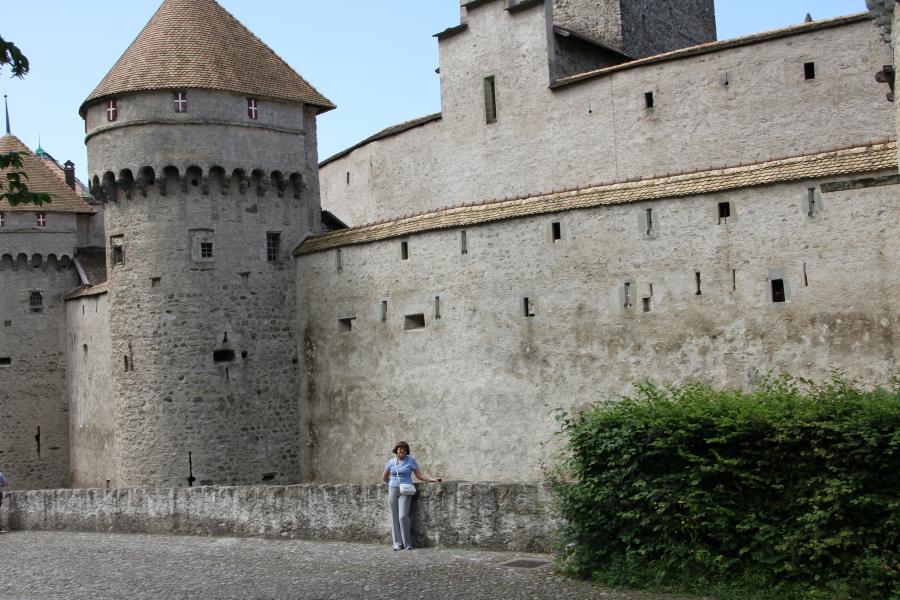
Chillon Castle is located in Switzerland, in the canton of Vaud, on the shores of Lake Geneva, on the outskirts of the city of Montreux.


It is believed that it was built in the XI-XII centuries. The first mention of the castle in chronicles is attributed by historians to the supposedly 1150 year [992: 00], p.6. The castle is about 100 meters long and about 50 meters wide. It was the largest castle in the possession of the Savoy House (Savoy) [992: 00], p.18.

 .
.
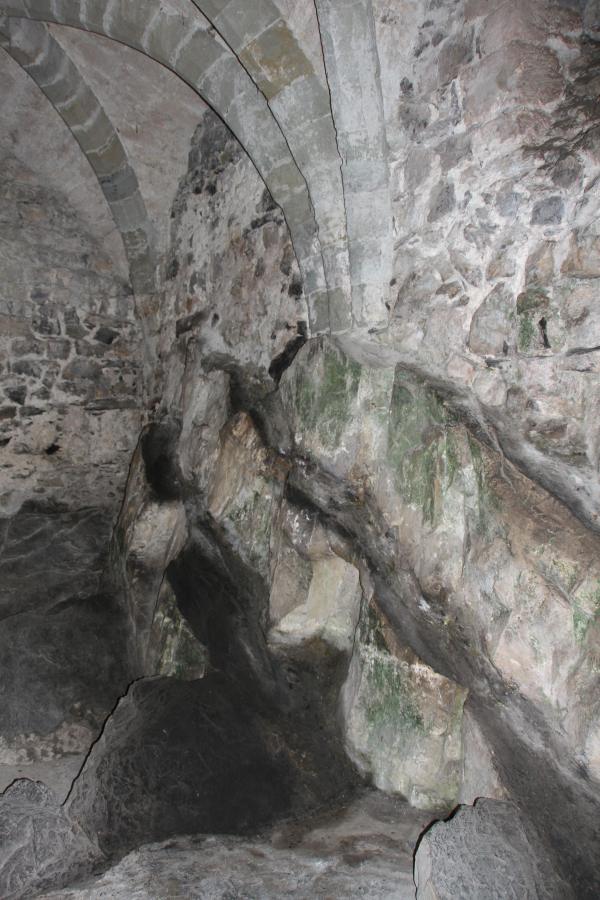
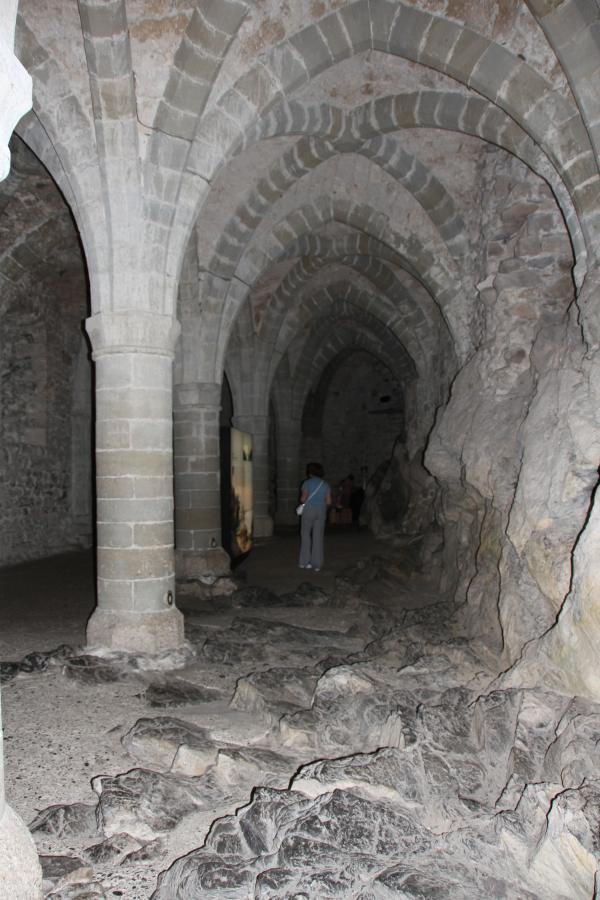
The castle is built on a rocky island, the towers, walls and basements of the fortress are skillfully embedded.
 .
.
Sometimes the cellars of the castle served as a prison and place of execution.
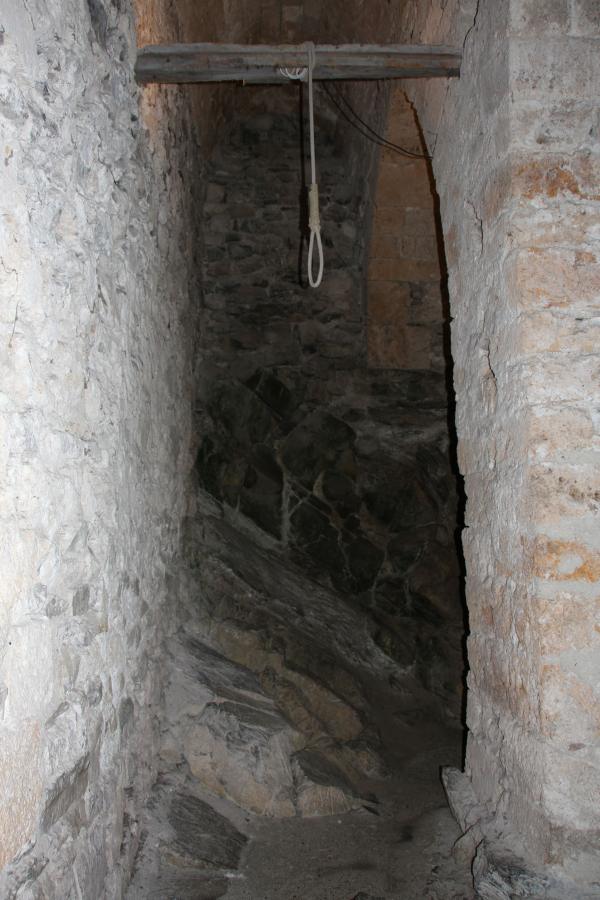 .
.
At one time, Chillon controlled the path to Italy, which determined the crucial importance of this ancient castle in medieval European history. It was he who was glorified by Lord Byron in the poem “Chillon Prisoner”, written in 1816 during a pilgrimage to the places described by Rousseau [1064: 1], [992: 00], p.9. The poet told about the imprisonment in the basement of the castle of François Bonivard (1493-1570). A memorial plaque attached to a wall of the cellar of Chillon’s castle is also visible on the Byron castle visit.
A modern guide informs: “Chillon Castle is a unique architectural ensemble of 25 buildings … from the side of the mountains the castle looks like a fortress, and from the side of the lake it looks like a princely residence … halls of the castle: Señora Hall, Holiday, Stamp and Grafsky halls … the chapel of St. George with magnificent medieval frescoes … the richest collections of furniture, objects of applied art from tin and ancient weapons.
Chillon rocky plateau has long been strategically important because it is located on its way to Italy through the Great St. Bernard Pass. The time of construction of the oldest parts of the castle is not precisely established. The fortress expanded in stages, until the middle of the XII century, when the castle passed to the Counts of Savoy. The modern look of the castle was formed in the XIII century during the reign of Tom I of Savoy (both dates are Scaligerian, in fact, the castle was probably built no earlier than the XIV century – Auth.) … seniors. At this time, the castle becomes the residence of the balla. In 1798, Chillon was freed from the domination of Bern “[1064: 1].
Thus, historians divide the history of the castle into three periods: 1) the Savoy period from the XII century to 1536, 2) the Berne period from 1536 to 1798, 3) the Voduaz period from 1798 to the present day.
And now the fun part. In one of the halls of the Chillon Castle, nicknamed today Gerbov, on the walls are the emblems of its ancient owners of the XVI-XVIII centuries. That is, the Bernese rulers of the castle, since the Chillon castle was the property of the Bernese lords from 1536 to 1798 [1064: 1]. A general view of the large Armorial Hall.
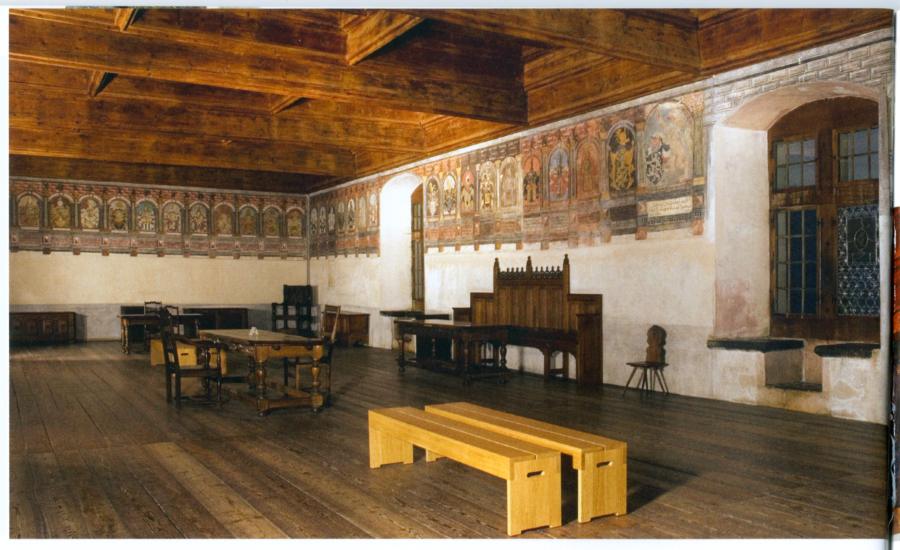
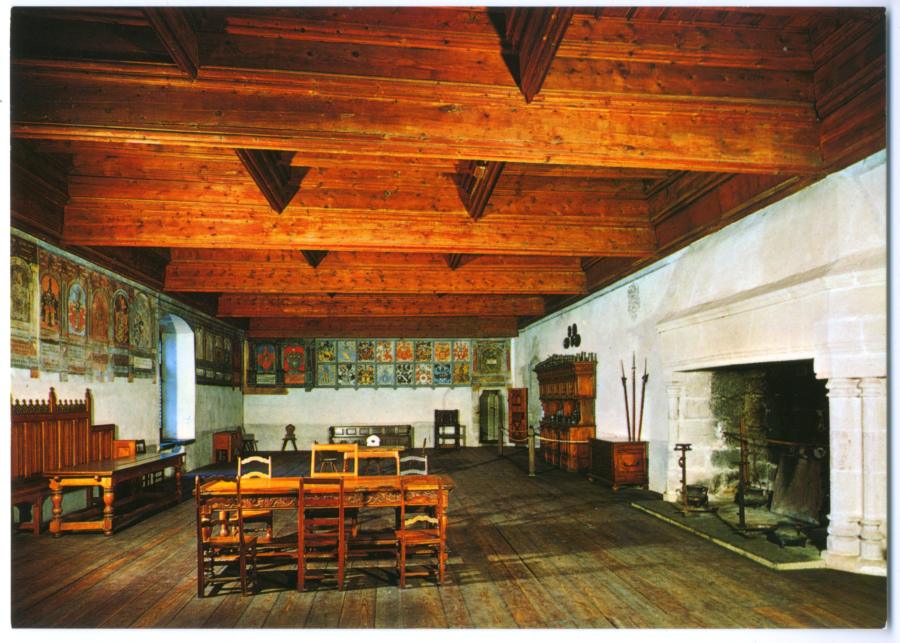
Historians report: “During the Bern period, it was the only MAIN hall of the castle, sparkling with its medieval splendor, worthy of the ceremonies held for it. Its high status was emphasized by the remarkable wall paintings of the 16th century … especially the frieze with multi-colored coat of arms replenished over the centuries. This series of coats of arms … recalls the Bernese balles that served in Chillon, and is the most fully preserved collection in the whole canton … These works were interrupted by but, in connection with the transfer of bali in Vevey in 1733 … The coats of arms of the dignitaries who served from 1711 to 1798 are arranged in two rows.
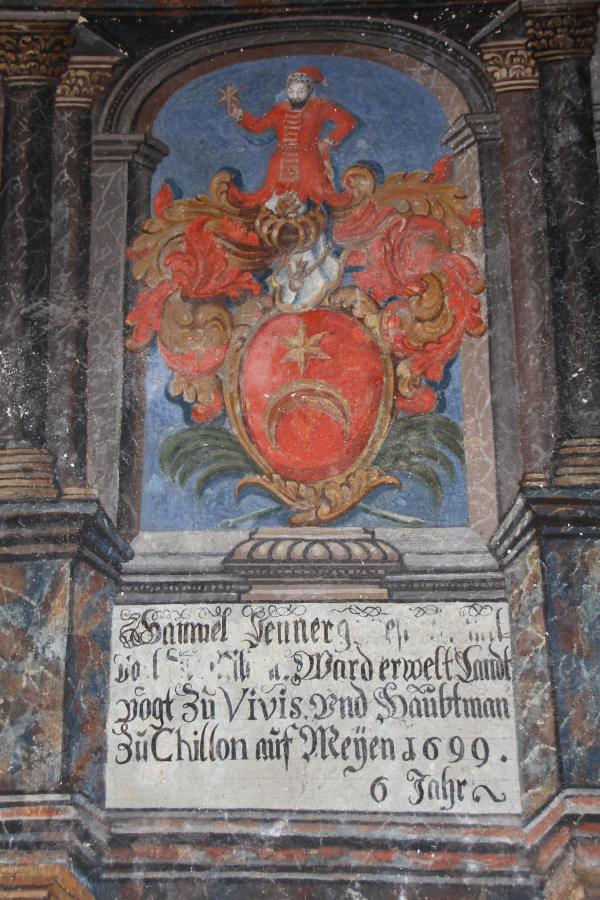
 , ris.8.36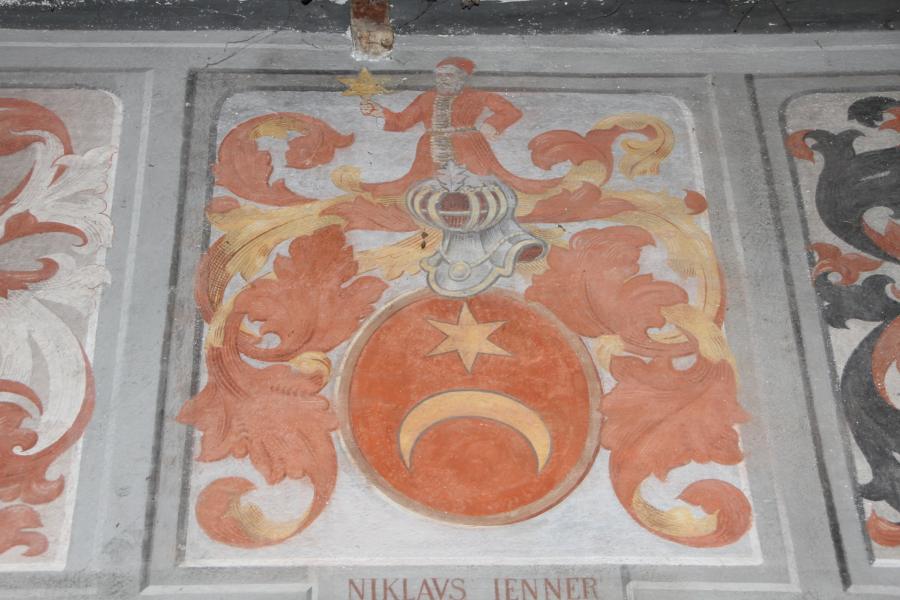
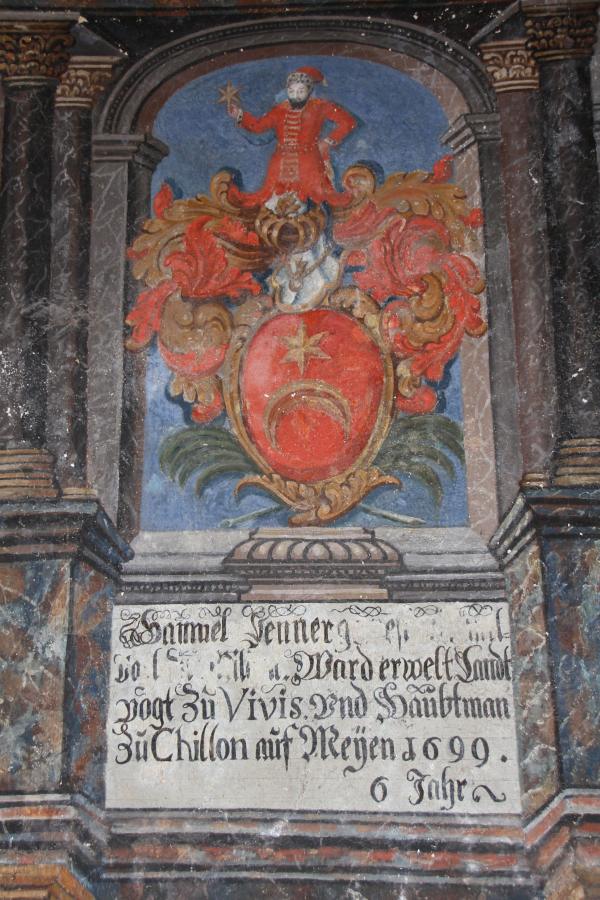
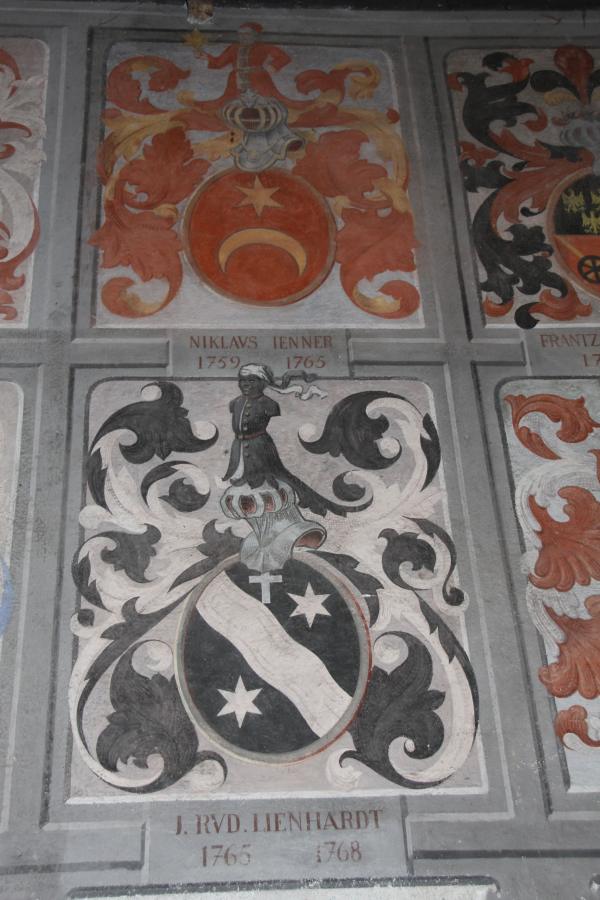
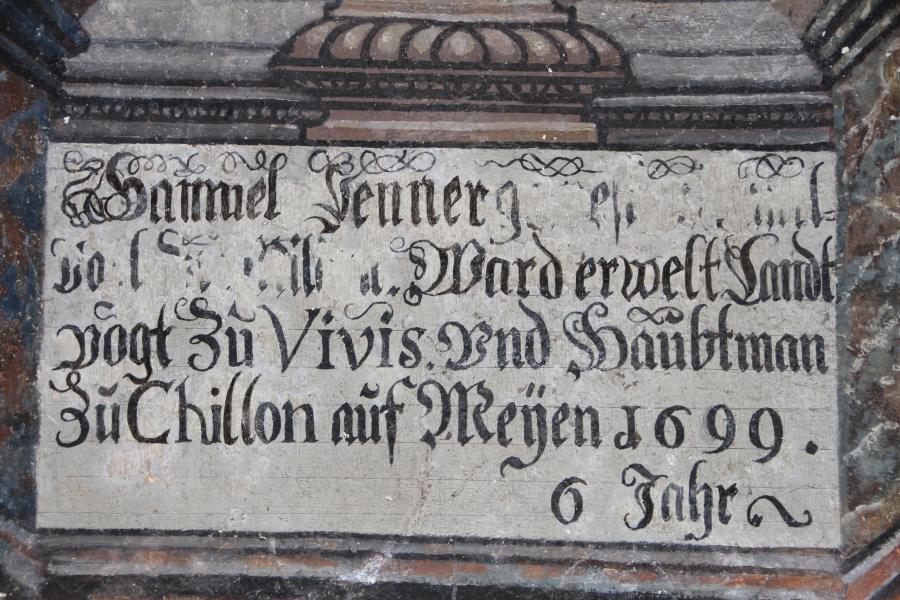
We give two arms, which immediately struck us as soon as we entered the Armorial Hall. Under one of them is the date of 1699, that is, the very end of the XVII century,
Under another – the name NIKLAVS IENNER and the date 1759-1765, that is, the middle of the XVIIIc.
By the way, the inscription under the first emblem is damaged. The year is preserved, and in the first and second lines of it something has been rubbed off. A few words today can not be read.
 .
.
It is very interesting that ON BOTH CEREBLES A PICTURE IS PERSON IN RUSSIAN RED Sagittarius CAFTAN AND IN RUSSIAN CAP.
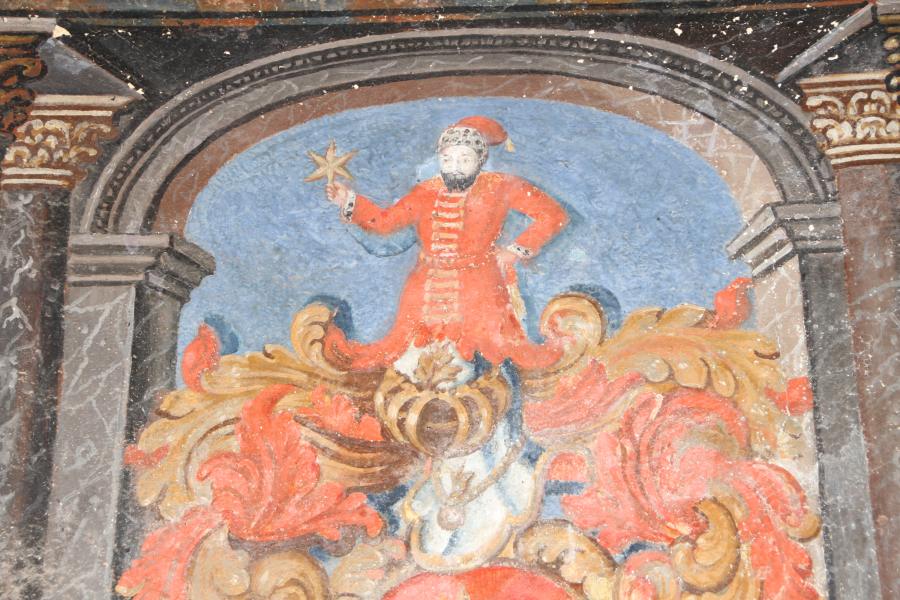
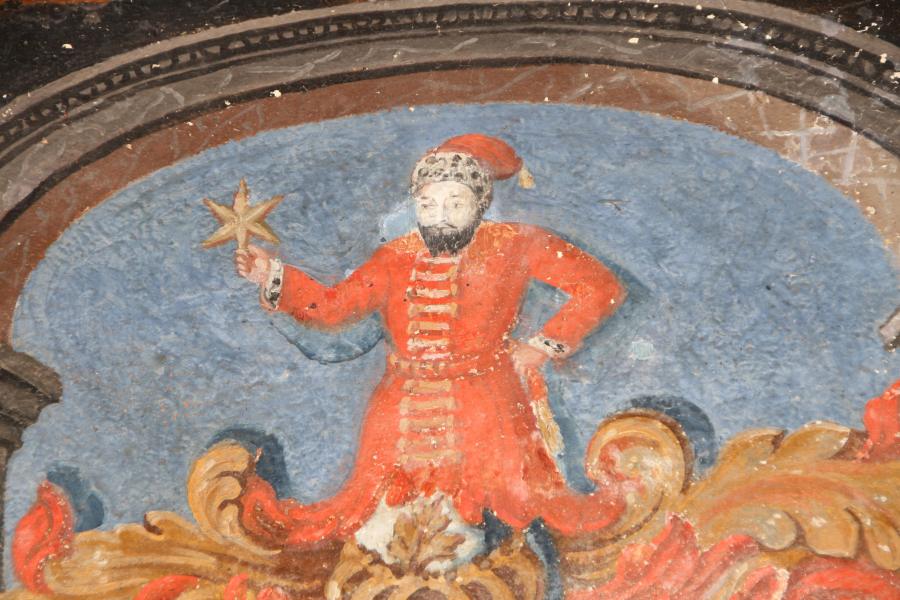
He has a six-pointed star-cross in his hand. And this image is placed at the very top of the emblem. It crowns the whole coat of arms, is its most important part. In both cases, the person in the Russian caftan is drawn in the same position, arms akimbo and with a star in his right hand. In addition, on both coats of arms, the crescent moon with a star, on which the Archer -Cossack in a caftan rests.
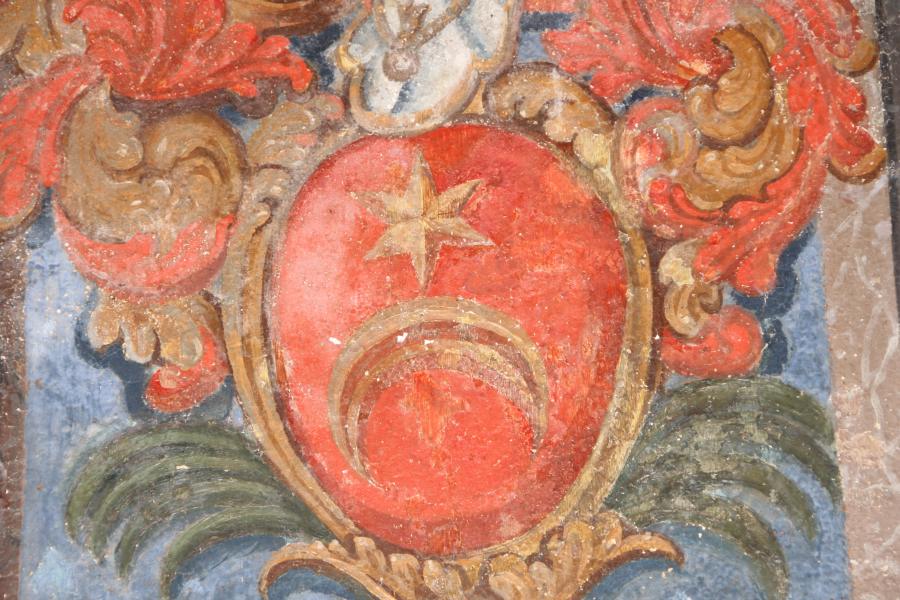
is clearly visible .
So, it turns out that the main part of some of the ancient emblems of the Bernese owners of Chillon Castle was the image of a Russian Cossack in a red caftan. And also the Ottoman = Ataman crescent with a star. By the way, the very date of the conquest of Chillon and the transition under the authority of the Bernese lords – 1536 [1064: 1] – falls just at the end of the era of the Ottoman conquest.
Although we always consider the issue of the origin of ancient names secondary, it is nevertheless useful to note the following. The name of the Swiss Bern, from where the Bernese lords ruled the Chillon castle, is very similar to the Russian word “Faithful”. But the word “True” really called Russian Cossack cities. For example, the city Alma-Ata, the capital of Kazakhstan (= Cossacks + Stan), was previously called that. This was the Russian Cossack town of Verny [85], v.7, p.505. The lands around the city of Verny on the old maps were called “Land of the Cossack hordes”. See, for example, Remezov’s “Map of Siberia” in the State Hermitage Museum, see the book “New Chronology of Russia”, Chapter 11.
Perhaps the “land of the Cossack Horde” was at one time Switzerland, or at least part of it around the city of Bern = Faithful. Cossack Horde belonged and Chillon castle. According to our results, it is quite likely. The Russian Cossacks were to appear here again during the Ottoman = Ataman conquest of Europe, in the 16th century. Today it is firmly forgotten. Red Cossack caftans and crescents with stars in the old halls of Chillon Castle are rare extant traces that have escaped the “purges” of the XVII-XIX centuries, when evidence of the true history of Europe was shamelessly destroyed. Apart from the general picture, they are now incomprehensible and speak little to the modern visitors of Chillon Castle. But nevertheless, they are not included in the books and guidebooks out of caution. Apparently, they feel that here ”
Perhaps another explanation of the name of Bern. Since the emblem of Bern is a bear, it is possible that the name BERN is derived from the Slavic word BROWN. So called brown bears. By the way, from here, probably, the name of the German city of Berlin comes from the word lair, that is, brown + bed, brown + den.
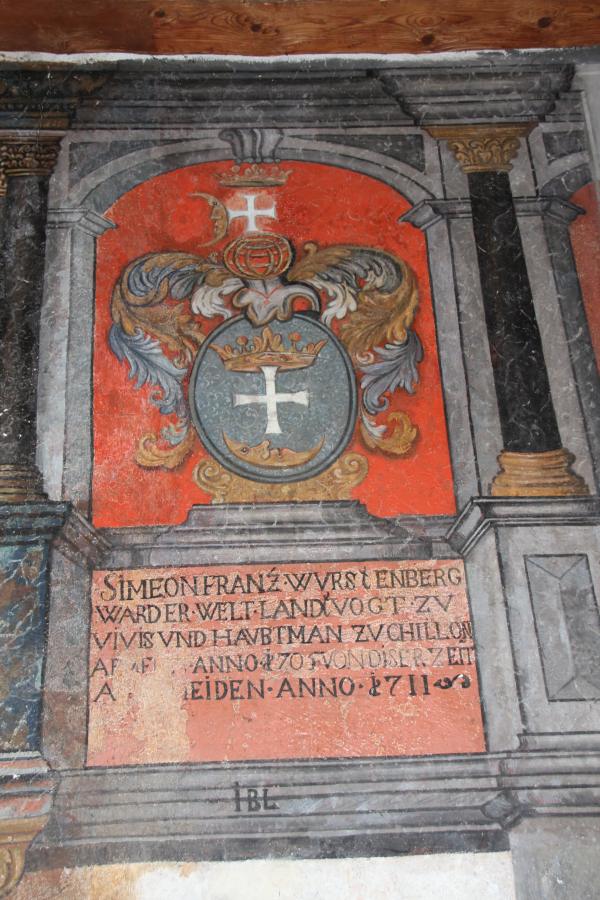
But back to Chillon Castle. It is too early for us to leave the Armorial Hall. Let’s walk again along a series of ancient Bernese coats of arms. And we find that the Ottoman = Ataman crescents with a star are found on other coats of arms. Recall that, according to our results, the star is sometimes depicted as a cross, either six-pointed or four-pointed. For example, on the Bern coat of arms of 1711, we see two crescents, around each of which is a star in the form of a four-pointed Christian cross,
 .
.
Please also note that the unit at the beginning of the date is here written in the form of a Latin letter i with a curl below. As it was shown in the book Numbers Against Lies, earlier dates began with the letter I or J, that is, with the abbreviation Jesus (Isus or Jesus). And only later this letter was craftily declared the designation of “thousands of years” and called the “unit”, than the medieval dates automatically grew old for a thousand years, pushing the Nativity of Christ, and therefore many other events – into the distant past.
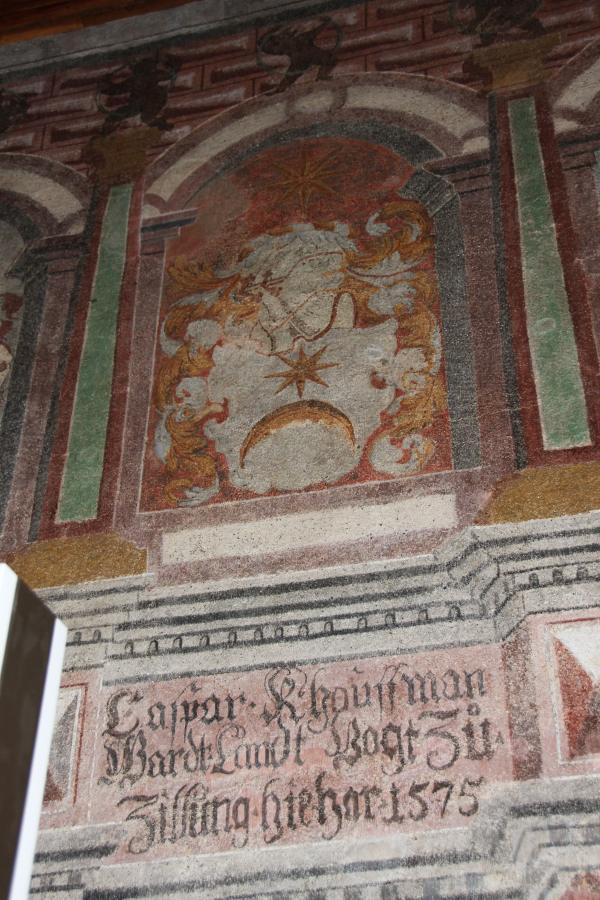
Ottoman = Ataman crescent with a star, we see on the Bernese emblem of 1575.
 .
.
By the way, note that here the date begins with the letter i, that is, it was originally read as “the 575th year of Jesus.” We repeat that only later they began to read it as “one thousand five hundred and seventy-fifth year,” pushing the Nativity of Christ a thousand years down.
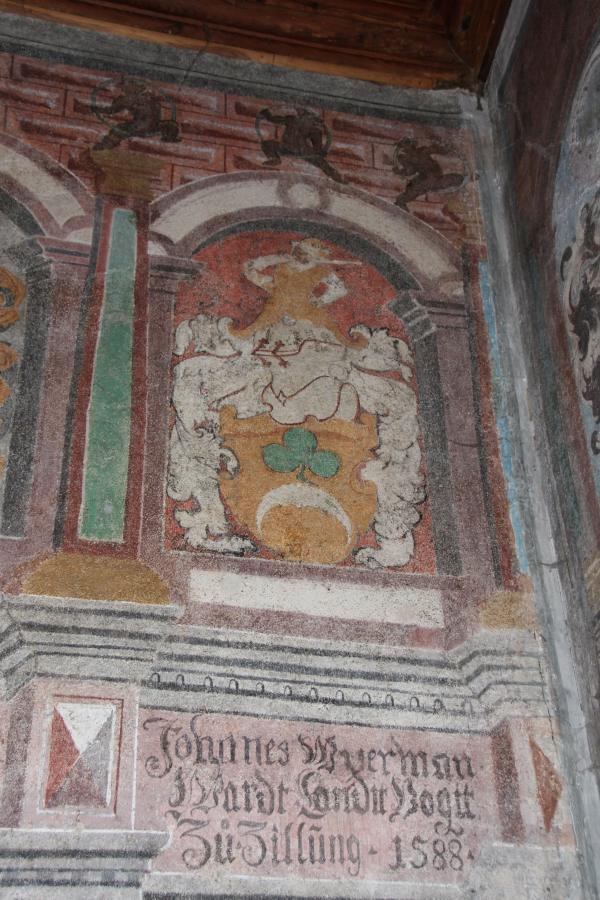
And here is a very interesting coat of arms of 1588.
 .
.
The later coats of arms of 1699 and 1759-1765, about which we spoke above, are very similar to it. In fact, on the coat of arms of 1588 above A Sagittarius is depicted holding on his shoulder some sort of weapon, similar to a musket-gun. Under his feet, a helmet, and just below – the Ottoman = Ataman crescent with a star, which is represented here in the form of a three-pointed cross. Later, it was this form of the Christian cross that became the “royal lily”. The date here also begins with the Latin letter i.
On the coat of arms of 1601
 ,
,
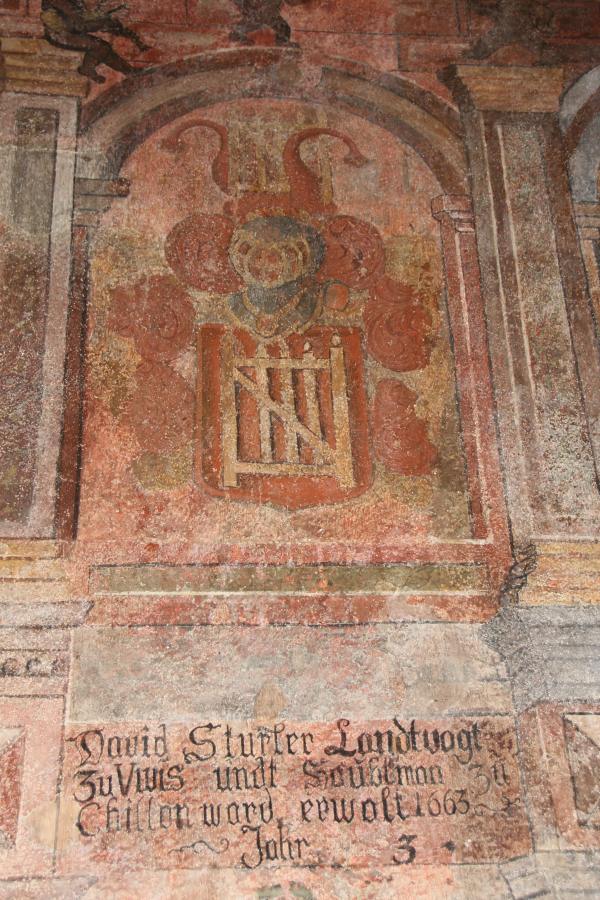
and on the coat of arms of 1665,
 ,
,
we see “horns”, that is, a slightly distorted image of the same Ottoman crescent. Numerous such examples of the “reformation of the crescent”, in order to obscure its original meaning, we have already cited in our books.
It is possible that the distorted image of the crescent with a star we see on the coat of arms of 1687. Here he was presented in the form of a “lion” inscribed in a crescent in the form of a strongly bent tail,

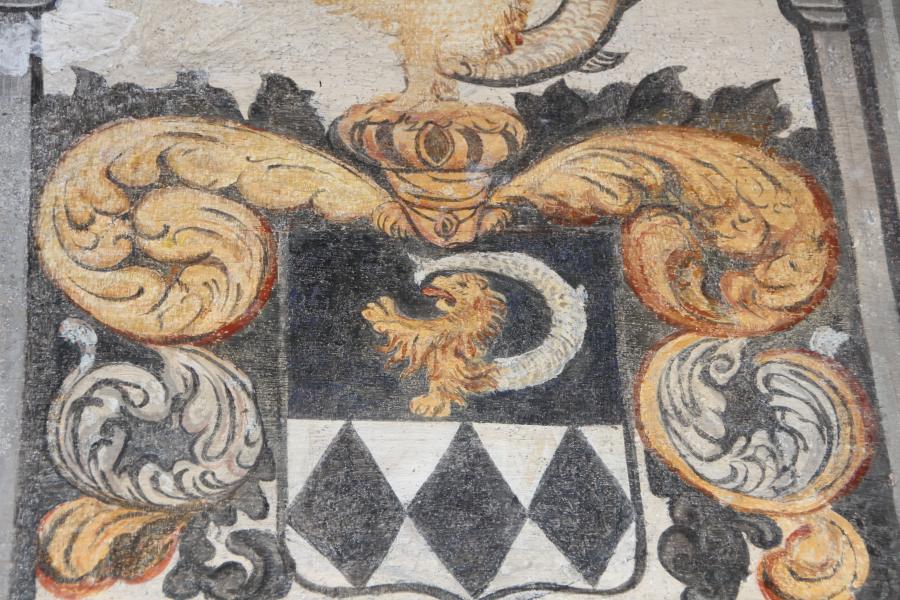
Again, we see that the date begins with the letter J, that is, with the abbreviation of the name Jesus.
By the way, on the later coats of arms in Chillon castle dates already begin with the number “one”. As we have already explained, in XVII-XVIII centuries, historians changed the chronology and, in particular, the letters I or J craftily declared the designation “thousands of years”, after which instead they began to write the unit that has become familiar to us today.
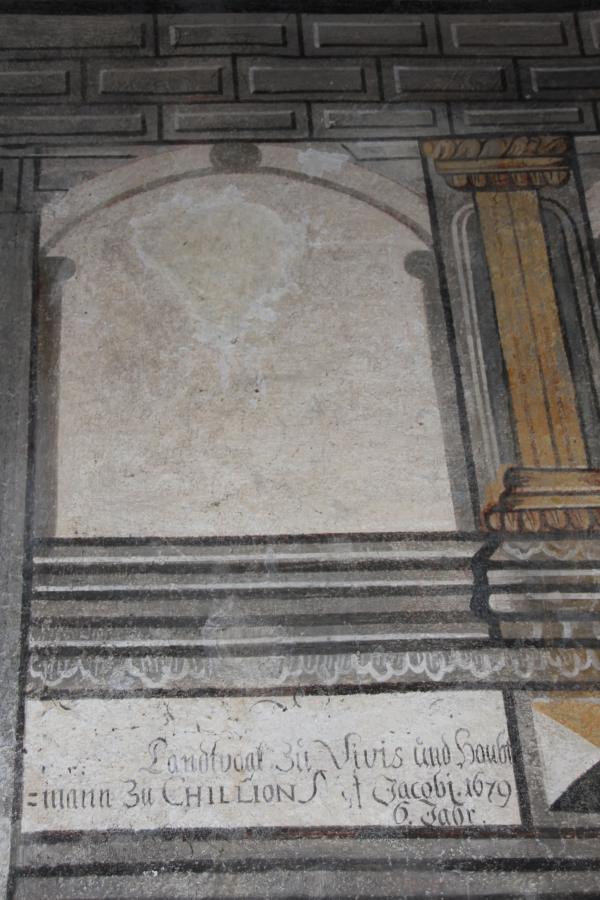
By the way, in the series of the coats of arms of Chillon Castle, we found two coats of arms, the images of which were completely shot down.
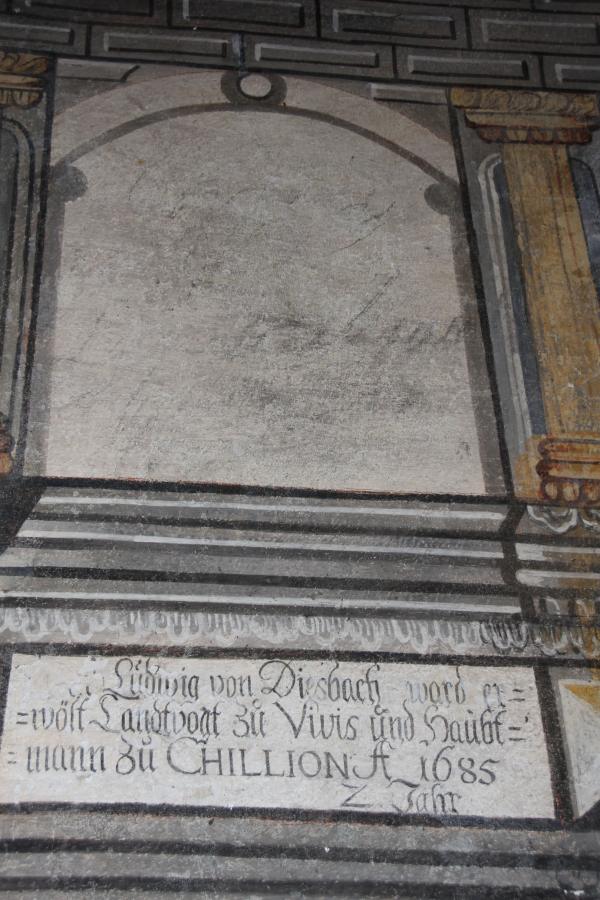 .
.
Blankety Blank. Again. G.B.
The question is, who and why did not like these ancient emblems so much that they ruthlessly cleared them, leaving not even traces of the previous images? This we will never know. Most likely, there were some very frank Horde and Ottoman symbols or inscriptions. Which later reformers could not leave. Therefore, shamelessly scraped.
Ottoman crescents with a star are found in Chillon Castle, not only on the coats of arms. Also on the antique furniture, exhibited today in the castle.
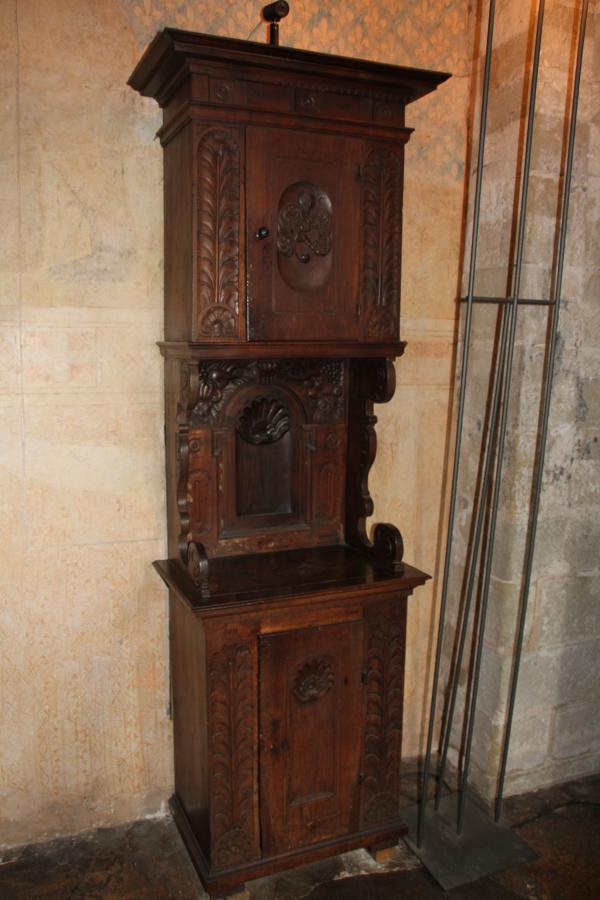
we see an old cabinet, on which the coat of arms is carved. On the coat of arms – a clear ataman crescent with stars.
 .
.
Pay attention to another significant circumstance. As we have repeatedly noted, the ancient Horde and Ottoman temples and living quarters were usually decorated with floral and geometric patterns. People, animals and birds are usually not painted. Such, for example, is the ancient painting of St. Basil’s Cathedral on the Red Square in Moscow. And here we see the same thing in Chillon Castle. On some of its window openings preserved ancient painting,
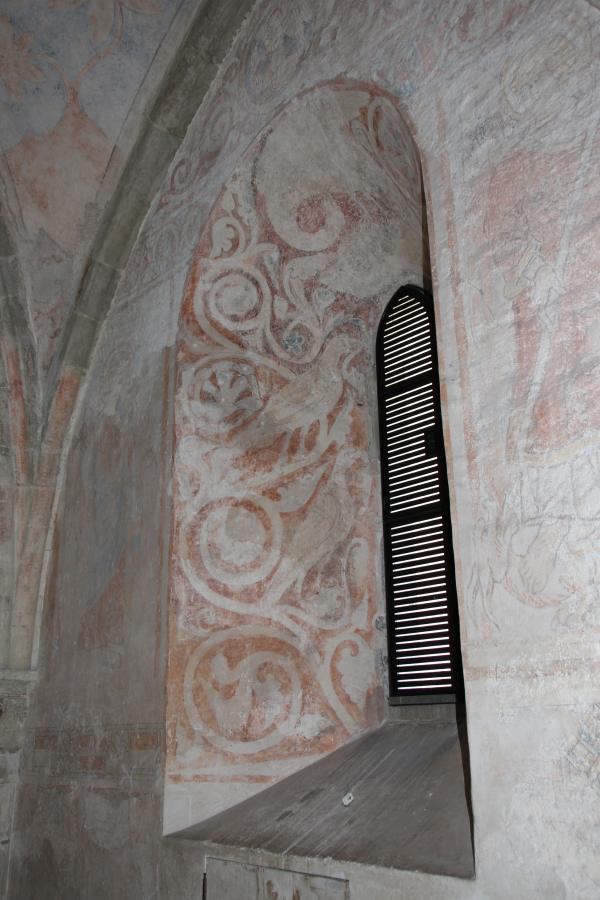
 and ris.8.53
 .
.
She is purely geometric, floral.
We will see now how the walls of the rooms in the Chillon castle were decorated. Today we are shown tapestries that supposedly once hung here.
 .
.
These tapestries today adorn the walls of several rooms in the castle. However, historians themselves admit that all this is a late reconstruction of the XIX century, “based on” the old Swiss tapestries. But here in the other rooms of the Chillon Castle, a really old painting was preserved.
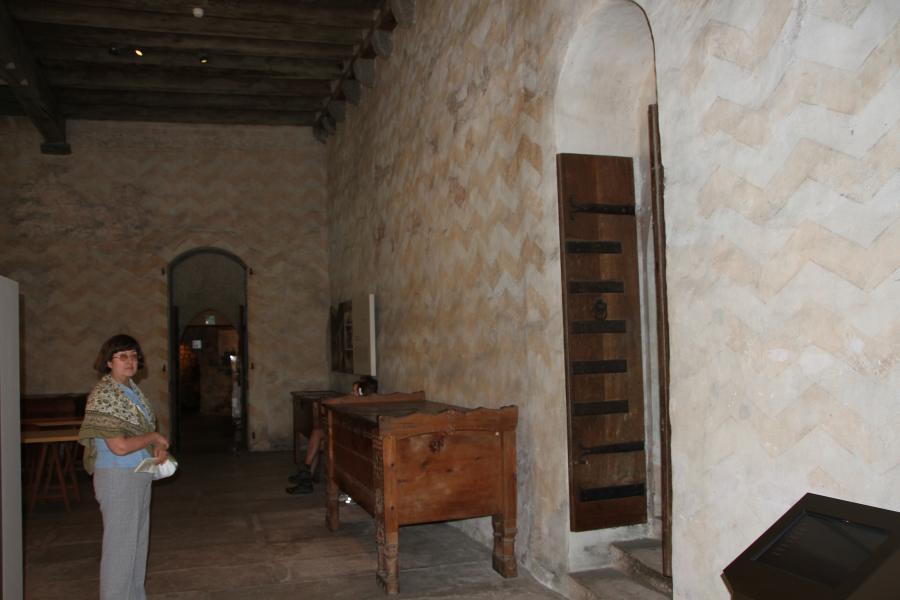
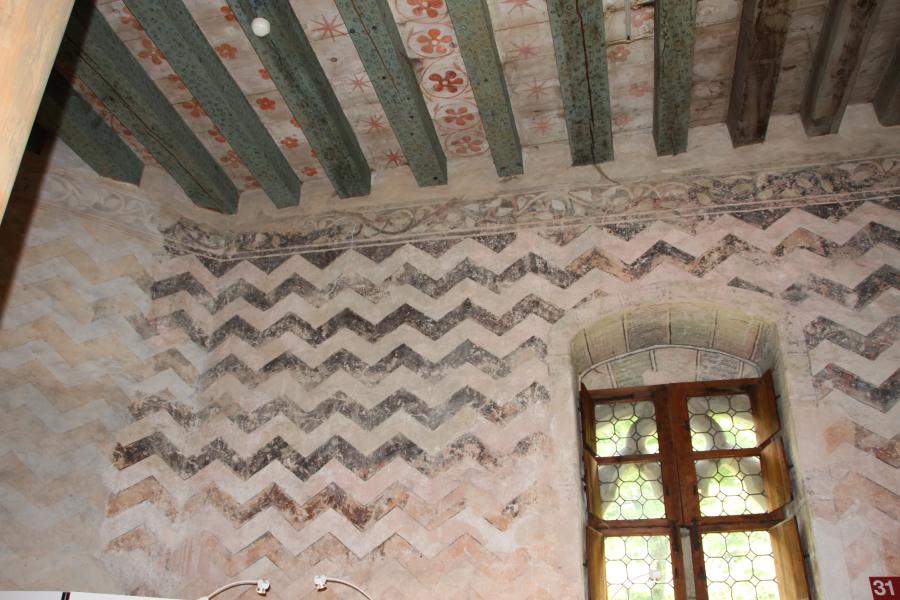 , fig.8.57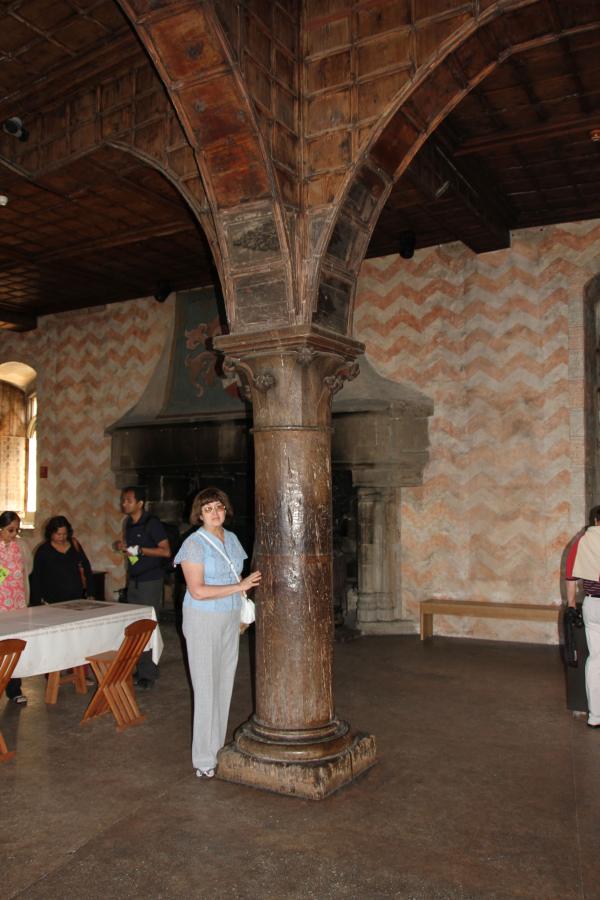

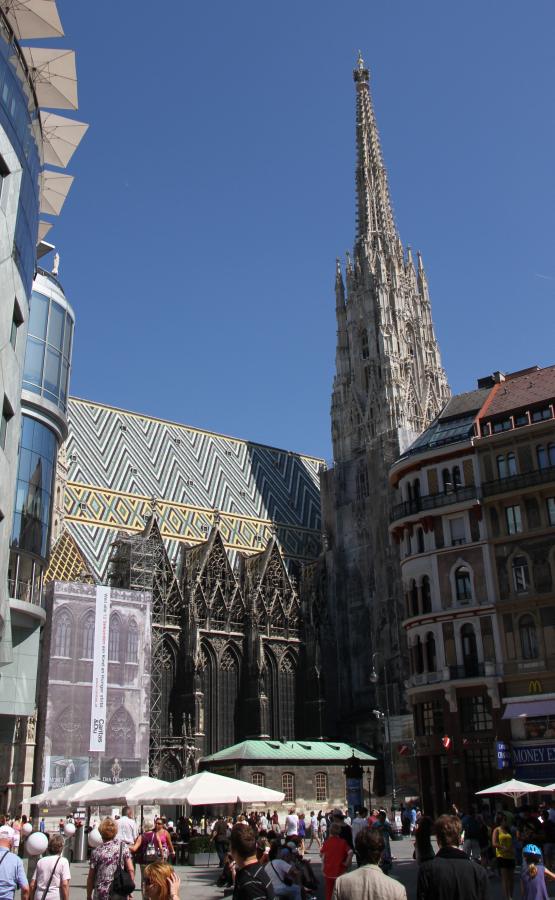
It is interesting that it, like the painting on the window openings in the castle, is purely geometric. Before us is a very distinctive zigzag pattern. You can probably interpret in different ways the origin of such decoration of the ancient walls of Chillon castle. But it should be noted that this pattern almost coincides with the widely known ancient pattern on the roof of the huge St. Stephen’s Cathedral in Vienna, Austria.
 .
.
And now we recall that this zigzag pattern on the roof of the St. Stephen’s Cathedral in Vienna is in fact Saracen, that is, Ottoman = Ataman. The administration of the cathedral clearly states that “the brick pattern of the roof reproduces the pattern of the Saracen carpet” [207: 1], p.20. As we wrote in the book “Biblical Rus,” within the Scaligerian version of history, this fact is extremely strange: after all, the cathedral today is considered Christian, and its roof is “covered” with Ottoman carpet! Historians refrain here from further comments. But our results put everything in its place. After all, it could not be otherwise, since in the epoch of the XV-XVI centuries Vienna, and indeed all of Europe, were ruled by the Ottomans = Atamans and Russia-Horde. And Ottoman symbolism adorned, in particular, not only the main spire of the Viennese cathedral,
The same Ottoman pattern we see in the Chillon castle. All right As we now understand, the reasons are the same as in the case of St. Stephen’s Cathedral. Chillon, too, was part of the Horde and Osmania = Atamania, and therefore was decorated accordingly.
Let’s pay attention to one more interesting circumstance. Historians report that from the XIII century Chillon Castle belonged to the House of Savoy. << In the XIII century. the Counts of Savoy conquered most of the land, of which the region of Vo was divided into numerous fiefdoms. This marked the beginning of dominion, which spread to almost two-thirds of the territory of modern French Switzerland. Extensive possessions in the south and north of the Alpine mountain range allowed them to take control of the main roads through the western Alps … In 1214 Thomas of Savoy founded about 2 kilometers from the outskirts of Chillon the city of Villeneuve. To the “New City” (that’s what its name sounds like in translation), they allocated enough land to build a toll station, a food market and a port on it …
A temporary residence of the Dukes of Savoy was set up in the fortress (in Chillon – Auth.), Only castellans-bali lived there permanently. The possessions of the Counts of Savoy were so extensive that they had to constantly move from place to place to rule without losing contact with their subjects … The castle becomes the largest administrative and financial center of the northern lands of the House of Savoy >> [992: 00], with .6-7.
Historians think that the “dukes of Savoy” were only local, “Swiss” rulers of the XIII-XVI centuries. They owned large lands, they did not have a permanent residence, they were forced to constantly move from place to place, so as not to “lose touch with their subjects.” Our results clarify the picture and put everything in its place. We have already encountered similar oddities in the Scaligerian version of history. The great emperor Charles V, too, as we are interpreted, did not have a permanent residence in Western Europe. Also, they say, traveled here and there, appearing now in Germany, then in Spain, then in France … And his empire stretched for gigantic distances and, as chroniclers of those times wrote, the sun never set over the Empire – so vast were the possessions of the Fifth King-Charles.
All right In the case of the dukes of Savoy, this is not really about small Switzerland, but about a huge Great Empire that arose in the XIII-XIV centuries and encompassed not only Eurasia, but also Africa, a significant part of America. So the “dukes of Savoy” are most likely Horde governors who ruled on behalf of the emperor Khan in the center of Western Europe, in large territories of the future Switzerland, France, Austria. It is true that their possessions, or rather the possessions of the Khan, to whom they submitted, were extensive. Tsar Khan himself was mainly in the metropolis of the Empire – in Russia-Horde. He obeyed the whole giant Empire. Sometimes he could appear with the inspection, for example, in Western Europe. He was greeted respectfully. He solemnly moved from place to place, then retired back to the East, to the metropolis of the Horde. During the first Horde conquest of the XIII-XIV centuries, Novgorod – New Cities was founded in the provinces of the Empire, including the territory of the future Switzerland. As we see, one of them was the Swiss Villeneuve. It must be assumed that the main governors of the emperor Khan also moved a lot along the entrusted to them. Then the chroniclers decided that the governors of the khan, who were constantly moving from place to place, were the “dukes of Savoy”.
It is very interesting that the House of Savoy struggled with the insurrection of the Reformation of the XVI century, together with the Mamelukes, that is, with the Cossack Horde, Circassians. Today it is forgotten that the famous Mamelukes ruled not only in medieval Egypt, right up to the invasion of Napoleon (see our book, The Heyday of the Kingdom), but it turns out in Western Europe. For example, in 1535, in a war with the Huguenot Protestants in the territory of the future Switzerland, the House of Savoy appeared together with the Mamelukes, also called Mamelus (Mamelus – Mamelouks) [1101: 0], p.5. However, the dating of these wars, most likely, should be shifted upwards by at least fifty years.
As we have already noted, in the reformist Europe of the 17th-19th centuries, the Horodites did not like Savoyans. This circumstance was reflected in the history of Chillon Castle. As we have already reported, the poet Byron sang of Francois Bonivard, imprisoned in the castle. Why and why did the poet sing it? Here is the answer. We quote: << In 1510, Francois Bonivard was elected the Prior (in the reformist Geneva – Auth.), Who was imprisoned by the Savoy kings in the Chillon Castle in 1530. Freed in 1536 by his compatriots, he wrote a book about the history of the city, the publication of which was forbidden by Calvin, this time because he didn’t like his style as a reformer. The famous poem by Lord Byron “The Chillon Prisoner” again restored the name Bonivard to memory and contributed to the publication of his chronicle in 1831 >> [275: 00], p.46.
Thus, Bonivar was, it turns out, an opponent of the House of Savoy, he suffered for it, and therefore his name was then actively praised by many Western Europeans. Including Byron.
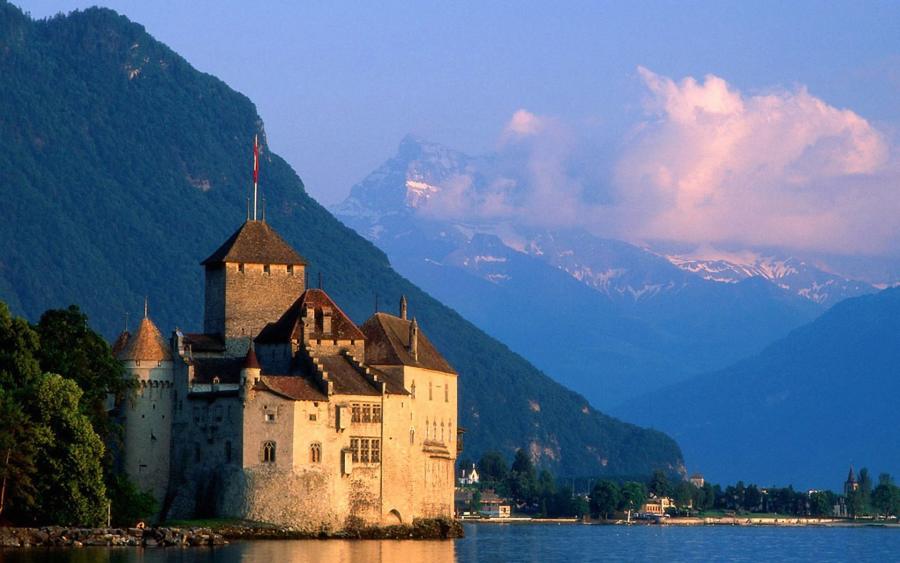
In conclusion, we give two more photographs of the Chillon Castle.
 .
.
 Hidden History Research