The article below is mainstream history…but still important.
Two main things –
And, the amount of information about trade in and around Yaroslavl, the Volga and the Mologa Rivers.
Tamara Dadianova,
doctor of philosophical science,
Member of the International Association of Aesthetics,
Member of the Union of Journalists of Russia.
Ossetians on Mologa
Not only Yaroslavl prince Fyodor Cherny, but also his relative, on the line of Maria’s first wife, Gleb Vasilkovich, who ruled Belozersk principality, returned from a military campaign to recalcitrant Yases with trophies. As I noted earlier, Fyodor came from the rate of Khan Mengu-Temir with a label chartered, according to which the residents of 36 cities had to pay tribute to him now, who became the husband of Khan’s daughter Yulduz (Anna) and who had by that time her two sons Constantine and David. Fedor was pleased. His goal has been achieved: he has become influential and rich. He decorates not only his fingers with precious stones, but also the salaries of valuable books, icons, and clothing. In the home church on the walls hang icons, exported from Alanya. Among them – the most beloved “Mother of God with the eternal baby.” She is from Dedyakov, mined in a bloody battle. The witness was his confessor Prokhor, who later headed the Rostov diocese. Gleb Vasilkovich was also married to a Mongol: the daughter of Khan Sartak – Theodore, whom he brought in 1257 from the Horde. Captured Alans became its main prey. Chingisids besieged the distinguished city of Dedyakov for almost 20 years. And yet broke, calling for the help of his vassals from the north-eastern lands of Russia.
I believe that the Alans, in order to heal the wounds, were themselves not averse to leaving their long-suffering homeland turned into ashes, even as slaves. The desire to get away from the bloodthirsty oppressors – the Tatar-Mongol khans – promised them a relatively quiet life. From the Caspian along the Volga and its tributary to the Mologa River, they set off without things, taking to the road only spiritual values: the secrets of making enamel, tiles, painting, a plow with a plowshare, cold steel. The ancestors of modern Ossetians had not only knowledge of how to pass and swim from China, India, Persia to Lake Nevo (Ladoga) and beyond. They had extensive economic ties with the Chinese, Hindus, Persians, Arabs, Greeks, Georgians, Armenians, Polovtsy, Jews, Muscovites, Novgorodians, Germans, Swedes, Lithuanians, etc.
The major cities of Alanya were looted and destroyed by the Mongols: Magas, Nizhny Arkhyz, Rome Mountain (Fust?) And Dedyakov mentioned by me more than once, through which the Great Silk Road passed and in which there was a fair or, in the oriental, market. The cities were destroyed, but the surviving residents did not lose trade contacts and ties with overseas merchants and artisans.
Gleb Vasilkovich acted wisely, populating the princedom Alans of the principality: his Belozersky and Rostov passed into his charge after the death of his brother Boris who died in the campaign to the Caucasus. He pursued several goals.
- To strengthen the Mongols who were exposed by the Mongols as a result of the massacre in 1238 on the Sit border of the principalities by hereditary and skillfully militarily-Caucasians who were highly valued by the Mongols themselves, selecting personal guards in the fold.
- To settle these lands with Christians who could spread Orthodoxy among the pagan tribes of Ves, Chud, and Mary who lived here. / Most of the inhabitants of Alanya professed faith in Christ, borrowing it from the Greek colonists who lived with them side by side for many centuries. The Armenian Church commemorates the martyrs of 16 Alanian princes, led by their leader Sukia (Barakad), who suffered for the faith of ca. 100-130 years.
The Yaroslav regiments during the military campaigns in the Caucasus could not help but feel the active Greek-Byzantine influence on the style of church buildings both in Dedyakovo and in the upper reaches of the Kuban, in the area between the Bolshaya Laba and Kuban rivers. It was here, on the Lower Arkhyz settlement in the gorge of Bolshoy Zelenchuk, that the center of the Alanian Diocese of the 10th-11th centuries was located. Here the most easily accessible routes passed through the passes to the south, to the ports of the Black Sea coast, and it was along these lines that the caravans of the Eastern and Western merchants walked during the period of the Great Silk Road. In this place were the residences of friends and allies of Byzantium – the Alanian rulers: Sarosla, Itasa, Durgulele the Great. “There was a bridgehead, from where the Byzantine influence extended to the adjacent territories of the North Caucasus.” (Kuznetsov V.A. Essays on the history of Alan. Vladikavkaz:
- Alans were in close military, economic and cultural interaction with the Volga Bulgars. Some researchers, in particular, R. Kh. Bariev, even absolutize this process. In my opinion, it is quite natural that after a long-term siege of Dedyakov, the Asian invaders rushed immediately to Volga Bulgaria, sending there shelves led by Yaroslavich Fyodor Cherny, serving Khan Mengu Temir. Gleb Vasilkovich and his sons Alexander Nevsky took part in the campaign.
- The aforementioned Belozersky prince, returning from a campaign with such a large number of captured jars (Alans), hoped to adopt the best agronomical technologies: the inhabitants of Alanya knew heavy tillers attached to a wheeled plow, which was driven by several pairs of oxen. A knife-stencil angled at an angle separated the strip of land, the ploughshare cut it and turned it over. Such a tool could provide, in comparison with the plow, a very high productivity of labor. Archaeologists know “Kuzburun plowshare” (named after the place of discovery in the Caucasus), dating from the eleventh to thirteenth centuries. The high-performance, heavy, advanced plow made it possible to plow up large expanses of the fertile lands of Ciscaucasia and receive not only the necessary, but also the surplus product. This could be observed repeatedly by the White Lake and Rostov citizens, being on the arable lands in the vicinity of Dedyakov during their campaigns of 1277-1278.
Wheat and millet fields, vines, grazing sheep and buffalo, birds attracted the gaze not only of Asian nomads. Prince Gleb remembered that his father Vasilko Konstantinovich was the grandson of Vladimir Princess Alana Maria Yasyni. The accomplices of the campaign against the recalcitrant jars: Andrei Gorodetsky and Dmitriy were the sons of Alexander Nevsky, who was the grandson of the same Mary. (Over the 72 years that have passed since the death of Vsevolod-Dmitry Yuryevich’s first wife, nicknamed “The Big Nest,” the memories of a Caucasian female relative to whose homeland they came against their will have not yet faded).
Alans knew the secrets of making high-hard steel, in its structure similar to martensitic. Zinc or lead was used as a copper melt. They also used rigid casting molds for mass production of jewelry, small items, and also owned other casting forms: according to the wax model and in lamellar clay forms. Knew forging and chasing metal, owned and pottery.
The high level of the Alanian economy and their skillful craftsmanship contributed to the emergence of early feudal cities in Ciscaucasia. This attracted the attention of Prince Gleb and his son Michael, who wanted the sown bread to grow in the northern lands, the udder flowed and produce fruits, temples were built, and crafts flourished.
This was previously dreamed of in 1218 by Konstantin Vsevolodovich, the son of Maria Yasynya, giving Yaroslavl to the first son Vsevolod-Ivan (later, to the grandfather of Maria — the wife of Fyodor Cherny), making him the first prince of the land of Yaroslavl, and the second son Vladimir, highlighting Belozersky principality. Vsevolod-Ivan then he will die in battle with the army of Batu on the shores of the City on March 4, 1238, together with his father’s brother George-Yury. Vsevolod-Ivan’s children: Vasily and Konstantin will be canonized. After the death of 20-year-old Vasily in 1249, daughter Maria, together with his wife Xenia and grandson Michael, will rule in Yaroslavl. Maria’s husband, Prince Mozhaisky Fyodor Cherny, after the death of Mary and Michael, returning from the Horde with his second wife Tatar-Mongolian Yulduz (in baptism – Anna and in schema – Anastasia) and children-Chingizids: David and Constantine, will seek to develop crafts and architecture raise them to the level that was observed in Alanya. Anna will help him in this field. The Confessor Prokhor, a comrade in the military campaigns, will begin to arrange affairs in the diocese, realizing that Christianity ideologically strengthens the state. Let us recall his journey-inspection of the diocese and the desire to attach the relics obtained in the campaigns. On the Volga, in place the tributary of the Tolga tributary into it, it will show the shrine to the Orthodox and un-baptized world, which will be called the icon of Our Lady of Tolga, and it will have a beneficial effect on the congregation. The love of Fyodor and Prokhor to the Tolgsky Icon reminds me of the similar feeling of Andrei Bogolyubsky to the Greek icon, seen in Kiev, then taken to Vladimir and called Vladimir. If you turn it to 1800, then it will look like Tolgskaya by the staging, gestures, glance!
By the way, readers should be reminded that Andrei, the 2nd son of Yuri Dolgoruky, was married to Alanka and died at the hands of Alan Ambal-klyuchnik on June 28, 1174 in his native Bogolyubovo, a suburb of Vladimir, where he built the magnificent Church of the Nativity of the Virgin Mary for his beloved icon named Vladimirskaya. The blood of heroic ancestors flowed in his veins. He was dismayed by the fragmentation of Russia, because he all his life constantly and irrepressibly sought to create a new center of Russia. Exquisite aesthetic taste had his father, Yuri. The architect from the Galician prince Vladimir Volodarevich tried to realize the ideas of creating a majestic white-stone city. After the death of Yury Dolgoruky in 1157, this master passed on to his son Andrei Bogolyubsky, the first prince of the Great Russians. Unfortunately, children have died earlier than he: Yury Bogolyubsky is the first husband Queen Tamara – disappeared without a trace somewhere after his expulsion from Georgia. Another son, Gleb, died shortly before the tragic death of Andrei. The throne passed to brother Vsevolod in the absence of his direct descendants.
And then the architect of Vsevolod the Big Nest, which sat on the princely table in 1176, perfected the architectural art and the plastic possibilities of the limestone, erecting it in honor of Saint Dmitry (Prince Vsevolod the Third was baptized by this name). / “Once the richly creative hand of the Alans decorated the temples of Vladimir and Yuriev-Polsky; unless these heraldic griffins, lions and all the patterned monsters were not like the tamgoy (stigma) of distant Asian expanses,” N. Roerich noted in ” Diary Sheets “(Moscow: Inter. The Center of the Roerichs, 1999, vol. 1, p. 73). / The son of his younger brother Vasilko – Gleb Vasilkovich was also a zealous builder in the Belozersk principality. The son of Vsevolod Yurevich, the Big Nest – Yaroslav II, or Fyodor Vsevolodovich (1190 – 1246), is known to us as the father of Alexander Nevsky (1220-1263). If you want to know how Prince Yaroslav looked, you can turn your eyes to frescoes on the south side in the Church of the Savior on Nereditsa in Novgorod the Great (1206). The features of Yaroslav’s face will remind of his Caucasian genes and the origin of his mother, Maria, from Alania.
The great Russian princes and their relatives knew that Dedyakov (Tyutyakov) stood at the intersection of two major trade routes that ran through the North Caucasus: from Azov to Derbent, Shemakha and further to Iran and from Russia along the Volga Through Madzhary to the Caucasus “(Kuchkin V. A. Where to find the Yassky town of Tyutyakov? – Proceedings of the North-Ossetian Research Institute, 1966, Vol. XXV, p. 183).
- Gleb set the goal of ridding the Alans of extermination by the Mongols. The Russian princes, in fact, saved the Alans from the Tatar-Mongols in such a peculiar way. Probably, they remembered that in many of them, though in a small fraction, Yana (Alan) blood was flowing. Otherwise, the yasam would have to either rush after the Polovtsy to Panonia (Hungary), or go high into the mountains, or join separate guard units of the Mongols, participating in constant bloody palace coups on the side of khans confronting each other and candidates for these titles.
Gleb Vasilkovich not only dreamed, but also actively promoted that vessels with rich oriental goods from Iran, India, the Caucasus, Byzantium could, through his Belozersky principality, freely flow into Lake Nevo (Ladoga) and further to Sweden … From the Volga River inflow – the Mologa rivers – further along the Chagodoshe river, merchants went to the lake Somino, and from there to the Syasi river – the tributary of Lake Ladoga. Everything was complicated by one circumstance: there was a watershed between the rivers flowing into the Volga and Lake Ladoga – cargo had to be transported by tug, as there was a 5-mile dragged, the transition from the river Volchin to Lake Lebedino. (Then one of the canals of the Tikhvin system would be dug through this portage at the beginning of the 19th century, fulfilling the ideas of the Belozersky prince and Peter the Great). He cared about improving waterways. Not far from Lake Kubensky, where the river Sukhona created a long and narrow peninsula, Gleb gave the order to cut the peninsula formed by the canal, which then the people would call the “Prince-Glebovy chasm”. A similar channel he spent on the river Vologda. Creating The first channels in Russia, the “navigable trenches,” the prince tried to transform the region dear to his heart. On the City River, a tributary of the Mologa, the Batyyans tortured his father in 1238, who refused to change his homeland. The boy was patronized by Uncle Yaroslav – Grand Prince of Vladimir (father of Alexander Nevsky). With him he made his first trip to Sarai, being seven years old. Subsequently, the son of Baty – Sartak, reigning over the Don, in Alania, will give him his daughter in marriage. For his 40 years, Gleb has seen a lot: he visited Yaik, Irtysh, Zaisan, crossed the Altai Mountains. Repeatedly been in the Horde. He was patient and resilient. Yaroslav, having endured the march, died; Gleb had to accompany the body of his relative to Vladimir. He also visited Khanbalik (Beijing), where the Alans were part of the Mongol guard. Will not Yaroslavl, Rostov residents, Vologda residents and Ustyuzhans serve after his visits there together with Caucasians? During the 27 years of his reign, the Belozersky prince tried to beautify his principality, introducing everything new and progressive from what he saw and learned in his forced hikes and travels. Gleb was not embittered in those difficult circumstances. He did not have time to realize all his plans, but the matter did not disappear: his aspirations were picked up by descendants.
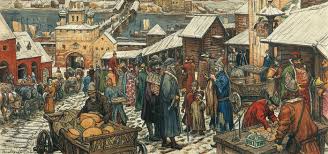
On the bank of Mologa, 50 versts from the mouth of the river, there was a Holopiy town, where the captured Alans lived, engaged in hydro-construction works (digging canals, fortifications), crafts and trade. They set up a notable exchange market here with a Caucasian scale inherent to them, where their long-standing trading partners, who were still visiting them in Dedyakov, began to gather.
Merchants from northeastern and southern countries began to moor at the marketplace in Kholopiy. Timofey Kamenevich-Rvovsky – hierodeacon of the Holy Monastery, located right there on the Mologa River, who lived at the end of the seventeenth century, noted that the town rescued 180 pounds (almost 3 tons) of silver from just one trading fee in 4 navigation months. Culture entered deaf Finno-Ugric lands. The colonization of these northeastern outskirts of Russia was carried out by attracting new technologies and contacts, which I mentioned above.
Ivan Kalita, having bought from the grandson of Gleb Vasilkovich – the Roman principality of Belozersk, moved the fair from the Slave town to the very Molodsk estuary. Some Genoese, for example, Matthew and Dmitry Fryaziny, having visited the Yaroslavl land, will find permanent residence in Russia, will become the rulers of the Pechora. And there are plenty of such examples.
Arabic, Italian and others. Speech sounded in the original land of Vesi! It was the first fair of Russia. Alans fulfilled the goals set by Gleb: ancient Sassanian silver coins rang, eastern silks rustled, overseas architects and artists appeared … Residents of the Holy Town, or otherwise, the Ossetian settlements, will eventually disappear, having assimilated with Rusichi with the whole and with the Chud. It is surprising that the nobles of Georgian origin, Yashvili, Magalashvili and others, will settle much later in these territories. I think that this will not happen by chance: Ossetians and Georgians often entered into marriages, helped each other and were co-religionists.
John Vasilyevich bequeathed the town to Grand Duke Dmitry Ioannovich, and that Ivan the Terrible. In the 16th century, the fair was moved to Nizhny Novgorod due to the plague epidemic raging here. For two centuries (XIV-XVI) it was the largest Russian fair. Famous historians Kostomarov and Trinity will call it even “world”! Maybe the heart of the Belozersky principality – Kholopiy town (Ossetians) was Novgorod, which historians are looking for? But this is only a guess. There were several other names: the Old Kholopiy and the Old Kholop’e, and Borisogleb, and the Borisoglebsk (Musins-Pushkins estate). But, alas, the followers of Prince Gleb, who absolutized his idea of “navigable moats”, flooded this land and cultural monuments located on it and adjacent to it in the early 40s of the 20th century , forming a kind of Atlantis here. But this is another story …
The main features of the Alanian mentality: heroism, love of freedom, belligerence, active enterprise, perseverance, a passion for aesthetics of the interior and the environment have fully contributed to the creation and consolidation of the Russian statehood and autocracy. Alans or (as the inhabitants of Rostov and Mologa began to call them, following the Georgians), the Ossetians have never let down the Russians, since they have made friends under the Mongol dictates. This fact has been confirmed for centuries up to our time. Caucasians also learned a lot from them: patience, political flexibility, the ability to adopt the best and organically adapt it to their culture.
 Hidden History Research