And I quote:
“The name of Mary left a deep imprint in the names associated with Chufut-Kale. As it turns out, in addition to the old necropolis in the Gorge of Mary, here, very close, there was a settlement called the CITY of MARIA – Mariampolis,
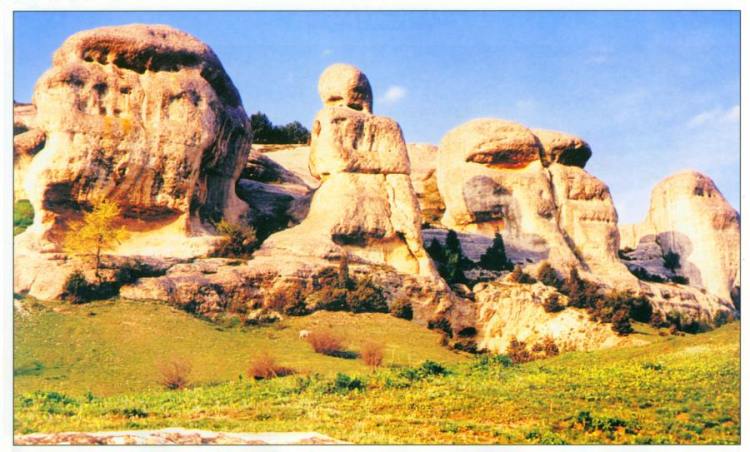
Mariampolis is located on the same side of Chufut-Kale as the Christian necropolis, fig.4.44, fig.4.45, fig.4.46. By the way, the Greek word POLIS probably comes from the Russian word SETTLEMENT.

fig.4.44

fig.4.45

fig.4.46
The ancient necropolis in the Maria Gorge was occupied by many researchers. Today it is believed that “by ethnicity, the buried are defined as Sarmatian-Alans. The question arises, where did they live, under the protection of the defensive wall on the plateau, or was the settlement nearby in the gully?” in connection with the burial ground with a fortress … Supporters of the late date of the appearance of fortifications on the plateau denied this connection “[164], p.25.
Some archaeologists believe that the necropolis belonged to the settlement of Mariampolis in the Gorge of Mary. But anyway, all these places are in close proximity to the plateau, where the city of Chufut-Kale stands.

On ris.4.47 given one of the tombs found in the Christian necropolis Gulch Mary. The tombstone is made in the form of a basilica. So built some Greek (ie Christian) temples.
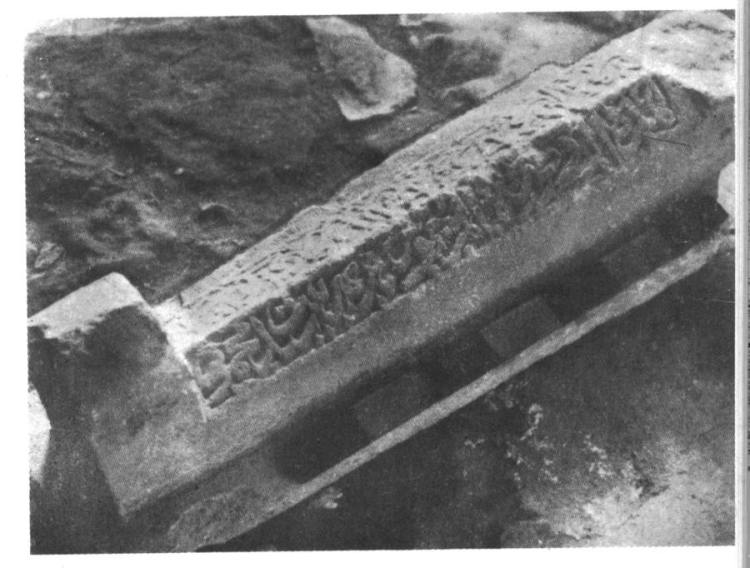
On ris.4.48 shows another tombstone found in Calais.
The fact that most of the ancient tombs in the necropolis of Mary’s Gorge were Christian is considered to be well established. The following is reported. “On the basis of the excavated burials, we can conclude about the gradual spread of Christianity among the local population. This is evidenced by worn crosses, crosses scratched on the walls of crypts, as well as on tombstones, rings with Christian symbols. Limestone tombstones that were installed near the dromos (dromos (plural dromoi or dromi) (historical) An avenue, especially in Ancient Greece. (historical) A walkway to a building, (especially) a ceremonial walkway to a temple or tomb in Ancient Greece or Egypt) on the surface,
The images of the instrument for the execution of the Messiah were carved on them. One of the gravestones was obviously given the shape of an architectural structure, rectangular in plan, with one rounded rtsovoy (Rhythm?) part … Obviously, the tombstone depicts a Christian church of basilic type … And it is likely
Various commentators believe that the people buried in the necropolis of Mary’s Gorge were Scythians, Sarmatian-Alans, Goths, Goths-Alans, Huns, “late Scythians”. In addition, they write like this. “As for the Alans, according to the authors of the 13th-15th centuries, their area of residence in the Crimea was definitely correlated with the fortress of jewels – Kyrk-orom” [164], p.28. (Kyrk is Scottish Kirk is Church. Orom is Rest.)
As we now understand, all these historical names refer to people of the XIII-XVI centuries who lived in these places or brought here from afar after death, for burial near the holy city of Mary the Virgin. (From Egypt?)
 Hidden History Research