
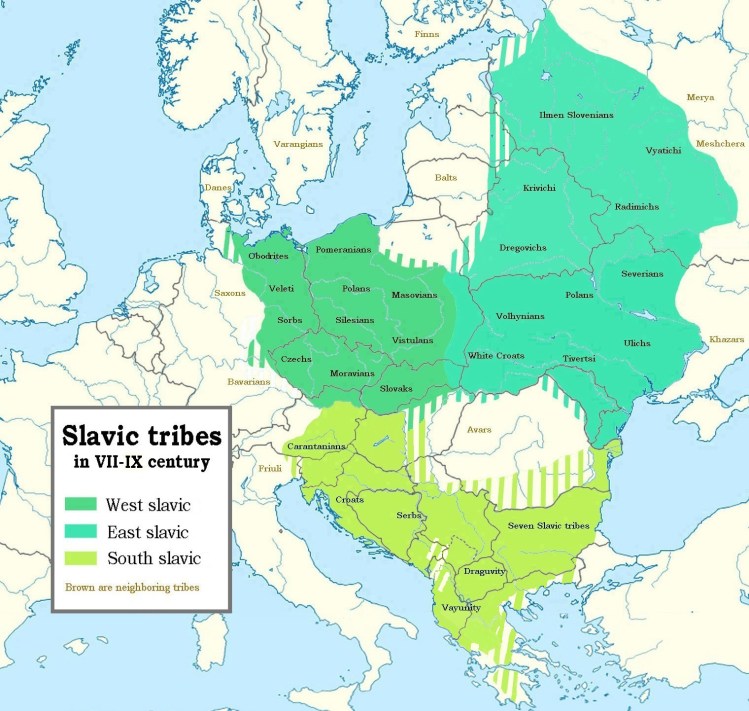
Unfortunately – I can’t read the original article.
But here’s the summary.

Many old historical works begin their story either with the Flood, or with the Creation of the World, and for greater persuasiveness in the beginning include legendary events that are even dated in time. Authors often name not only the “founders” of cities, states and dynasties, but also the “ancestors” of peoples and groups of peoples. In such works one can read for example that the mythical king Romulus “founded” the city of Rome – Roma; that the “ancestor” of the Pannonians is Pan, the Czechs – the Czech, etc. The names of peoples associated with toponyms – p. Morava and Moravians, Volga and Bulgarians, Muscovites and the Moscow River.
Since the idea of the Flood and the “ark” (ship) of Noah is practically universal for European peoples in the Christian era, the chronicles of that time attribute it to their descent from the sons of Noah – Shem, Ham and Japheth, and from the grandchildren of Noah. Noah’s ark (ship) also suggests a common place where all peoples come from, and as a result gives rise to the idea of their migration – they all one way or another moved from the same place (from Ararat) and after a long resettlement (or series of relocations) at the place where they are at the time of the creation of the chronicle.
In accordance with this universal scheme, many historical works of the XII-XVIII centuries tell legends about how and where the Slavs came to their present lands. In these legends there are not only the names of “tribes” and peoples, but also toponyms; comparing them with each other and with toponyms on old maps makes it possible to draw certain conclusions and put forward interesting hypotheses.

Via Wiki Whatever: Slavs in the USA and Canada by area: 20–35% 14–20% 11–14% 8–11% 5–8% 3–5% 0–3%
The results of the research conducted in this direction presented below cover: 1) a review of information from several “key” essays; 2) the choice of several “iconic” names and toponyms; 3) illustrations of the location of the corresponding place names on geographical maps of the 15th-17th centuries. and a discussion of their spelling options, and 4) comparisons, analysis, and conclusions.
We specifically note that our goal is
– identifying the links between individual stories and options; and
– identifying possible influences and borrowings,
and not at all figuring out which version is the most correct or which details in it are closer to reality.
 Hidden History Research
One thought on “Legends about the origin of the Slavs”