

From NC:
The letter “X” formerly denoted the name of Christ, but was later proclaimed to stand for the figure of ten. The letter “I” formerly denoted the name of Jesus, but was later proclaimed to be the indication of one thousand
One of the main chronological shifts by 1053 years, or by about 1000 years, could have risen from the comparison of the two different methods of recording dates by the later chronologists.
The first method: abbreviated form of recording.
For instance, “the III century since Christ” could be recorded briefly as “X.III”, “X” being the first letter of the Greek word XPICTOC (Christ). The letter “X” is one of the prevalent medieval anagrams for the name of Christ. Thus, the phrase “Christ’s Ist century”, when abbreviated, could read as “X.I”, the phrase “Christ’s IInd century” could read as “X.II”, and so on.
These abbreviations may possibly have caused the appearance of the contemporary designation of centuries. However, as of a certain later time the medieval chronologists suggested that the letter “X” in the beginning of a date should be regarded as the figure of “ten”. Such interpretation automatically adds a thousand years to the initial date. Thus, an erroneous date appears, a thousand years more ancient than the real one.
This hypothesis of ours concurs well with the famous fact that the medieval “Italians designated centuries by hundreds: trecento (or the 300’s) – the XIV century, quattrocento (or the 400’s) – the XV century, cinquecento (or the 500’s) – the XVI century” ([242], page 25). However, these names of centuries point directly at the beginning of count from exactly the XII century a.d. because they ignore the currently accepted addition of an “extra millennium”. Hence, the medieval Italians appear to know nothing about this millennium.
As we now understand, there was a very simple reason for it – this “extra thousand years” has never existed. Facing this effect of “ignoring the extra millennium”, contemporary historians usually avoid explaining It. At best, they simply note the fact itself, occasionally referring to it as a “convenient tool.” They say dates were easier to write this way. They say, “In the XVXVI century dating, hundreds and even thousands of years would quite often be omitted” ([102], page 117).
As it occurs to us, medieval chronologists would honestly write: year 150 from Christ, or year 200 from Christ, meaning – in the modern chronology – year 1150 or 1200 a.d. It was only later that the Scaligerite chronologists declared these “small dates” to require a necessary addition of a thousand years, – in certain cases, even several thousand years. This was how they would make medieval events look “more ancient.”
Furthermore, the Latin letter “I” – the first one in Iesus, the Greek spelling of the name Jesus – originally could be an abbreviated version thereof. Thus, the year 1300, for instance, might have originally meant I.300, that is, “year 300 since Jesus” written the Greek way. This recording method conforms with the previous one, because I300 = year 300 of Jesus = year 300 from the beginning of the XI century a.d. In this respect, we believe the next important fact to be worthy of special attention. In medieval documents, especially those of the XIV-XVII century, with dates written in letters, the first letters believed today to symbolize “large numbers” turned out to be separated from the last ones recording tens or hundreds by dots.
A few of numerous examples are cited below.
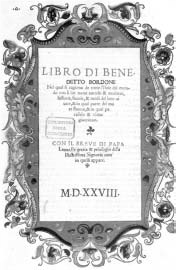
1) The title page of the book printed in Venice, allegedly in 1528. The date is written as {M.D.XXVIII.}, or with separating dots, q.v. in fig. 6.62.
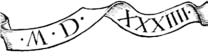
2) Map of the world by Joachim von Watt, allegedly of 1534. The date is written as {.M.D.XXXIIII.}, that is with separating dots, q.v. in fig. 6.63 and fig. 6.64.

3) The title page of the book by Johannes Drusius, allegedly printed in 1583. The date is written down as {M.D.LXXXIII.}, or with the separating dots, q.v. in fig. 6.65.

4) Publisher’s sigil of Lodevic Elsevir. The date, allegedly 1597, is written as {(I).I).XCVII.}, – with separating dots, as well as crescents facing left and right used for Latin letters “M” and “D”, fig. 6.66. This is a very interesting example, because the left band also has a recording of the date in “Arabic” digits.

The alleged date of the year 1597 is transcribed as I.597 (or I.595), Besides the dot separating the first “figure” from the remaining digits, we also see this figure of “one” clearly written as the Latin letter “I”, or the first letter of the name Iesus (Jesus).
5) The date “1630” is written with right and left crescents on the title pages of printed books presented on fig. 6.68 and fig. 6.69.

By the way, the title of the second book is quite curious – Russia or Moscovia, also known as Tartaria ([35], page 55).

 Hidden History Research