About Dating Silver Codex (Codex Argenteus)
Appendices
Yordan Tabov
Institute of Mathematics and Informatics
Appendix 1.
Excerpts from the article:
Noise, I. Gunpowder and acid. Electronic Almanac Art & Fact No. 2, 2006.
http://artifact.org.ru/content/view/15/70/
When they first began to produce glass tubes, one can only speculate, but when they began to use glass tubes and glass in chemical experiments is recorded in all encyclopedias.
Johann-Rudolph Glauber (Glauber JR) (1604-1668), as a pharmacist, first used glassware in his alchemical experiments. He mastered glass-blowing and founded industrial glassmaking in Thuringia (Germany), received liquid glass (potassium or sodium metasilicate). While manufacturing chemical glassware for experiments, he found that small additives in the glass of other substances greatly change its color. While experimenting, he received colored glass imitating precious stones. For example, red glass like ruby - adding gold salt to the glass.
The use of glassware allowed Glauber to obtain acids for the first time. He also invented the distillation process using a refrigerator. With this distillation method, glass tubes that were cooled in cold water were used for the first time. Glauber described his invention in the work “New philosophical furnaces, or a description of the first open art of distillation,” which he published in 1658.
Glauber managed to obtain very pure sulfuric acid from iron sulfate by heating FeSO4 crystals in a retort. 7H2O and driving off the obtained product – “vitriol oil”, which, as it turned out, could dissolve not only copper but also copper ores. Later, already in Amsterdam, Glauber began to use alum KAl (SO4) 2 to obtain sulfuric acid. 12H2O and “white vitriol” – zinc sulfate ZnSO4. 7H2O, which behave when heated similarly to iron sulfate. The trade name for the crude sulfuric acid is “vitriol oil”. Acids and other caustic and poisonous liquids should always be stored in thick-walled glass vessels with ground glass stoppers. Cork or wooden cork from these substances are destroyed and therefore unacceptable to use. Thus, the production of acids is directly related to the beginning of the use of glassware in alchemical experiments.
Sodium nitrate is a colorless or white mineral, NaNO3. Hardness 1.5–2, density 2.3. Easily soluble. Cleavage is perfect. Forms confluent or granular masses, less often cubic crystals. It occurs in the form of efflorescences on soils. Sodium nitrate was first mined in the valley of a tributary of the Danube River. Nitra in Slovakia.
Glauber received nitric acid and a glauber salt by the action of sulfuric acid on sodium nitrate. According to his technology, he took two glass flasks. I put sodium nitrate in one and poured it with concentrated sulfuric acid. Then he covered the first flask with a second flask, so that the necks of the flasks were connected. And he covered the junction with a hermetic solution. Then he began to heat the flask with the mixture. After some time, the nitrate began to dissolve, and the flask was filled with a reddish gas. It was nitric oxide. When all the nitrate had dissolved, he put the flask in a cold place for several hours. After that, white salt remained in the flask at the bottom – this is Na2SO4 (Glauber’s salt), and all the liquid in the bottle is smoking nitric acid. Usually the product of this reaction is yellow in color due to the presence of dissolved nitrogen dioxide in it, which is formed as a result of thermal decomposition of nitric acid. Then he poured the resulting nitric acid into a glass container. It should be noted that the concentration of the resulting nitric acid is proportional to the concentration of sulfuric acid at the beginning of the reaction. Then he poured the resulting nitric acid into a glass container. It should be noted that the concentration of the resulting nitric acid is proportional to the concentration of sulfuric acid at the beginning of the reaction. Then he poured the resulting nitric acid into a glass container. It should be noted that the concentration of the resulting nitric acid is proportional to the concentration of sulfuric acid at the beginning of the reaction.
Glauber conducted the reaction to produce nitric acid and glauber’s salt in 1625. (B. Grun. “The Timetable of history. A Touchstone book.” Published by Simon & Schuster, 1946, 1991, p. 280). Concentrated nitric acid (“spirit nitri”) turned out to be an extremely corrosive liquid that dissolved all metals (both iron – “Mars”, and copper – “Venus”, and silver – “moon”), only gold (“sun”) remained in nitric acid unchanged. Nitric acid stains skin, horn and wool, and turns yellow.
………………..
Glauber owned another important secret – the method of obtaining “Spiritus Salis” – hydrochloric acid HCl from sodium chloride under the action of sulfuric acid. Heating this mixture gave a colorless suffocating gas with a pungent odor (hydrogen chloride), which upon absorption by water gave hydrochloric acid. And one more undoubted achievement of Glauber is that by heating a mixture of nitric acid and ammonium chloride – ammonium chloride NH4Cl – he got “aqua regia” – a mixture of nitric and hydrochloric acids, which dissolves even gold. Glauber received royal vodka in 1648.
Glauber described the methods and recipes that he developed and perfected in his first major essay, New Philosophical Ovens, or a Description of the First Open Art of Distillation, which was published in 1650 (Furni novi philosophici oder Beschreibung einer neu erfundenen Destillir-Kunst, Amstelodami, 1648-50). In five volumes, all the methods known to Glauber for producing various acids, salts and other substances were described.
Acid ink
Johann Glauber in 1625 received sulfuric acid. For writing on parchment, “iron-gall ink” was used, the main ingredient of which is “oak apple”, a spherical painful growth on a tree, about the size of a playing ball, growing mainly on oak leaves and thin shoots. Such a growth occurs when a nut-grower lays an egg in a growing kidney, around which a soft pale green ball, similar to an apple, is then formed.
These nuts are crushed and saturated with rainwater – in the sun or near a fire. Sometimes, instead of rainwater, white wine or vinegar is used. This is the first component of iron-gall ink. The second important ingredient is ferrous sulfate, also known as vitriol, vitriol, or the “salt of death”. It was produced or found naturally in Spain, where it was formed as a product of evaporation of moisture from glandular soils. By the end of the sixteenth century, vitriol was probably produced by placing old iron nails in sulfuric acid; the resulting liquid was then filtered and the precipitate was mixed with alcohol (which explains the acidity of late medieval ink). Vitriol is mixed with soaked ink nuts and mixed well with a fig sprig. The resulting pale brown liquid slowly turns black. Gum arabic is also added, not so much for stickiness as for ink viscosity: goose feathers, unlike self-written ones, require viscous ink. Gum arabic is dried acacia juice shipped to Europe from Egypt and Asia Minor. The resulting pale brown liquid slowly turns black. Gum arabic is also added, not so much for stickiness as for ink viscosity: goose feathers, unlike self-written ones, require viscous ink. Gum arabic is dried acacia juice shipped to Europe from Egypt and Asia Minor. The resulting pale brown liquid slowly turns black. Gum arabic is also added, not so much for stickiness as for ink viscosity: goose feathers, unlike self-written ones, require viscous ink. Gum arabic is dried acacia juice shipped to Europe from Egypt and Asia Minor.
When exposed to air, iron gall ink darkens even more on the pages of manuscript books. Unlike fairly easily erasable coal inks, iron-gall ink is well absorbed in parchment. They are also more transparent and brilliant. ” (V. Baranov. Materials and manufacturing technology of a medieval manuscript book. In the book. Medieval manuscript book. Budapest. Faculty of Medieval Studies of the Central European University – electronic version.
http://www.ceu.hu/medstud/manual/MMMru/frame5. html).
The “acidity of late medieval ink” could first appear after Glauber received sulfuric acid in 1625. Consequently, all manuscripts made with “acid” inks date from 1625.
The reaction of the “silver mirror” and the purple dye
Aleksey Safonov
To carry out the “silver mirror” reaction, you must have AgNO 3 silver nitrate , ammonia solution NH 4 OH and any R-COH aldehyde, for example formic H-COH, or glucose, which also contains the group COH.
The reaction of the “silver mirror” is carried out in two stages:
1. It is necessary to obtain an ammonia solution of silver oxide [Ag (NH 3 ) 2 ] OH. For this, a 1% solution of silver nitrate is taken and a 25% aqueous ammonia solution is
poured onto it : 2AgNO 3+ 2NH 3 + H 2 O = Ag 2 Ov + 2NH 4 NO 3
First, a precipitate of silver oxide Ag 2 O appears . The ammonia solution must be added until silver oxide Ag 2 O goes into solution as a complex salt:
Ag 2 O + 4NH 3 + H 2 O = 2 [Ag (NH 3 ) 2 ] OH
2. To carry out the “silver mirror” reaction, an aldehyde is added to the solution of diammine silver hydroxide:
2 [Ag (NH 3) 2 ] OH + НСОН = 2Agv + HCOONH 4 + 3NH 3 + H 2 O
The resulting mixture is heated in a water bath to 70 ° C. An ammonia solution of silver oxide [Ag (NH 3 ) 2 ] OH oxidizes the aldehyde to an acid (in the form of its ammonium salt) to form free metallic silver. The reduced silver lays a thin layer on the walls of the chemical vessel in which the reaction is carried out, and a silver mirror is obtained (Illustration 6).
See Tollens Reaction – Silver Mirror Test for more on this.
http://www.uni-regensburg.de/Fakultaeten/nat_Fak_IV/Organische_Chemie/Didaktik/Keusch/D-Tollens-e.htm
To obtain a purple dye, aqua regia (a mixture of concentrated nitric HNO 3 and hydrochloric acid HCl in the ratio 1: 3), tin (II) chloride dihydrate SnCl 2 • 2H 2 O and Au gold.
The formation of the dye takes place in 3 phases:
1. It is necessary to dissolve Au gold in a solution of “aqua regia”:
Au + 4HCl + HNO 3 = H [AuCl 4 ] + NO  + 2H 2 O
Hydrogen tetrachloroaurate (III) is formed with the release of nitric oxide.
2. A 1% solution of tin (II) oxide dihydrate SnCl 2 • 2H 2 O is prepared . In order to prevent hydrolysis of tin, it is necessary to add a little hydrochloric acid HCl.
3. A little solution of tin (II) chloride dihydrate SnCl 2 • 2H 2 O: 2H [AuCl 4 ] + 2SnCl 2 + 4HCl = 2Au + 3H 2[SnCl 6 ] is poured onto tetrachlorooaurate (III) of hydrogen H [AuCl 4 ]

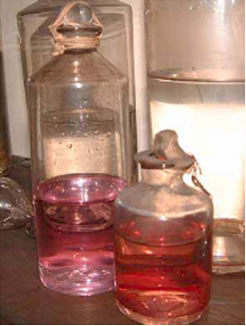
At first, the liquid turns yellow-brown, and after a few minutes a scarlet color appears. This is a colloidal solution of gold, the so-called “Cassian gold purple”, which was obtained in this way by Johann Glauber in 1659 [1]. Its color depends on the concentration of the reagents and takes on different shades – from scarlet to violet [2] (Figures 7 and 8).
 Illustration 7 |
Illustrations 7 and 8 show colloidal gold color solutions.
|

Literature:
1. Markus Niederberger, Colloidal Gold, 2006.
http://www.mpikg-golm.mpg.de/kc/scripts/colloidal%20gold.pdf
2. Entertaining chemistry. http://home.uic.tula.ru/~zanchem/zanopyt/2.htm#3
Excerpts from the article:
Akerman, S. Christina of Sweden (1626-1689), the Porta Magica and the Italian poets of the Golden and Rosy Cross. http://www.alchemywebsite.com/queen_christina.html
Queen Christina’s practise in alchemy preoccupied her for most of her adult life. Her interest in alchemy also has some intriguing Rosicrucian connections. The original Rosicrucians pamphlets of 1614 spread high expectations for a new age and a universal reformation of the arts and were circulated among radical Paracelsians in Northern Europe. The Rosicrucian elements that were to surface in Italy, however, appear to have grown out of a purely alchemical interest where the transmutational operations promised a future restoration of the “golden age” and was best expressed in poetry.
While the royal antiquarian in Stockholm, Johannes Bureus, dedicated Christina a manuscript copy of his speculations on the mystical origin of the Runes, his Adulruna Rediviva, in 1643 and a copy of his apocalyptic work, the Roar of the Northern Lion, in 1644, it is not known whether he showed her his reply to the Rosicrucian Fama, his Fama e Scanzia Redux of 1616.
………….
Prior to that that, however, Christina had been approved by the alchemist Johannes Franck, who described her future reign as the fulfillment of Paracelsus ‘prophecy of a return of Helias Artista and of Sendivogius’ vision of the the rise of a metallic monarchy of the North With these visions in store Franck urged on the Queen to start searching for the ruby red powder of the philosophers. He expressed these hopes in the tract that he offered her: Colloquium philosophcum cum diis montanis (Upsala 1651).
…………………….
Christina also owned some forty alchemical manuscripts by the foremost medieval authors, as well as practical handbooks. They included works by Geber, Johan Scotus, Arnold de Villa Nova, Raimund Lull, Albertus Magnus, Thomas Aquinas, Benard Trevisano, George Ripley, George Anrach d’Argentine, Johan Grasshof and a Rosarium Philosophorum – with its alchemical imagery of merging the solar -King and the lunar-Queen into a hermaphroditic union.
………………
There is no evidence to determine exactly when Christina started with alchemy, but her involvement tended to increase toward the end of her life. In the summer of 1667 in Hamburg, Christina experimented with the messianic prophet and alchemist Giuseppe Francesco Borri, but Cardinal Azzolino wrote her that she had to distance herself from Borri because he was searched by the inquisition. Christina at this time also corresponded with another alchemist, Johan Rudolf Glauber. She also took interest in the phosphorus discovered by Hennig Brandt. In her collecion of spiritual medieval manuscripts, counting to over 2000 items, are included texts by Joachim di Fiore and Campanella. Also on the list is a copy of the Hermetic Asclepius. Her collection includes Trithemius’ Steganographia (Ms. Reg. Lat. 1344) and John Dee’s Monas Hieroglyphica (Ms. Reg. Lat. 1266). She also owned parts of a Picatrix and a Latin version of the Sefer-ha-Raziel (Ms. Reg. Lat. 1300), a book of angelic magic. Her collection of printed books counted to several thousand items and included Paracelsus’ works, alchemical works of Johannes Theurneisser and Andreas Libavius. In 1655, she gave a large collection of alchemical manuscripts from Prague to her librarian Isaac Vossius. These were once owned by Rudolph II and are written in the German, Czech and Latin languages, a collection which now resides as the Codices Vossiani Chymici at the University of Leiden. Christina’s books are listed in a document now in the Bodleian library, Oxford. It is prefaced by a drawing of a rose in full bloom with the text “Erst einen Knop danach einen Rosen.” The corresponding list in the Vatican (Ms. Vat. Lat. 8171) carries a Bible, drawn by the same hand, with a bee and a spider with the text “Mel ibit tibi fel”, ie
……………… ..
In 1655, she gave a large collection of alchemical manuscripts from Prague to her librarian Isaac Vossius. These were once owned by Rudolph II and are written in the German, Czech and Latin languages, a collection which now resides as the Codices Vossiani Chymici at the University of Leiden. Christina’s books are listed in a document now in the Bodleian library, Oxford. It is prefaced by a drawing of a rose in full bloom with the text “Erst einen Knop danach einen Rosen.” The corresponding list in the Vatican (Ms. Vat. Lat. 8171) carries a Bible, drawn by the same hand, with a bee and a spider with the text “Mel ibit tibi fel”, ie
Christina was very eager to know more of alchemy and brought in a younger woman called Sibylla into the experiments. She also employed a working alchemist, Pietro Antonio Bandiera, to run her laboratory and finally testamented him the equipment. An alchemical tract was dedicated to her by Giovanni Batista Comastri, the Specchio della Verita (Venice, 1683). There is a document in her own hand, entitled “Il laboratorio filosofico – paradossi chimici,” but it appears to be notes from a text with the same title. The last text that Christina read, found by her deathbed in 1689, was a letter on the universal medicine, the alkahest, by Samuel Forberger.
Selected literature:
Susanna Akerman, Queen Christina of Sweden and her Circle: The Transformation of a Philosophical Libertine. Brill, Leiden 1991.
PC Van Boeren, Codices Vossiani Chymici. Leiden 1975.
Eugene Canseliet, Deux Logis Alchimique: En marge de la science et de l’histoire. Pauvert, Paris 1979 (1945).
Johannes Franck, Alkemiska skrifter: Hermetiska teser om den filosofiska stenens grundlaggande principer. Utg. Carl-Michael Edenborg. Philosophiska forlaget, Stockholm 1992.
Mino Gabriele, Il giardino di Hermes: Massimiliano Palombara alchimista e rosacroce nella Roma del Seicento. (Con la prima edizione del codice autografo della Bugia – 1656). Editrice Ianua, Rome 1986.
Kjell Lekeby, “Drottning Kristinas gudomliga metamorfos. Fran intersexualitet till mansblivande” Fenix 1997: 2.
Arne Wettermark “Christine de Suede et la science des roys: Quelques maximes a la lumiere de la tradition hemetique.” Nouvelles de la Republique des lettres 1990: 2 pp. 61-82.
Fragments of explanations of the details about the fate of the manuscripts from the Queen Christina library, given by Susanna Ackerman at the Alchemy Academy forum on the alchemy website http://www.levity.com/alchemy
Alchemy Academy archive September 1999
http://www.levity.com /alchemy/a-archive_sep99.html
Subject: ACADEMY: Christina’s alchemical manuscripts
Date: 5 Sep 1999 From: Adam McLean
Dear Susanna Akerman,
I am sorry I do not have any knowledge of the document you cite that might give us some insight into Christina’s alchemical work.
I wonder if I might ask you a separate question regarding Christina’s personal library, in particular the manuscripts she collected on alchemy. As we know it is found now mainly in two libraries – The University of Leiden and the Vatican.
Can you give us some information particularly on the alchemical manuscripts? Is there any clear picture of which works found their way to Leiden and which to the Vatican? Did this repesent a point of choice made by Christina? Did she choose only to take certain works to Rome? Or was this division entirely made by Vossius?
I am sure I read something of this in one of your books or articles but cannot imediately find the reference.
It would be instructive to have some information on this fine collection of alchemical manuscripts made by Christina in the 17th Century.
Adam mclean
Subject: ACADEMY: Christina’s alchemical manuscripts
Date: Mon, Sep 6, 1999 From: Susanna Akerman
Adam Mclean wrote:
> I wonder if I might ask you a separate question regarding Christina’s personal library, in particular the manuscripts she collected on alchemy. As we know it is found now mainly in two libraries – The University of Leiden and the Vatican.
A list of these manuscripts can be found on Adam’s site in the file on manuscript libraries, those of Leiden (Codices Vossiani Chymici or Voss. Chym.) And the Vatican (Reginenis Latini or Reg. Lat. For short).
Take a look!
> Can you give us some information particularly on the alchemical manuscripts? Is there any clear picture of which works found their way to Leiden and which to the Vatican? Did this repesent a point of choice made by Queen Christina? Did she choose only to take certain works to Rome? Or was this division entirely made by Vossius?
All of the above questions are very relevant for a future study. The problem is that there is little information over the procedure left in our archives. The Manuscripts at Leiden were given as payment to Isaak Vossius who as a Greek scholar of renown had worked to set up an academy in Stockholm to investigate the Oriental background to the Bible. Money ran short and the Prague collection was given as payment for his work in Christina’s court. In 1654 Christina had shipped them together with other collections on the ship Fortuna to Antwerp, where they were set up on the gallery of the stock-market pending her further plans.
The manuscripts had been taken by the Swedes at Prague in 1648 when Swedish troops invaded the Hradchin palace and looted books, manuscripts and artworks (such as Arcimboldi’s “vegetable” portrait of Rudolph). Most of the material in the collection were written during the time of Rudolph II. A particular item that interests me is the Latin index to Aegidius Gutman’s late 15th-century work, often thought to be lost: “Offenbarung gottlicher Majestat”. It is referred to by Julius Sperber in his “Echo” (1615) to the Rosicrucians as a work he had seen seventeen years before and in the same genre as the Rosicrucian writings. The collection contains many German and Czech items, as well as Latin ones. They are not lavish presentation copies but rather are plain copies of such works.
Christina’s Manuscripts in the Vatican may have been acquired later (as with Palombara’s “La Bugia”) when her interest and time for laboratory work increased. Thus she may not have been an active alchemical collector until her Roman period starting in 1656. The most curious item in her collection may have been brought from Stockholm: John Dee’s Monas Hieroglyphica (1564) written in German with illustrations. It is bound in red moroccan leather with her family (Wasa) coat-of-arms imprinted on it gold. In the same volume there is a letter of Fredrik V in 1618 announcing that he is “crossing the Rubicon”
What did Vossius expect of his collection? One may note that Spinoza in 1667 writes to Vossius to hear of his opinion on Dr. Helvetius announcement of a perfected processing of the
Stone in the Netherlands in the same year. Vossius answers that the case is not believable. It is difficult to judge whether this shows Vossius’ expertise or disinterest in the matter. In the literature it is said that Vossius wanted to trade his alchemical books for more interesting Greek manuscripts.
But the collection remains intact to this day at Leiden University library.
Susanna akerman
Subject: ACADEMY: Correction – Gutman
Date: Tue, 07 Sep 1999 From: Susanna Akerman
In my recent Christina-letter I inadvertently wrote that the index to Aegidius Gutman’s “Offenbarung” in the Leiden collection is a 15th cent work. I of course meant that it is from ca. 1575 or as it is listed at No. 644 Voss.Chym. F.37: “Manifestatio divinae majestatis descripta capite I Geneseos.”
For easy reference the web-adresses to Leiden and the Vatican listings are respectively:
http://www.levity.com/alchemy/almss30.html
http://www.levity.com/alchemy/vatican.html
with Reg.Lat items (Christina’s) at the end of the list.
Susanna akerman
Subject: ACADEMY: The alchemical library of Rudolph II
From: Adam McLean Date: 27th September 1999
Susanna Akerman in her book ‘Queen Christina of Sweden and her Circle’, and in a recent posting to this group, has shown that Queen Christina acquired much of Rudolph’s alchemical manuscripts during the Swedish occupation of Prague. These manuscripts were later divided into two main tranches, one of which is now in Leiden and the other in the Vatican.
Please excuse my ignorance, but has any scholar, on the basis of such information, attempted to reconstuct Rudolph II library, expecially the alchemical material? I feel sure someone must
have attempted this over the years, but such a publication has not come to my attention. It would be interesting to see just what alchemical material Rudolph had in his library.
Adam mclean
 Hidden History Research