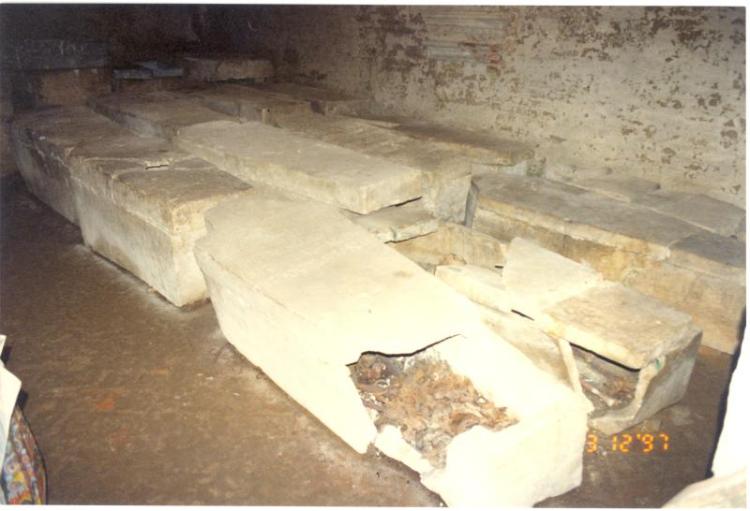
Tombs of the 15th/16th cc Russian Tsarinas under Archangel Cathedral, Moscow.
From NC :
At our disposal, from the editorial office of a well-known Moscow newspaper, unexpectedly there were rare photographs of the tombs of Russian tsars and a plan for their location in the basement of the Archangel Cathedral of the Moscow Kremlin. This material seemed extremely interesting to us. On its basis, important conclusions can be drawn. In December 1997, we personally visited the basement of the Arkhangelsk Cathedral and carefully examined all the tombs, comparing them with the materials we had and taking our own photographs.
From this visit a sad conclusion was reached.
I’m not so interested in which tomb belongs to which dead person. It’s more the utter desecration that seems to have been wrought by the Romanov. Not only did they rewrite the books but…
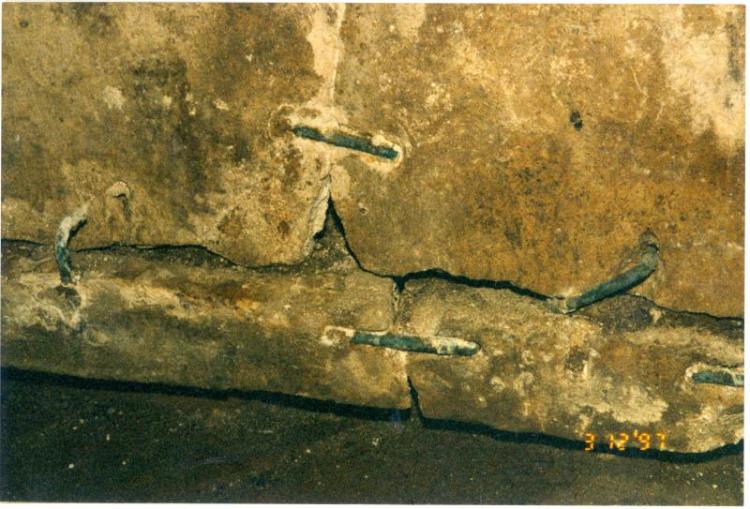
A careful examination shows that the vast majority of the tombs attributed today to the Russian empresses of the XV-XVI centuries are not made of solid stone, but OF FRAGMENTS OF STONE PLATES OF DIFFERENT THICKNESS. These fragments were fastened with copper pins or brackets. Then, all this rather fragile “structure” was plastered. Only after that did it take the form of a tomb. Naturally, when such “prefabricated tombs” were transferred from the Ascension Monastery to the basement of the Archangel Cathedral, the plaster from the seams partially crumbled, and as a result many tombs fell apart. The tombs were apparently transported sloppy. However, it is worth noting that the sarcophagi of the Romanov era, made of solid stone, did not split. And it was precisely the “prefabricated sarcophagi” that split into parts. In some cases, – for example, the tomb of Sophia Paleolog, the tomb of a relative of Staritsky – the sarcophagi were in especially poor condition. They are almost completely collapsed…
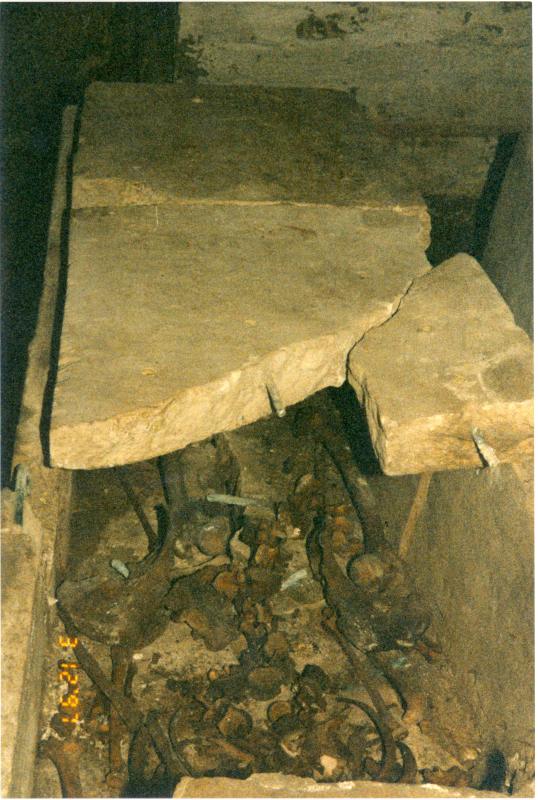
In the cracks, copper brackets are clearly visible, in any case – green, and not rusted, staples sticking out of the thickness of the stone. They fastened individual pieces of the combined tomb. Some of the staples fell out altogether, and now lie among the bones.
We see that these coffins were originally made not from solid limestone slabs, but from their pieces, so to speak, from battle, from debris. This means that in front of us are the OLD TOMBS OF SIMPLE PEOPLE, then issued by the Romanovs to the royal tombs of the 16th century. Such a manufacture of tombs of ordinary people from the fragments of stone slabs at hand is quite understandable. They made it simpler and cheaper. It is clear that not everyone could afford a sarcophagus carved from solid stone or cast from concrete.
So, apparently, the Romanovs in the middle of the XVII century simply used the old nameless tombs, or chased the names from some tombs, to bring the “material foundation” under their false version of history. The original burial places of the Russian-Horde Tsarina Romanovs simply destroyed. If at all these burials were in Moscow, and not in the royal cemetery in African Egypt, in the Giza Valley or in the famous Luxor. But the Romanovs needed to “present” something as evidence of the new picture of old Russian history they had drawn. And we see that it was in this era, in the 17th century, that Romanov historians and archaeologists “successfully discover” the supposedly authentic ancient tombs of Yaroslav the Wise, St. Vladimir, and so on.
Having received an order from above, they hastily made the “old royal burial”. However, I must say, quite casually. Apparently, they just came to the old MONASTERY CEMETERY and decided to turn it into a supposedly cemetery of “the former, pre-Romanov’s queens.” Old inscriptions with the names of the nuns were shot down. Tombstones with new “corresponding inscriptions” were placed at the top. Then they buried under each such slab on an old stone coffin. But since the coffins were DROPPED, the executive officials did not inscribe on them very carefully. In fact, is it worth the extra effort. All the same, now all this will be buried forever in the earth. In some cases, they forgot to inscribe the tomb. And in two cases, probably due to an oversight, they missed the names of simple nuns scratched with a nail on old coffins. So the fake “tsarist necropolis” was brazenly created in the Moscow Kremlin. In fact, as we understand it, there was simply no tsarist necropolis in the pre-Romanesque era in Moscow. The great Russian-Horde khan-kings and their queens of the XIV-XVI centuries were taken away to be buried in the imperial royal cemetery in African Egypt, in the famous field of the pyramids or in Luxor.
Less well-known were buried in Russia. But the Romanovs, having come to power in the 17th century, tried to destroy those old sarcophagi that could tell the true story of pre-Romanov Rus-Horde. And what we are shown today as “antiquity” is either Romanov’s remake or the old poor sarcophagi of ordinary people, issued by Romanov’s historians as “royal tombs”.
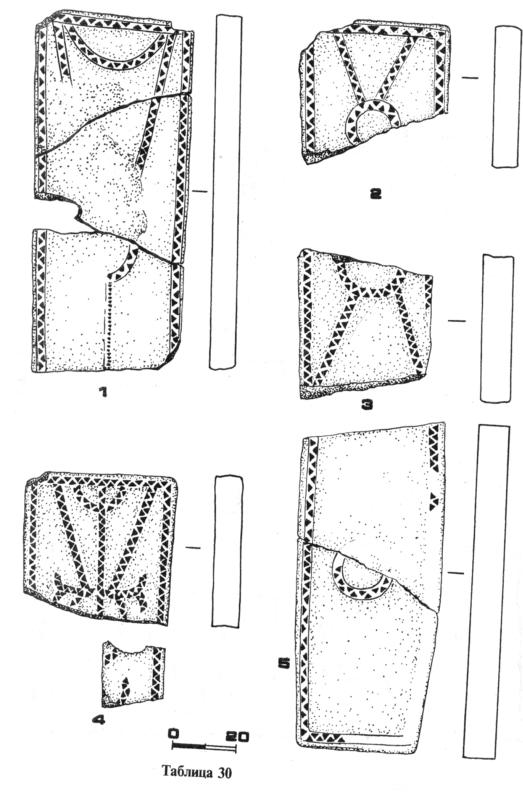
Having come to power, the Romanovs began to use genuine old Russian white-stone tombs as building material. This clearly expressed the attitude of the Romanovs to previous Russian history. Let’s think about it. In ordinary life, it is unlikely that ordinary builders, in search of building material for houses, will go to a neighboring cemetery and take tombstones from there. To build a house out of them. For example, would you like to live in such a house? Such things have always been perceived as an abuse of the memory of the departed. Sometimes such events occurred, but just as a sign of neglect or negative attitude towards those people who are buried under these plates. This is precisely what we see in the actions of the Romanovs, who came to power in Russia. As an example, we give evidence from the book of the archaeologist L. A. Belyaev [62]. Speaking about the excavations in the cathedral of the Epiphany Monastery in Moscow, he reports the following: “Ornamental white-stone gravestones of the beginning of the XIV century (?) From the refectory of the refectory” [62], p.297. That is, the old pre-Romanesque white-stone Nadrobi were used as a building material for the refectory,
Tomb of Peter the Great
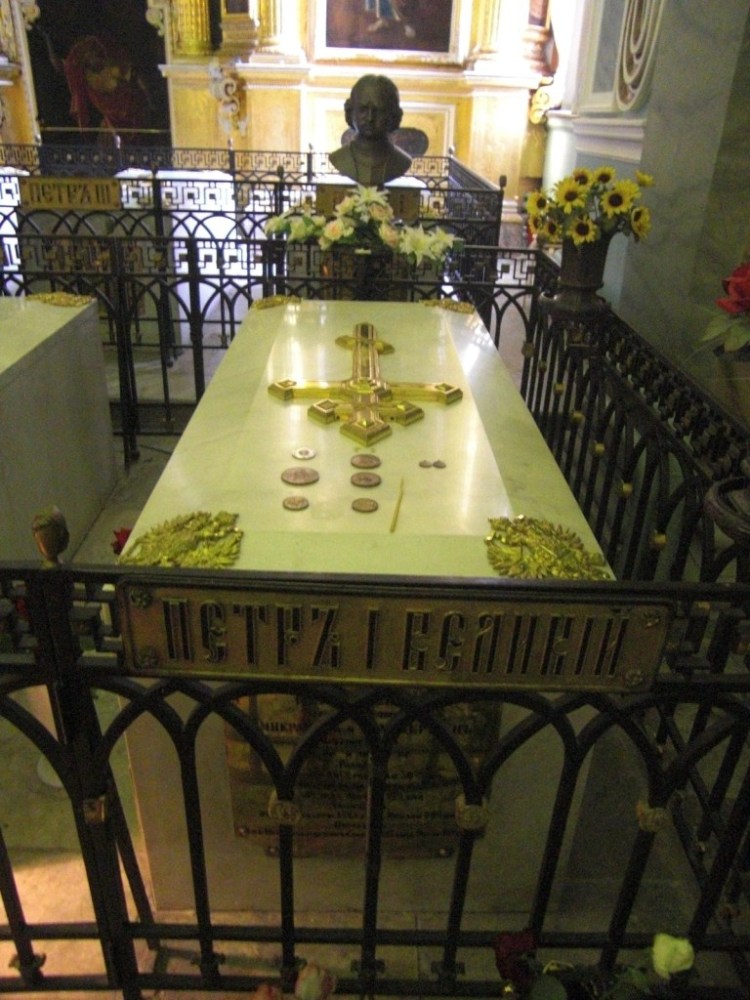
Photo Credit – © Susan Flantzer
Speechless is me :o(
.
 Hidden History Research