Oh. Something went awry there!
From SparkNotes :
Mark Antony
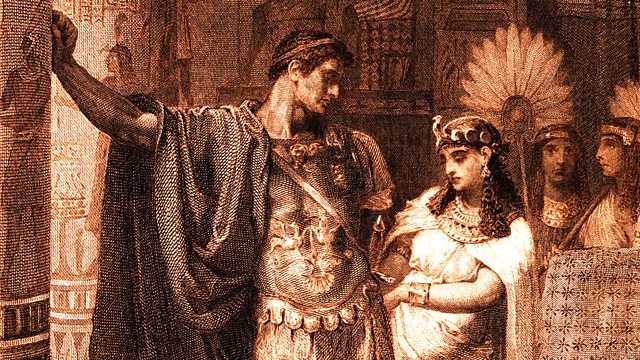
Throughout the play, Antony grapples with the conflict between his love for Cleopatra and his duties to the Roman Empire. In Act I, scene i, he engages Cleopatra in a conversation about the nature and depth of their love, dismissing the duties he has neglected for her sake: “Let Rome in Tiber melt, and the wide arch / Of the ranged empire fall” (I.i.35–36). In the very next scene, however, Antony worries that he is about to “lose [him]self in dotage” (I.ii.106) and fears that the death of his wife is only one of the ills that his “idleness doth hatch” (I.ii.119). Thus, Antony finds himself torn between the Rome of his duty and the Alexandria of his pleasure. The geographical poles that draw him in opposite directions represent deep-seated conflicts between his reason and emotion, his sense of duty and his desire, his obligations to the state and his private needs.
Antony’s understanding of himself, however, cannot bear the stress of such tension. In his mind, he is first and foremost a Roman hero of the first caliber. He won his position as one of the three leaders of the world by vanquishing the treacherous Brutus and Cassius, who conspired to assassinate his predecessor, Julius Caesar. He often recalls the golden days of his own heroism, but now that he is entangled in an affair with the Egyptian queen, his memories do little more than demonstrate how far he has strayed from his ideal self. As he points out to Octavia in Act III, scene iv, his current actions imperil his honor, and without his honor—the defining characteristic of the Roman hero—he can no longer be Antony: “If I lose my honor, / I lose myself. Better I were not yours / Than yours so branchless” (III.iv.22–24). Later, having suffered defeat at the hands of both Caesar and Cleopatra, Antony returns to the imagery of the stripped tree as he laments, “[T]his pine is barked / That overtopped them all” (IV.xiii.23–24). Rather than amend his identity to accommodate these defeats, Antony chooses to take his own life, an act that restores him to his brave and indomitable former self. In suicide, Antony manages to convince himself and the world (as represented by Cleopatra and Caesar) that he is “a Roman by a Roman / Valiantly vanquished” (IV.xvi.59–60).
Cleopatra
The assortment of perspectives from which we see Cleopatra illustrates the varying understandings of her as a decadent foreign woman and a noble ruler. As Philo and Demetrius take the stage in Act I, scene i, their complaints about Antony’s neglected duties frame the audience’s understanding of Cleopatra, the queen for whom Antony risks his reputation. Within the first ten lines of the play, the men declare Cleopatra a lustful “gipsy,” a description that is repeated throughout the play as though by a chorus (I.i.10). Cleopatra is labeled a “wrangling queen” (I.i.50), a “slave” (I.iv.19), an “Egyptian dish” (II.vi.123), and a “whore” (III.vi.67); she is called “Salt Cleopatra” (II.i.21) and an enchantress who has made Antony “the noble ruin of her magic” (III.x.18).
But to view Cleopatra as such is to reduce her character to the rather narrow perspective of the Romans, who, standing to lose their honor or kingdoms through her agency, are most threatened by her. Certainly this threat has much to do with Cleopatra’s beauty and open sexuality, which, as Enobarbus points out in his famous description of her in Act II, scene ii, is awe-inspiring. But it is also a performance. Indeed, when Cleopatra takes the stage, she does so as an actress, elevating her passion, grief, and outrage to the most dramatic and captivating level. As Enobarbus says, the queen did not walk through the street, but rather
Hop[ped] forty paces . . .
And having lost her breath, she spoke and panted,
That she did make defect perfection,
And breathless, pour breath forth.
(II.ii.235–238)
Whether whispering sweet words of love to Antony or railing at a supposedly disloyal servant, Cleopatra leaves her onlookers breathless. As Antony notes, she is a woman “[w]hom everything becomes—to chide, to laugh / To weep” (I.i.51–52). It is this ability to be the perfect embodiment of all things—beauty and ugliness, virtue and vice—that Cleopatra stands to lose after her defeat by Caesar. By parading her through the streets of Rome as his trophy, he intends to reduce her character to a single, base element—to immortalize her as a whore. If Antony cannot allow his conception of self to expand to incorporate his defeats, then Cleopatra cannot allow hers to be stripped to the image of a boy actor “squeaking Cleopatra . . . / I’th’ posture of a whore” (V.ii.216–217). Cleopatra often behaves childishly and with relentless self-absorption; nevertheless, her charisma, strength, and indomitable will make her one of Shakespeare’s strongest, most awe-inspiring female characters.
 Hidden History Research