It’s very weird how one thing can lead to another! I started with Dante and Beatrice (Bee-a-tree-chay…oops. Done that one.) and ended up in the Babylonian Captivity. Shrug.
O all ye passing by along Love’s way, attend a while and see if there be sorrow such as I sustain. Please suffer me and listen now, I pray; imagine patiently if I am inn and key to every pain. Not, surely, by my merit’s meager sway: by Love’s nobility, Love placed me in a life so sweet and sane, I often heard behind me others say: “How did he earn to be so weightless in his heart—please, God, explain?” Now I have lost impetuous delight that all my tender loving treasure lent, and I am indigent because I’m timid when I talk or write. So that, like those who hide impoverishment for shame of how they seem in others’ sight, outside my mood is light, while in my heart I wither and lament.
(Vita Nuova by Dante Alighieri)
Avignon vs. Rome: Dante, Petrarch, Catherine of Siena
THOMAS RENNA
And as a Final Research Stop…
From NC :
BABYLONIAN EXILE.
In the Bible there are a number of events called the ‘Babylonian Exile’. The first is the Babylonian exile of the XIV century, during the epoch of the ‘Mongol’ conquest. It is reflected in the history of the Catholic Church as the Babylonian captivity of the papacy. Its details are virtually unknown. What is suggested to us is a XVII century version. It was composed after the breakup of the ‘Mongol Empire’ and is a part of the distorted Scaligerian history. In particular Dante’s works, for example his ‘Letters’, where he speaks a lot of the Avignon Exile (he calls it Babylonian [2v1], ch.1:4) were written, most likely, not earlier than the XVII century.
The same refers to the works of Petrarch (allegedly 1304-1374) which were allegedly written XIV century. As we said before they were most likely to have been created in the XVII century [2v1], ch.1:4.
It is thought that Dante lived in 1265-1321 [797], p.359. The bronze bust of allegedly XV century, modeled on the mold of Dante’s face is well known [304], v.2, p.410. Most likely it was made not earlier than the XVII century using the death mask of a man who lived in that epoch. Alternatively it could be yet another ‘visual aid’ of the XVII-XVIII cc. for the textbooks on the Scaligerian history in front of us.
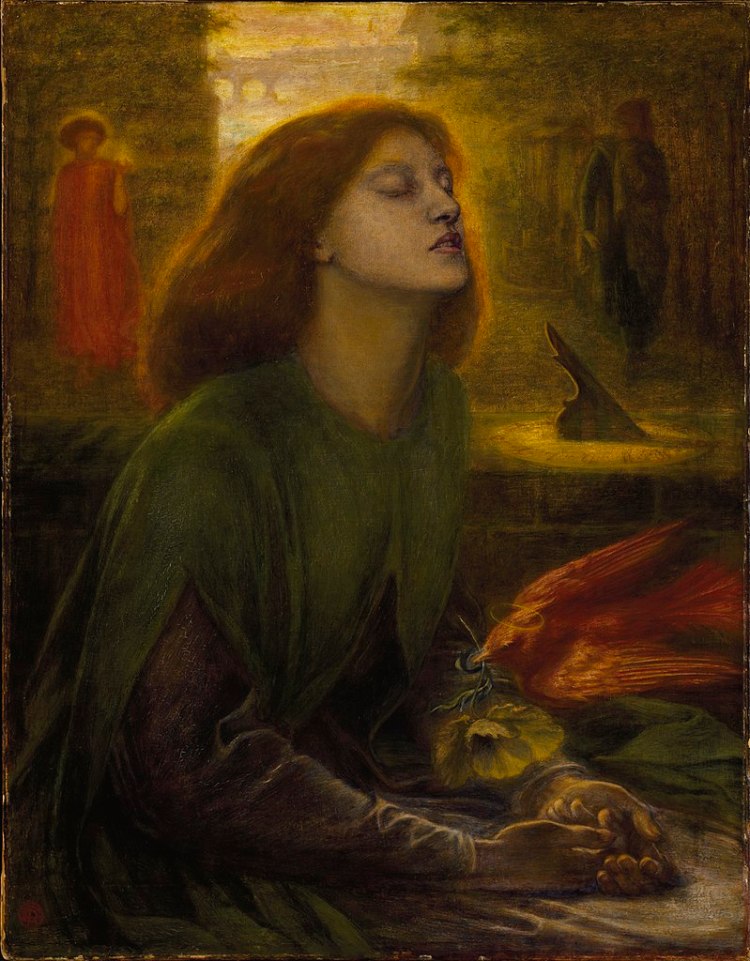
P.S. I lied. The final link is the picture above. Beata Beatrix by Dante Gabriel Rossetti, brother of Christina Rossetti – writer of the poem/song
“When I am dead, my dearest,
Sing no sad songs for me;”
 Hidden History Research