
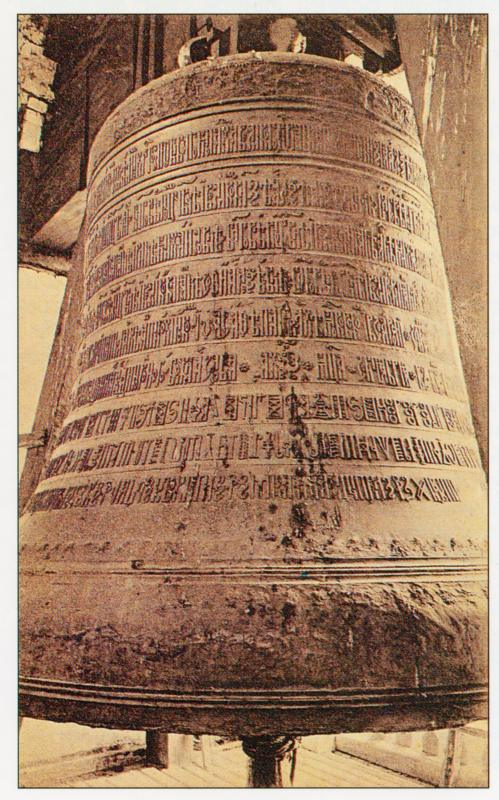
Usual Disclaimer: I don’t read Russian so this has been googlated from the original Russian text of Fomenko and Nosovsky. It may not be “quite” as complicated as it looks to us now in Computer English !?! My apologies.
We divide several letters merged into one into component letters and put them in curly brackets. The title is denoted by the sign “~”. We kept the line break given by N.M. Speransky. It should be remembered that the letter Kommersant used to be often read as O.
“COAT OF ARMS” By the grace of all goodness and with all of us {ba ~} our gogr
“Coat of arms” by the intercession? And? About? The faces of the defender L? Tzuyuzts? S
dy? icy ns? ez? Virgin “Coat of Arms” and for the prayer of our father
about “Coat of Arms” “Coat of Arms” and the merciful intercessor of the Reverend psav ??
“COAT OF ARMS” by ????? ny and ordered (a) the servant of Christ Yarya Ole (ksi) (ya) I {from}? L
celebrate your soulful and {from} heart desire “COAT OF ARMS” “COAT OF ARMS”
“GERB” zlt this bell? S ?? l ???? eat? T ?? il? L? L? K ???? is ??? l?
?? t ??? l ??? l ?? et ?? “COAT OF ARMS” and the great and reverend and {bg} and our miracle
of the Tsgov Palace? ve? lio? od ??? a? ikee? tsivgo? o? ekvll “COAT OF ARMS” “COAT OF ARMS” “COAT OF ARMS”
Most likely, the picture is as follows. Historians offer us as a “translation” of the inscription on the Zvenigorod bell a text found in the archives of the Tsar’s office. Moreover, it is unclear to what time the “cryptography translation” refers. Maybe this clerical translation was made at a time when the old Russian alphabets of the XVI-XVII centuries were already thoroughly forgotten. The inscription on the bell could no longer be read as freely as before. The result was a very approximate retelling of it. There were probably several attempts to read the inscription. “Translations” turned out to be different. Some of them survived to our time and were perceived as “inscriptions from different bells.” As a result, a legend might have appeared as if there were two Zvenigorod bells. On which there were allegedly similar inscriptions. One listed members of the royal family and patriarchs. And in the other – the brothers of the monastery, elders and monks.
One gets the feeling that modern historians prefer not to read the original inscriptions on the Zvenigorod bell, but instead cite its various and very approximate “translations” made in the 18th-19th centuries.
 Hidden History Research