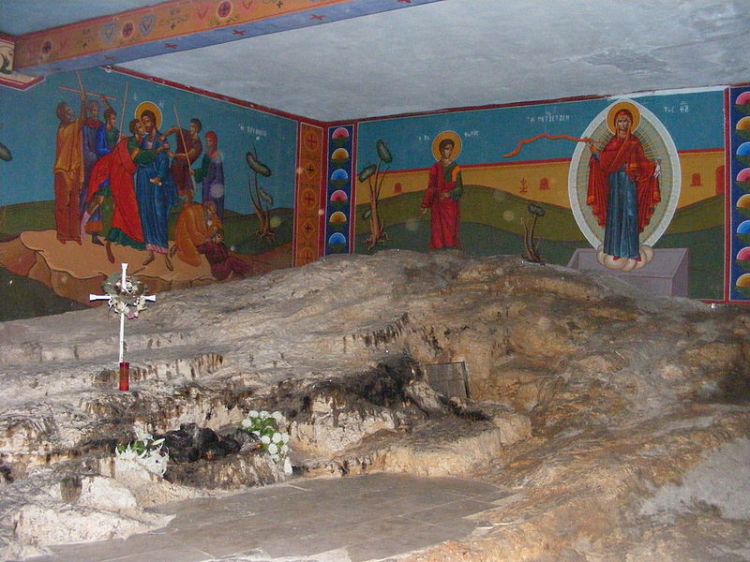
Reputed site of the stoning of Stephen, Greek Orthodox Church of St Stephen, Kidron Valley, Jerusalem
Or Boxing Day. M’eh.
NC :
23. STEPHEN PROTOMARTYR AND STEPHANOS HAGIOCHRISTOPHORITES WHO WAS THE FIRST MARTYR FOR ANDRONICUS.
In the history of the Christian Church it is known that the FIRST martyr for Christ was Archdeacon Stephen. See for example ‘Acts’, chapters 6-7, 8:1-2; and also [153], an article ‘Stephen, the Archdeacon and Protomartyr’.
 one of the numerous old images of St. Stephen martyrdom.
In the biography of Andronicus the FIRST of his attendants who died during the rebellion was named as the chief of the palace guards STEPHANOS Hagiochristophorites, i.e. translated from Greek into Russian ‘Stephen Supporter of Holy Christ. This is how Choniates describes the very beginning of the rebellion.
‘The hot and hasty Stephanos Hagiochristophorites, who cared for his lord and emperor in various ways, agreed to arrest Isaakios Angelos … He arrived at the house of Isaakios … and ordered Isaakios to descend and follow him… As was to be expected Isaakios delayed, speculating that as soon as he appeared the worst of all possible evils would befall him. Hagiochristophorites was resolved to use force… Isaakios saw that he could not escape… With sword drawn (his head was bare and over his body he wore a cloak…) he mounted his horse and raised his sword hand against the head of Hagiochristophorites … ISSAKIOS BROUGHT DOWN A MORTAL BLOW AND STRUCK THE POOR WRETCH IN THE MIDDLE OF HIS SKULL. Having cleaved him in twain, he let him lie there… As for Hagiochristophorites’ attendants, he terrified the one with his bare sword, cut off the ear of another, and another flying elsewhere whereupon all fled to their homes. Then Issakios rode at full speed towards the Great Church … He shouted out to all, that with this sword … HE HAD KILLED STEPHANOS HAGIOCHRISTOPHORITES … Those of the city populace … came streaming by the thousands to the Great Church… Among the others Isaakios’ paternal uncle, John Doukas, together with his son Isaakios, came to his assistance and hailed his act of sedition… Because none of the emperor’s supporters was present … neither from among the illustrious nobility nor from among those who retained Andronikos’ favour, nor axe-bearing barbarian, nor … lictors … the assembled throng became bold and excited … Andronicus was not present in the imperial palace, but was at the palace of Meloudion, situated on the eastern side of the strait leading into the Propontis.
Near the first watch of the night, he heard of Hagiochristophorites’ death he … addressed the citizens of the capital with a brief dispatch that exhorted them to desist from attempting to foment rebellion; it began as follows: ‘He who has received, has received; punishment has ceased’. In the early dawn, Andronicus’ attendants attempted to restrain the swelling mob, and Andronicus himself arrived at the Great Palace on an imperial trireme … Isaakios (Angelos – Author) was anointed emperor and … left the Great Church accompanied by Patriarch Basil Kamateros … When Andronicus arrived at the Great Palace … he gave his attention to resisting the mob and assembled his companions to go into battle … He soon realized that he was attempting to accomplish the impossible and spoke to the people through a messenger. He agreed to lay aside his crown and deliver it to his son Manuel … But exasperated more than ever by his words, the mob heaped the most atrocious insults on both him and his designated successor … Because the multitude was now pouring inside the palace through the so-called Karea Gates, which had been broken down, Andronicus fled, taking off his purple-dyed buskins. Struck mad by God, on the way he REMOVED HIS ancient amulet and the CROSS from his neck and donned a barbarian cap that tapered to a point like a pyramid. Thus attired he boarded the same royal trireme…’ [140], p.349-354.
Thus the rebellion against Andronicus, culminating in his deposition, started exactly with the murder of Stephanos. It was him to be the first ‘martyr for Andronicus’. Besides Stephanos Hagiochristophorites was chief of the royal guards, i.e. was the chief attendant, the archdeacon in Greek. Like Stephen Protomartyr, the Christian Saint. He was the Archdeacon [153]. Therefore, the name of the first man, who died for Christ and the name of the first man who died for Andronicus are the same. It was Stephanos.
As a final point we would like to point out another solid parallel. Stephen Protomartyr was stoned [153]. The stoning mentioned above – incidentally the only one described by Nicetas Choniates – was also mentioned in connection with STEPHANOS Hagiochristophorites specifically. Though, according to Choniates it is Stephanos himself who is doing the stoning [140], p.305. But we understand that we are dealing not with the original text, but with its edited version. That is why who exactly was stoning whom depends on the affiliation of the chronicler. ‘Good people’ and the ‘evil’ ones often swapped places on the pages of the chronicles. But the very fact of stoning survived.
We will once again quote from Choniates: ‘Stephanos Hagiochristophorites …picked up a stone the size of his hand and threw it at Makrodoukas… he urged everyone to follow his example … The entire assembly picked up large stones and hurled them at the men…’ [140], p.305.
In fig.2.36 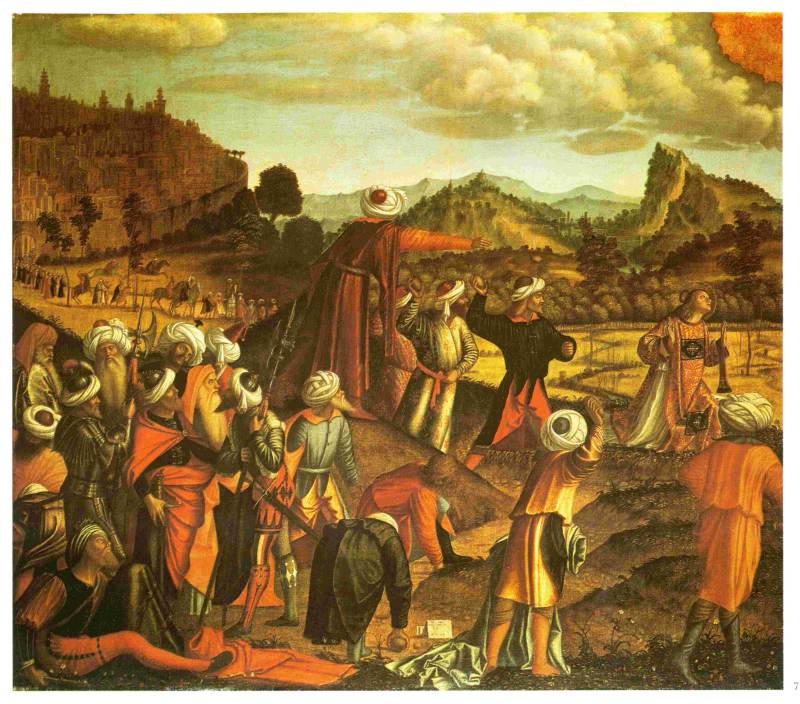 there is presented a painting by Carpaccio ‘The Stoning of St. Stephen’. Stephen is depicted on the right. He has already fallen on his knees and they are throwing stones at him. A central figure in a red royal garment standing on a hill and pointing at Stephen, draws our attention. It is possible, that this was the way of depicting Isaakios Angelos, who became an emperor that day. And who personally murdered Stephanos Hagiochristophorites, see above.
In fig.2.37  there is presented a painting by Giorgio Vasari ‘The Stoning of St. Stephen’. Here we also see a figure on the left emphasized with particularly bright, orange colours. The artist clearly wanted to draw the spectators’ attention to this man. He strikes Stephen. It could be Isaakios Angelos, who headed the rebellion against Andronicus and who killed Stephen with his own hands.
 Hidden History Research