I LOVE AMP’s work. But…
…Like all his colleagues, he challenges my little grey cells almost to bursting point. Which is GOOD :o)
The Great Parable of History
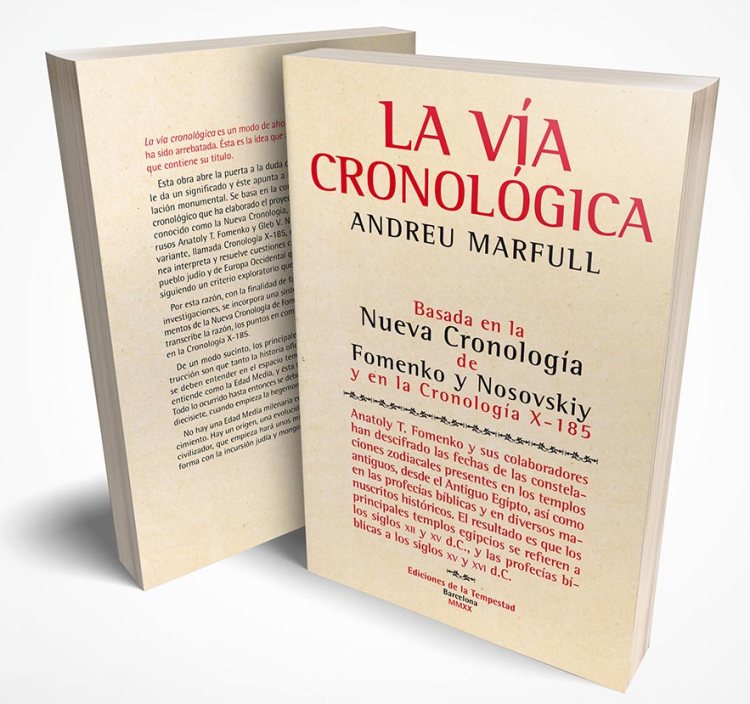
Chapter of the book:The chronological path: Based on the New Chronology of Fomenko and Nosovskiy, and on the X-185 Chronology© Andreu Marfull Pujadas© of this edition: Ediciones de La Tempestad SL, 2020Barcelona, May 2020ISBN 978 84 121768 1 0
***According to the reconstruction that is transcribed here, together with the Tartar and Mongol expansion, a priestly body is created that preaches the grace of God associated with an imperial lineage, which with the glory of Genghis Khan becomes universal. With this, the Kingdom of God is fused with the birth of a new power that wishes to rule the world, establishing itself as the “chosen one”, or “anointed one”. The Tatar or Mongol power thus creates the glory of a deified being, who returns to his original land to take control of the main symbolic empire: the Holy Land of the Nile.
It is the resurrection of the “divine” power of Osiris, who acquires another identity in Horus. Behind her is the takeover of Egypt, from multiple narratives, such as the wrath of the God of the Hebrews in the time of Moses. But there is also the equivalent story of Alexander the Great, who also liberates the Jews and allows them to take control of Egypt. For this reason, and not for another, official history has written that Alexander the Great “resurrects” as a new God, and equates him to Amon (or Amen, which is how it is pronounced in the Egyptian language). That is to say, Amon in Alexander is also Horus, and in turn he is Christ, and his power comes from the Tartar or Mongol arm, which is also Jewish. And for the same reason, the Jewish people celebrate liberation from the Babylonian yoke with the feast of Hanukkah (or Hanukkah), also known as the Festival of Lights. This symbolism commemorates the liberation of the Jewish people in the hands of the Greco-Persians and the rebuilding of the Temple of Solomon. Historically, it goes back to the times of the great Alexander the Great, whom the Jews traditionally honor by calling their first-born sons Alexander, ever since.1
Everything is the same story.
Figure 27 depicts this episode, and shows its historical, Egyptian, biblical and medieval meaning, and is articulated in the form of the Osiris myth, from his death at the hands of Seth (his brother) until his resurrection by means of the intercession of Isis, who succeeds in begetting Horus; going through the subsequent fight between Horus and Seth, in which the former wins. It is the sacred history, which has come to us written in multiple ways.

Figure 27. Equivalences the myth of Osiris with the Old Testament and the Middle Ages . Source: self made.
Figure 27 can be summarized in four narratives (The Myth of Osiris, the Symbolic Bible, the Historical Bible and the Middle Ages), and in the transition from the Empire of Osiris to that of Horus, in a process that lasts approximately 116 years, where biblical history has turned the years into centuries and sent them more than a thousand years into the past. But in reality, the events occurred six centuries ago, between 1370 and 1486.
Then, the death of Osiris before his brother Seth, after which Osiris resurrects and conceives Horus, with Isis, is
- the death of Abel before Cain, and after that Eve conceives Set, to fill Abel’s void;
- the sacrifice of the parents of Moses and their adoption with Pharaoh;
- the failed first Temple of Solomon, which is destroyed by the king of Babylon, despite the fact that the Jews maintain their prestige;
- the death of Andronicus Komnenos in 1370 (the official 1185) and the subsequent reconstruction of his power with the appearance of the Kingdom of Georgia and the Empire of Trebizond, in the alternate year 1389 (the official 1204), and the Battle of Kulikovo, of 1380, after which a distribution of powers between Mongols is agreed; and
- the invasion of all Asia, Persia and half of Europe by Genghis Khan, who allied himself with the Keraites, after subduing them (in the same way that the Babylonian king Nebuchadnezzar subdues the biblical people of Israel and later allies with them).
In this initial scenario,
- Osiris is Andronicus Comnenus;
- Seth are the king of Babylon, Nebuchadnezzar, Isaac Angelus (family of Andronicus, and who makes him kill) and Genghis Khan;
- Isis is the adoptive mother of Moses (Pharaoh’s sister) and Queen Tamar of Georgia; and
- Horus are Moses and King-Emperor David of Georgia and Trebizond.
The fight between Seth and Horus is
- the chronicle of the Great Flood;
- that of the plagues of the angry God against Pharaoh;
- the destruction of the first temple of Solomon by the king of Babylon; and
- the Mongol occupation of Persia and half the known world.
Horus’s victory over Seth is
- that of David against Goliath, and the later glory of the kingdoms of Judah and Israel;
- that of Alexander the Great on Egypt and Persia, Babylon, in which Israel is liberated and Solomon’s Temple is rebuilt;
- that of the Mamluks over Egypt (official year 1250, alternative 1435), resulting in the Palaiologos at the head of the Greek or Roman Empire (official year 1261, alternative 1446), Prester John at the head of the Imperial House of Ethiopia (year 1270 official, 1455 alternate) and to the division of the entire Mongol Empire into great powers belonging to one main lineage.
The great pact between East and West is
- the birth of a great lineage, fused with the ancient powers, which Genesis (Ge. 6) assimilates to the union between the Giants and the children of Adam and Eve, prior to the Flood;
- the Ark of the Covenant, God’s covenant with humanity in the times of Noah, Abraham and Moses;
- the pact of the “Alexandrian” empires of Greece, Egypt and Persia, after which the second Temple of Solomon was created;
- the pact of the Tartar or Mongolian Peace, in which commercial relations flourish from China to Europe, and the medieval Greek Empire; and
- the pact of the Ark of the Covenant that is kept in the kingdom of Prester John, of the Imperial House of Ethiopia, “descendant” of the kings Solomon and Saba, that the Apocalypse dates in the year 1486.
After which arises
- the glory of the Gnostic Christ in Jerusalem and that of Buddha in the East.
And, in this context, the Exodus from Babylon is
- the result of the “covenant” between Israel and Babylon to rule together, which is described in the Bible; as well as
- the alliance between Genghis Khan and the Keraites (the Hebrews before the Jews who follow the Law of Moses).
And, the so-called “second Exodus from Babylon”, which is assimilated to the Avignon papacy, is
- the project of the renovated Temple of Solomon, after the great Alliance, in which the Jewish princes are protagonists.
In this way, after this great struggle a new God is built and another story begins. Alexandria is founded and the Bible is written there, starting with the main book, the one that God dictates to Moses (the Torah) and the one honored by the Jews throughout history, from Genesis to Moses.
When Egypt is taken over everything changes. Osiris mutates and remains in Egypt, but Horus is reborn from him in the form of an omnipotent God, Yahweh, and an emperor who acquires different names: Jesus, Buddha or Krishna, and with them various spiritual schools are created, which are guarded under the priestly authority of Prester John, of the House of Solomon. Muhammad, in this context, appears associated with the Queen of Sheba, sharing a common land: present-day Saudi Arabia, and is undoubtedly part of this crucial episode in history, surely in the stage of the return to Egypt and in the establishment of the great pact between East and West, after the deed of Alexander the Great.
In turn, in the Christian tradition, it is the story that has commemorated Saint Thomas, who goes to India and meets the Magi, who bless him and grant him power to Prester John, thus initiating Christianity, in the same area of influence of the Buddha. Thomas means “twin”, and the New Testament assimilates him to the twin of Jesus, thus hiding their inalienable relationship. That is, “twin” refers to a duplicate, and tells us about his “birth.” The El Becerro manuscript (Fernández de Mendoza, nd) describes it in great detail. two
Later, some gospels are created from which the idea arises (with the passage of time) of creating a New Testament, shaping the ancient historicity of Jesus, as shown in Figure 28 attached.

Figure 28. Equivalences of the Osiris myth with the New Testament. . Source: self made.
The correlations are obvious. The symbolic story is the same, but the official story has (almost) nothing to do with it.
In this way, the essence of the great parable of history that the Bible threatens is resolved, both in the Old and New Testaments, as well as in Genesis, the Torah, and ancient and medieval stories.
With little more than a century really documented, thousands of years of long history have been built.
In this way, the X-185 Chronology reconstructs the moment in which the organized religious idea was born, in the fifteenth century, and points to the religious dispersion for the next two centuries, in the line posed by Fomenko’s New Chronology and Nosovskiy, but it is given another interpretation. Before, the cult of the polytheistic tradition develops, which persists until the seventeenth century, and it is then when its deliberate dismantling begins to, in this way, reunify the religious dispersion into one of the main, the Christian, and thus initiate the “ colonization”. And when this happens, an official history is built from the long biblical history, this time definitive and monumental, which has lost consciousness of its true origin.
1 Contribution of M. Ferrús.
2 The cited manuscript is worked on in section “Preface
 Hidden History Research
)