OK.
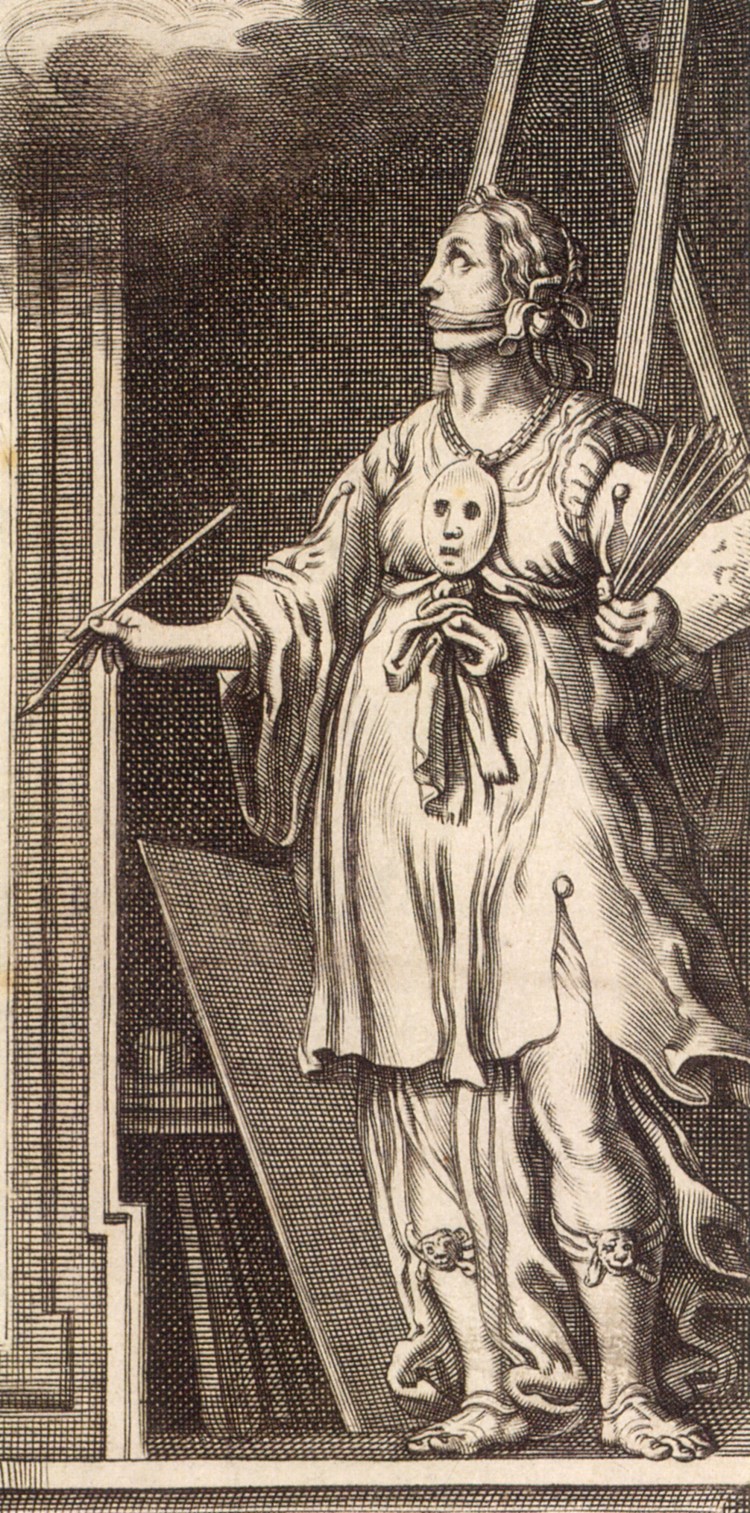
We get the image above which is NOWHERE in my original source “key” to unlocking art but somewhere, somehow, something happened.
Description of image above (which – so far – I’ve FAILED to track down to the “original/primary” source.)
Face mask vibe?
Oh and BTW – we are in the 17th century here!!!!
Sigh :o(
WOMAN, beautiful, with black hair, and thick, scattered, and twisted in various ways, with arched eyelashes, showing fantastic thoughts; cover the mouth with a band tied behind the ears, with a gold chain around the neck, from which a Mask hangs, and has Imitatio written on the forehead. She will hold the Brush in one hand, and in the other the panel, with the iridescent cloth covering her feet, and at the foot of it some instructors of Painting can be made, to show that Painting is a noble exercise. , not being able to do without much application of the intellect, from which application all the professions of any kind are caused, and measured near us (not doing the works done at random, although very perfect to the praise of the Author, otherwise ,than if they weren’t his). This very beautiful image is painted, and, if the beauty is aware of nobility, it is seen, because: the one, and the other is perfection, and the one, and the other is worthy of Empire; and according to Homero’s saying they both like, and delight, move, and fall in love, but the one, which is corporal, primarily the senses, the other, which is intelligible to the intellect; on the contrary, they are not even similar, but they are reputed by many Philosophers, and it is commonly believed that where there are beautiful qualities of the body there are mostly those of the soul, and where there is beauty there is nobility. The hair of the head becomes black, and thick, because being the good Painter in constant thoughts of the imitation of nature, or of art, as it gives perspective, and is the object of the eye,and for this, since he needs almost continuously to have all the visible effects of nature for his imagination, he comes for this reason to take great care, and maninconia, which then generates addiction, as the Medici say, from which naturally in men with many others this particular accident occurs. Hair will be hirsuti, and scattered overhead, and in different parts, with rings, which appear to be produced by neglect, because these arise outwardly from the head, as thoughts are born inside, and ghosts, which are means as to speculation, so again to material works. The arched eyelashes show wonder. And truly the Painter extends himself to such a subtle investigation of minimal things in themselves with the help of his art, that he easily acquires wonder and maninconia.The covered Mouth is indicium, which is not a thing, which is as useful as silence and solitude; however, the Painters are kept in secret places, not because they fear reproof of the imperfect work, as is commonly estimated. He holds the Golden Chain, from which the Mask hangs, to show, that the Imitation is inseparably linked with the Painting. The Anelletti della Catena show the conformity of one thing, with the other, and the conjunction, because not everything, as Cicero says in his Rhetoric, the Painter learns from the Master, but with only one he learns many, coming for conformity , and simile joined, and chained together. The quality of the Gold demonstrates that when the painting is not maintained by the nobility it is easily lost, and the mask shows the appropriate imitation to the painting. The ancients demanded Imitatione that discourse which, although false, was made with the guidance of some truth that had happened, and because they wanted that those Poets, who lacked that part, were not reputed Poets, so the Painters are not to be imitated, who they have not, since that trivial saying is true, that Poetry is silent in Painting, and Painting in Poetry reasons; it is true that they are different in the way of imitating, proceeding by opposition, because the visible accidents, which the Poet makes almost visible with his intellect, by means of intelligible accidents, are first considered by the Painter, for through which he then makes the mind understand the things signified; and it is nothing other than Pleasure, which one takes from one and the other of these professions, if not, that by force of art, almost with the deception of nature, he makes one understand with the senses, and the other feel with the intellect. Painting therefore needs the imitation of real things, which the Mask, which is a portrait of the face of man, hints at. And the iridescent garment shows that the variety is particularly delightful, as shown by the covered feet, that that one. . .
 Hidden History Research