
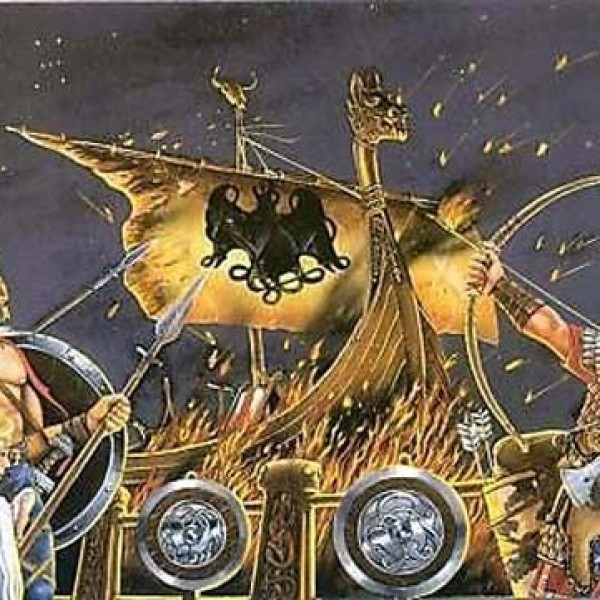
When a chief from among them dies, his family says to his young male and female slaves: “Which of you will die with him?” One of them then says: “I will,” Once he says that, it becomes binding on him, and he is unable to go back on his word, ever. Even should he desire to do so, it is not permitted. Most of those who do this are female slaves.
When the man, whom I mentioned before, was dead, they said to his slave girls: “Who will die with him?” And one of them said: “I!” They then put two girls in charge of her, to guard her and be with her wherever she went, even to the point that they sometimes washed her feet with their own hands. They then turn to matters pertaining to him, such as the cutting of his clothes doing whatever is necessary. Meanwhile, the slave girl drinks and sings every day, and is joyous and cheerful.
When the day came on which he and the girl were to be burned, I went to the river where his boat was, and indeed it had already been taken out of the water, and was supported by four pillars made of khadhank and other types of wood. A structure similar to large wooden scaffoldings was placed around it. Then the boat was dragged up until it was placed on top of the wooden scaffolding. They then began to walk back and forth, uttering words which I did not understand while he was still in his grave from which they had not taken him out. They then came with a bed, put it on the boat and covered it with quilted mattresses of Byzantine brocade, as well as with cushions of Byzantine brocade. Then came an old woman whom they call the angel of death and spread out on the bed the above-mentioned furnishings. She took charge of sewing it and putting it in good shape. She is the one who kills the slave girls. I saw her as a young, old witch, massive and somber.
When they came to his grave, they brushed the dust from the wood and then set the wood aside. They pulled him out wearing the garment in which he had died. I saw that he had turned black already from the cold of that country. They had placed nabidh, fruit and a three-stringed lute in the grave with him. They now took all this out. Indeed, he had neither started to decompose, nor had he suffered any change other than that of his color.
They dressed him in trousers, leggings, a tunic, and a brocaded caftan with gold buttons. On his head they placed a cap made of brocade sable fur, and brought him along until they carried him into the tent which was located on the ship. They seated him on the quilted mattress and propped him up with the cushions. They ten brought nabidh, fruit and aromatic herbs and placed them with him.
They came with bread, meat and onions and threw them in front of him. They brought a dog, cut it in two and threw it into the boat. They then brought all his weapons and laid them at his side. Then they took two horses, ran them until they broke out in a sweat, then they cut them up with the sword and threw their meat into the ship.
They then came with two cows, cut them up likewise and threw them in it. They then fetched forth a cock and a chicken, killed them both and threw them into the ship.
The slave girl who wants to be killed wanders back and forth, entering one after another of their huts. The man in the hut has sexual union with her, saying to her: “Say to your master that I did this out of love for you.”
When it was the time of the afternoon prayer on Friday, they brought the girl to something they had set up similar to the frame of a door. She then placed both her feet on the palms of the men’s hands, and she was lifted up, peeped over the door frame and uttered certain words. They brought her down and raised her up a second time, and she did as she had done the first time. They then lowered her and raised her aloft a third time. She performed as she had done the two previous occasions. They handed her a chicken, and she cut off its head and flung it aside. They took the chicken and threw it into the ship.
I asked the interpreter about what she had done, and he said: “The first time they lifted her up she said: ‘Behold! I see my father and my mother.’ The second time they did so, she said: ‘Behold! I see all of my dead relatives seated.’ On the third occasion, she said: ‘Lo! I see my lord sitting in paradise, and paradise is beautiful and green, and with him are men and slaves, and he is calling me. Take me to him’” They took her in the direction of the ship. She took off two bracelets that she had been wearing and handed them over to the woman whom they call the angel of death, the one who is to kill her. She removed two anklets that she had on and gave them to the two girls who had been waiting on her and who were the daughters of the woman known as the angel of death.
They raised her up to the ship, but did not let her into the tent. Men came carrying shields and wooden staves. They then gave her a bowl of nabidh. She sang over and drank it. The translator said to me: “With that she is bidding farewell to her women companions.” Then she was handed another cup. She took it, and made her song over it rather long and drawn out, while the old woman was inciting her to drink it and enter the tent in which was her master.
I saw her overcome with confusion. She wanted to enter the tent, but had inserted her head between it and the ship. The old woman took her head, directed her into the tent and entered with her.
The men began beating the shields with their staves lest the sound of her cry be heard, and the other slave girls became greatly distressed and no longer seek death with their masters. Six men then entered the tent, all of whom had sexual intercourse with the girl. They then laid her down at the side of her master, and two of them seized her feet, and two of them her hands while the old woman, who is called the angel of death, placed a rope around her neck, the two ends of which pointed in opposite directions, and handed it to two men to pull on. She stepped forward, holding a dagger with a wide blade, and began sticking it in and pulling it out in different places between the ribs of the girl. Meanwhile, the two men were simultaneously strangling her with the rope until she was dead.
The nearest relative of the dead man then appeared, took a piece of wood and lighted it at the fire. He then walked backward with the back of his head toward the ship and his face toward the people, holding the burning wood in one hand while he kept the other hand over his anus, for he was naked. [This was kept up until] he had set fire to the wood that was stacked under the ship, after they laid the slave girl they had killed at the side of her master.
The people then came forward with sticks and firewood. Each one of them had with him a piece of wood, the end of which he had set on fire, and which he now threw upon the wood packed beneath the ship. This spread to the firewood, then to the ship, then to the tent, [and finally to] the man and the slave girl and everything therein. There then began to blow a mighty and frightful wind, and the flames of the fire were intensified, and its blaze flared up.

 Hidden History Research
This is so shocking! How brutal. Mesmerising read though. It’s amazing how the men’s part in the proceedings always seem to be having sex! Funny that.
LikeLiked by 1 person
Absolutely, H. But the ‘angel of death’ did play the Good Fairy for 10 days, giving the girl copious amounts of drugged alcohol before pimping her around and then carving out her ribs as she was strangled. OMG.
LikeLike
Yep, a very famous account of a Viking Age funeral. Dr. Jackson Crawford has an excellent short video reviewing the eyewitness account https://www.youtube.com/watch?v=4-74nZZkAaY.
And as he points out, the Arab account is available in English now https://www.amazon.com/gp/product/0140455078?pf_rd_p=d1f45e03-8b73-4c9a-9beb-4819111bef9a&pf_rd_r=WGG6KVJW9PN5CCG82PH7
All that aside, I have my own suggestions of Fadlan’s account. First of all, he was visiting the Rus, not Norse of Scandinavia. Yes, the sagas describe cremation, often with a boat, but Fadlan’s report has lots of details that are hard to find in other Norse sources. I feel he was witnessing a blending of Eastern Baltic/Slavic and Norse rites. The key point that stands out to me is the girl’s description of “paradise” being beautiful and green. That rings closer to some Slavic ideas of an afterlife in which a soul rests in a bird which rests in a beautiful green tree near a tranquil lake, until it is time to fly back to the living, to live again.
All of the sacrificial animals is in line with Slavic beliefs too. They believed *very* strongly that the dead must be fed, and the gods too, especially with blood, because blood contains life force. The more sacrificed, the more powerful a newly deceased ancestor is in helping the living. Birds/rooster is very important because they live in all elements…fly in air, nest in trees (earth), live near water (eat fish and insects) and then die in the fire.
The brutality of the girl’s death is a hard one to understand for us in the modern world. But ritual death was practiced everywhere, as bog bodies have shown, across all of Europe. Garroting (air), Blade (earth), Poison (or thrown in a bog) the element of water and lastly fire, hastening transformation to the new state.
In the end, the brief description of paradise, at least for me is key that it is not a ritual from western Scandinavia. Even Norse women offering sacrifice to Freya in hopes of living in Folkvangr or Vanaheim, do not describe it in that way. I don’t doubt Fadlan’s account, I just think it is a more Slavic variant.
LikeLiked by 1 person
That is a brilliant comment, DebbieF. Thank you. I absolutely agree – that is why I put the Viking in the title in inverted commas :o)
I am reading an article by James E Montgomery – ibn Fadlan and the Rusiyyah. He quotes Golden’s Origins of the Rus….’The evidence is highly circumstantial at best. Given the complexities of their conjectured origins, it may, nevertheless, not be amiss to view the Rus at this stage of their development, as they began to penetrate Eastern Europe, not as an ethos, in the strict sense of the term, for this could shift as new ethnic elements were added, but rather as a commercial and political organisation. The term was certainly associated with maritime and riverine trder and merchant-mercenaries/pirates of Sakaliba stock (Northern and Eastern European, Scandinavian, Slavic and Finnic.)’
Thanks too for the links. Much appreciated
LikeLike