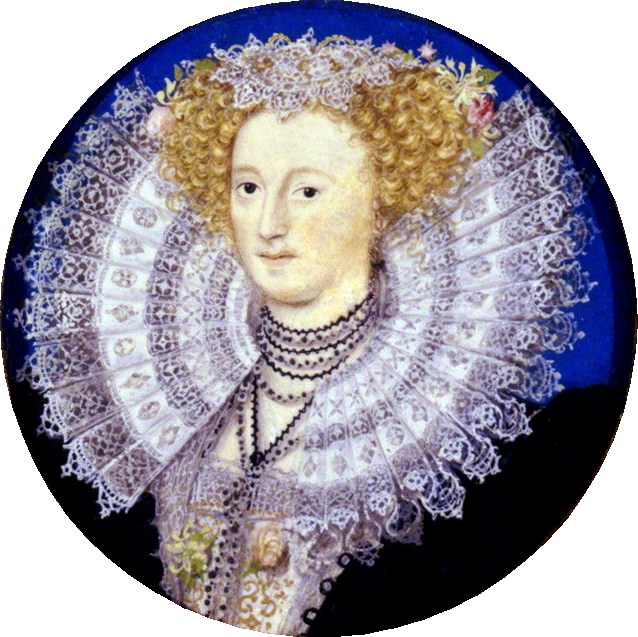
Did Mary Sidney write Shakespeare’s Plays?
What a wonderfully loaded question, hey?
Another question – What on earth has this got to do with the 12th Century and The Ravens of Dinefwr?
If you bear with me, I will try to explain but first – I don’t know whether to go down on my knees and Thank the Research Angel who forever sits by me, or to roll my eyes at her.
SIDE NOTE:
‘What, you have given me yet another research lane to wander along? Puh-lease, my lady.’
OK. I will start with the first question and answer it with two more questions!
Did you know the following about the Bard of Avon aka William Shakespeare….?
SIDE NOTE:
All thanks to The Mary Sidney Society for the following information.
There is no evidence he was ever paid as a writer.
There is no evidence he was recognised by a patron.
There is no evidence of an education in French, Italian, or Latin, languages in which the author was obviously fluent.
There is no original manuscript or even a piece of one.
There are no records from anyone in which Shakespeare is personally referred to as a writer (read the contemporary mentions of William Shakespeare carefully—the works are referred to, not the man).
Not Shakespeare, not his family, not anyone in Stratford is recorded as having mentioned he was a writer.
There is no evidence that he owned or borrowed any books or ever used a nobleman’s private library to access the more than 200 source materials used in writing the plays.
There is no evidence he was ever present in the royal court, where most of the plays take place.
There is no correspondence extant from Shakespeare, and only one unsent business letter to him; that letter makes no literary reference.
There is nothing in Shakespeare’s handwriting except six signatures (one illegible), all on legal documents, all within four years of his death, all spelled differently.
There is no evidence that anyone noticed when he died.
Did you know the following about Mary Sidney Herbert, Countess of Pembroke…..?
SIDE NOTE:
All thanks AGAIN to The Mary Sidney Society for the following information.
(She) was known to be a hot-tempered redhead, brilliant, multi-talented, strong, dynamic, passionate, generous, and a bit arrogant. She was born three years before Shakespeare and died five years after.
For two decades, she developed and led the most important literary circle in England’s history, Wilton Circle, taking the mantle from her mentor, her brother Sir Philip Sidney, who died in the Queen’s Protestant war. Her work, the work of her brother, and the work of many of the writers in her circle were used as sources for the Shakespearean plays.
She was devoted to literature and to creating great works in the English language. This was a brave mission since English was not considered a significant language at the time; there were great works in Italian, French, Latin, and Greek, but few in English. Nor was English spoken anywhere else in the world—rarely even in Scotland, Wales, or Ireland.
She was fluent in Latin, French, and Italian, and is believed to have also known Welsh, Spanish, and possibly Greek. She was one of the most educated women in England, comparable only to Queen Elizabeth. She was politically involved and outspoken, although she disliked the fawning and superficiality of the royal court.
…..
She also owned a prestigious library that included just about every book needed to research the magnificent treasury of subjects covered in The Complete Works of William Shakespeare. Whereas, there is not a single recording of a single book in the possession of Will.
OK. Things get lost in time etc etc. And I am not trying to prove that Mary was the true author of this marvellous opus. It was just that, whilst deep in researching 12th century Wales, I came across this unexpected reference to Mary Sidney.
Now for the second question. What on earth does this have to do with my work in progress?
Aha!
Well, the strangest thing, and the reason it stopped me in my tracks, is because Mary Sidney not only connects to The Ravens of Dinefwr but also to my first novel Weave a Garland of my Vows.
It will be much easier to explain Weave a Garland. This novel is about a French woman called Marie de Rohan (1600-1679)
At the age of 23 and married for the second time, she comes into contact with Henry Rich, Earl of Holland. She falls in love at first sight and bears him a daughter, born in London.
Henry Rich was the second son of the Lady Penelope Rich.
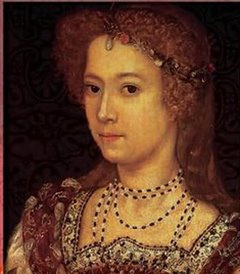
Lady P is easy to find on the t’internet. Her beauty, love affair, husbands, treason etc. But she was also the model for Stella of Astrophel and Stella fame written by Sir Philip Sidney.
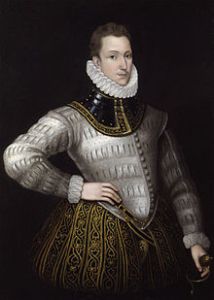
The brilliant Sir Philip was said to be deeply in love with Lady Penelope, hence his portrayal of her as Stella. Were they lovers? Who knows.
AND ALSO – Sir Philip was the much loved and deeply admired older brother of MARY SIDNEY.
SIDE NOTE:
I’m almost at 12th century Wales. Be Patient!
And also note that Mary Sidney was the Countess of Pembroke.
Pembroke was the home of Nest ferch Rhys, one of the Ravens.
And Philip and Mary’s younger brother was ROBERT SIDNEY.
This Robert Sidney married a lady called Barbara Gamage of Coety Castle, Glamorgan, Wales.
Barbara Gamage was a direct descendant of the original owners of Coety Castle – which in the 11th century was situated in Welsh county of Morgannwg, an early name form Gwent and Glamorgan.
Around 1092, a Norman knight called Robert Fitzhamon was asked by the ruler of Morgannwg (Iestyn ap Gwrgan) to help him fight against his neighbouring King in Deheubarth…..who just happens to be Rhys ap Tewdwr, father of all the Ravens of Dinefwr. Robert succeeded, reneged on his deal with Iestyn and became most famous as The Conqueror of Glamorgan. He took all of the land and all of the castles except one.
SIDE NOTE:
Are you still here with me? Can you guess which castle?
Yes. COETY Castle. There is another whole story about Coety Castle and the Breton knight Payn de Tuberville and his family that, in the 16th century, produced a daughter called Barbara Gamage who married the brother of Mary Sidney.
If you are confused – imagine how I feel. I do this kind of thing every day!!
And one day, I WILL find out if Mary Sidney wrote the Shakespeare Plays. Wish me luck.


Wow!….you research skills never cease to amaze me, but your writing instincts….are in the realms of the Muses! You have found incredible connections to both your current and past work! There is a story, a very old story, that is weaving its way through your writing, and that is one of the aspects that makes your work so authentic. It feels real, because it is:-) Now, about this Mary Sidney….I have always been firmly in the Oxfordian camp. I have not heard of Mary Sidney as a possible person behind the plume, but it has a great deal of possibility! The one thing that has bedeviled critics for years it explaining Shakespeare’s depth of understanding of women, especially in the later plays.
It is so spooky, Greta. Neither one of us has mentioned Shakespeare in years, but just this past week, out of my own research, I picked up a copy of “Shakespeare and the Goddess of Complete Being” written by Ted Hughes and published in 1992 to horrendous and scathing reviews. It seems to be having a new life among a few writers today, and I am absolutely glued to it. It has a small bit of a “The White Goddess” by Robert Graves in it, but it is truly a unique look at the opus of Shakespeare as if he had (or she had) a deep, instinctual connection to myth, and particularly the myths of Catholics (of the that time) and Protestants (and how that relates to more ancient European mythology). I won’t go into details, but it made me stop in my tracks to see your headline and topic today…Shakespeare. There is something truly powerful in the bard’s work that pours out anew endlessly, and endlessly bringing connections and meaning.
Now, if you find out more about Lady Mary…please…let us know!
LikeLiked by 1 person
Hi Deb. This is the 3rd time I’ve tried to reply. If you got the other 2 messages – apologies.
The links are amazing, aren’t they? And the fact that we are both reading about Shakespeare! I will look out for the Ted Hughes book and recommend The Sweet Swan of Avon whose author I’ve forgotten. D’oh.
There’s another link that I didn’t mention above. Mary Sidney’s home was Wilton, where Murier/Muriel the poet was associated.
I’ve always loved The White Goddess, although that is regularly panned nowadays.
Oh – so much to find out, so little time
Thank you :o)
LikeLike