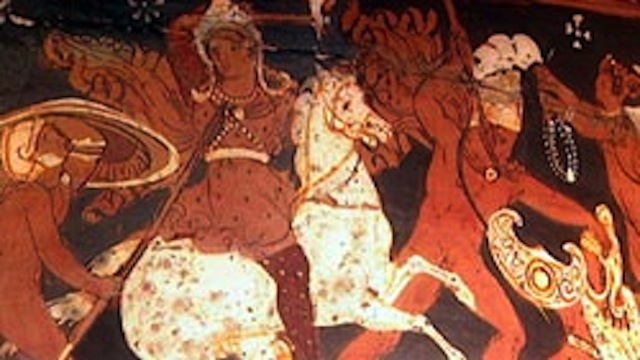
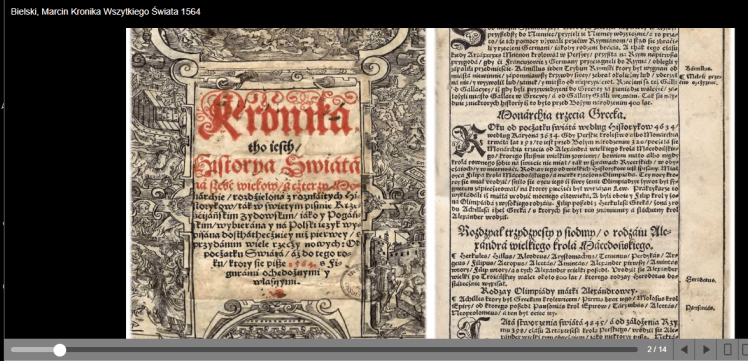
In the 16th century book Kronika Wszystkiego świata by Marcina Bielski (Chronicle of the Whole World) the author has a chapter called…
ABOUT AMAZON WOMEN, TATAR WIVES
They rode and fought with their men as equals.
No kidding!!
But – as another name for Tartarian is Scythian. And Scythian is another name for Scandanavian; these stories have come down to us via the Norse Sagas about Warrior Viking Women.
I’ve tracked down a copy of the above book. But I can’t read Polish. D’oh.
“
 Hidden History Research
Reblogged this on Greta Brookes and commented:
Love Amazons :o)
LikeLike
Greta,
I have been meaning to address this post, in detail, for quite some time. Let us start with what you said in this post, and break it down line by line.
You said: “In the 16th century book Kronika Wszystkiego świata by Marcina Bielski (Chronicle of the Whole World) the author has a chapter called…
ABOUT AMAZON WOMEN, TATAR WIVES
They rode and fought with their men as equals.
No kidding!!
But – as another name for Tartarian is Scythian. And Scythian is another name for Scandanavian; these stories have come down to us via the Norse Sagas about Warrior Viking Women.
I’ve tracked down a copy of the above book. But I can’t read Polish. D’oh.”
The first statement you made was “In the 16th century book Kronika Wszystkiego świata by Marcina Bielski (Chronicle of the Whole World) the author has a chapter called…
ABOUT AMAZON WOMEN, TATAR WIVES”
I, too, have located the “book in question”. It is 13 printed pages (14 if you count the cover) in Polish. The book’s title is “Kronika Wszytkiego Świata”, written by Marcin Bielski, and published in 1564 by Siebeneicher Mateusz in Kraków. If one translates the title, one literally gets “Chronicle of the All World”, which in common vernacular would be “Chronicle of the Whole World”. The Polish word for “Amazon” is “Amazonka” or “Amazonkach”, depending on how it is used. I have searched the transcribed version of this very short book and have found no reference to “Amazonka”. Nor am I able to find any word resembling ta, tar, tat, tart, tarta, tata, tartar, or tatar; which should appear in some form because “Tatar” or “Tartar” does not translate into Polish, it stays “Tatar” or “Tartar”. Anyway, I see nothing that even remotely resembles a chapter title of “About Amazon women, Tatar wives”, which in Polish should be “O Amazonkach, tatarskich żonach”. So where did you get that chapter title? There is no English translation that I can find of the Polish book “Kronika Wszytkiego Świata” written by Marcin Bielski.
The second statement you made was “They rode and fought with their men as equals.”, followed by “No kidding!!”. This is indeed true for Scythians and Sarmatians. At this point, I must make a distinction between Scythian, Sarmatian, and Tatarian (Tartarian). Based on your next statement “But – as another name for Tartarian is Scythian. And Scythian is another name for Scandanavian; these stories have come down to us via the Norse Sagas about Warrior Viking Women.”, I must also distinguish them from Scandanavians as well. Let us take them in the order in which you mention them: Tatar (Tartar), Scythian, and Scandinavian (to which I would add Sarmatian, for clarification).
Historically, the term Tatars (or Tartars) was applied to anyone originating from the vast Northern and Central Asian landmass then known as Tartary, which was dominated by various mostly Turco-Mongol semi-nomadic empires and kingdoms. Tartary was an historical region in Asia located between the Caspian Sea-Ural Mountains and the Pacific Ocean.
The Scythians, also known as Scyth, Saka, Sakae, Iskuzai, or Askuzai, were a nomadic people who dominated Central Asia, parts of Eastern Europe east of the Vistula River, and parts of South Asia between the 7th century BC and the 3rd century AD. They were part of the wider Scythian cultures, stretching across the Eurasian Steppe, which included many peoples that are distinguished from the Scythians. Because of this, a broad concept referring to all early Eurasian nomads as “Scythians” has sometimes been used. Use of the term “Scythians” for all early Eurasian nomads has however led to much confusion in literature, and the validity of such terminology is controversial. Other names for that concept are therefore preferable. The same thing has happened when discussing “Saxons”. Typically, in the past, the term was used very broadly to include Angles, Saxons, Jutes, and Frisians. But I digress. The “classical Scythians” known to ancient Greek historians were located in the Pontic steppe and the North Caucasus. The Scythians are generally believed to have been of Iranian origin, and were based in what is modern-day Ukraine and southern Russia. The Scythians called themselves Scoloti and were led by a nomadic warrior aristocracy known as the Royal Scythians.
Scandinavians are any inhabitants of Scandinavia. In turn, Scandinavia is a region in Northern Europe, with strong historical, cultural, and linguistic ties. The term Scandinavia in local usage covers the three kingdoms of Denmark, Norway, and Sweden. The majority national languages of these three belong to the Scandinavian dialect continuum, and are mutually intelligible North Germanic languages. In English usage, Scandinavia also sometimes refers to the Scandinavian Peninsula, or to the broader region including Finland and Iceland, which is always known locally as the Nordic countries.
Finally, The Sarmatians were a large Iranian confederation that existed in classical antiquity, flourishing from about the 5th century BC to the 4th century AD. Originating in the central parts of the Eurasian Steppe, the Sarmatians were part of the wider Scythian cultures. They started migrating westward around the 4th and 3rd centuries BC, coming to dominate the closely related Scythians by 200 BC. At their greatest reported extent, around 1st century AD, these tribes ranged from the Vistula River to the mouth of the Danube and eastward to the Volga, bordering the shores of the Black and Caspian seas as well as the Caucasus to the south. This region included today’s Central Ukraine, South-Eastern Ukraine, Southern Russia, Russian Volga and South-Ural regions, also to a smaller extent north-eastern Balkans and around Moldova.
So, as you can see, the Tatars (Tartars), Scythians, and Sarmatians are indeed related and occupied some of the same and overlapping areas (Scythians and Sarmatians more closely to each other than to the Tatars). In other words, Tatarian (Tartarian) is not another name for Scthyian. The Scandinavians, on the other hand, are not closely related at all to the other three peoples. Their languages aren’t even in the same language family as the Scythians and Tatars. Scandinavians spoke (and speak) North Germanic dialects. Therefore Scythian is most certainly NOT another name for Scandinavian. The Tatar (Tartar) language, together with the Bashkir language, forms the Kypchak-Bolgar (also “Uralo-Caspian”) group within the Kipchak languages (also known as Northwestern Turkic). While The Scythians spoke a language belonging to the Scythian languages, most probably a branch of the Eastern Iranian languages. The Scythian languages may have formed a dialect continuum: “Scytho-Sarmatian” in the west and “Scytho-Khotanese” or Saka in the east. The Sarmatians spoke an Iranian language, derived from “Old Iranian”.
Fortunately for you, I was able to translate into Polish and attempt to find this mysterious chapter entitled: “ABOUT AMAZON WOMEN, TATAR WIVES”. As far as I can tell, there is no such reference. Where did you find that title in English in connection with the book Kronika Wszytkiego Świata written by Marcin Bielski, and published in 1564 by Siebeneicher Mateusz in Kraków? This is indeed fascinating, but I am dubious as to your actual source for this information. I suggest that you take a look at the 2016 paper “The Role of Women in Military Organization of Nomads” by Gaukhar Z Balgabayevaa, Sergey V Samarkina, Elizaveta V Yarochkinaa, Aigul B Taskuzhinaa, Aigul B Amantaeva, and Svetlana V Nazarova. It is available for free download at https://files.eric.ed.gov/fulltext/EJ1115668.pdf. I hope that you find this useful. Thank you for your time and consideration on this subject matter.
LikeLiked by 1 person
Thank you very much for this info.
If I may be so bold (?!) it sounds a bit like Semantics to me but….
…as I’m a little overloaded right now, I’ll re-read tomorrow and answer properly
P.S. Merry Christmas :o)
LikeLike
It is hardly Semantics when the Scandinavians are in a completely separate geographical region and speak an entirely different set of related languages than did the Tatars, Scythians, and Sarmatians. Semantics only applies if the concepts being discussed are fundamentally the same, yet are being described using different words (with the same meaning). I know that I have shown this to not be the case in your attempt to equate Scythians with Scandinavians. I hope you find this all useful. 😎
LikeLiked by 1 person
And a Happy Crimbo to you, Rudolph! 😂😁😀😳😀😁😂
LikeLiked by 1 person
Greta,
You might also want to check out “The Amazons” by Guy Cadogan Rothery, pubished in 1910, by Francis Griffiths in London. It is available at https://www.sacred-texts.com/wmn/ama/index.htm. Hope this is useful as well. Thank you again for your time and consideration on this subject matter.
LikeLiked by 1 person
Glyn,
As above, so here below.
I’ve used the Sacred Texts site for many millions of years.
Please forgive me.
I’ll get back asap :o)
LikeLike
Take your time to carefully examine the evidence. 😎
LikeLike
Okely Dokely. Ta for th’advice!
LikeLike
😎😀😎
LikeLiked by 1 person
Glyn
One language. One world. One Empire.
I’ll explain ALL in an email. If you want :o)
LikeLike
An assumption that all of the dots are connected already is bad academic scholarship and smacks of “belief”, not “knowledge”. It has no place in serious academic research. You must look at the data and see how things fit together. Some pieces do not connect to other pieces. Some pieces will never connect to certain other pieces. “Opinion” does not equal “Fact”. Saying something is true, over and over, does not make it true. Juat because you find a piece of interesting information on a website does not make it true or credible. I can see that you are blinded by your “faith” in wishful thinking, instead of being guided by logic and impirical data. Your methodology makes me sad. 😢
btw, you still have not told me where you found the English translation of the chapter title that is supposedly in that Polish book. Even more evidence that you are connecting too many dots. I wish you well. May you be happy in your blissfullness. 😎
LikeLiked by 1 person
Aha! So in all of this what you are saying is that you want me to trawl through zillions of pages of research to find YOU the English translation of said chapter just to prove myself worthy of this work.
OK. It’s a “don’t hold your breath” moment.
I’ll connect that dot for you – with happy blissfullness :o)
LikeLike
When researching something, accurate and detailed notes are a very good thing. I just get the sense that you believe many things to be true, but have very little solid evidence, especially solid sources (other than the odd web page here and there that supports what you already believe). I could be wrong, but that is my assessment of your methodology. You seem to want to put the burden of proof on those who read what you write, instead of giving solid sources for what you present. As I said before, wishful thinking and only recording those pieces of data that support your worldview is a very biased way to do research. Let the pieces connect themselves. Then you can follow where they lead. I did a fairly complete job of explaining to you why Scythians are not Scandinavians, yet you are comfortable with dismissing it because you want them to be interchangeable. I want the moon to be made of green cheese. But it isn’t, and no amount of wishing will make it so. I even gave you a link to a paper that actually supports sone of what you said about Scythians in terms of the equality of women. Please take a look at that paper: https://files.eric.ed.gov/fulltext/EJ1115668.pdf
😎
LikeLiked by 1 person
Thanks for all the above. But it’s YOUR way of research and YOUR opinions on show (?)
Excuse the shortness of my tone but it’s 3am here and I need more sleep.
I WILL get back to you…whenever I feel like it :o)
LikeLike
Good research methods are not my opinions. Good methods can be verified. Logic is not an opinon. It is a methodology that exists regardless of someone’s opinion.
Critical thinking and problem-solving are not subject to opinion. I was attempting to help you gather sources about the topic area, but I had to first clarify some misconceptions that you have. If you choose not to believe what I said, even after I gave you details, I would be happy to point you to solid sources. So far, all I see is someone who wants what they believe to be actual knowledge. Scythian and Scandinavian are not interchangeable. That is not my opinon. It is the result of genetic and linguistic research. Science can show you that truth. If you do not accept logic and science, then use whatever methodology you wish. Just know that opinions are not facts, and believing is not knowing. I will utilise proper and complete research methods. If you have any questions, let me know. Sleep well. 😴
LikeLiked by 1 person
All of that just because I didn’t give you MY research source as and when demanded??
I’m not logical or scientific??
Critical thinking?
Problem Solving?
You pick one of many hundreds of posts here to throw THAT at me?
Those words?
Heyho!
My methodology is mine and mine alone and NOT subject to anyone else’s opinions.
That said – thanks for your time and advice :o)
LikeLike
When someone becomes as defensive as your responses have become, it is a sure sign of being caught unaware. I do not know nor would even venture to guess the reason/cause of your increasing defensiveness. Therefore, I shall leave you to your “bumbling”. As I said before, my level of detail was meant to help, not hinder. If you do ever have any questions, let me know. 😎
LikeLike
Yadayada,
When you’ve been bitched about, disrespected, ignored, stolen from and totally broken down by “people” that have never even met you – defensive is excusable.
I make No apologies for fighting for myself and my work.
I never said that you’d hindered me. I thanked you for your time and links.
I thank you again
LikeLike
You are welcome. I only attempt to inform when I see things that aren’t quite correct. I wish you well. Feel free to ask questions of me, when you feel that it might be appropriate. Cheers! Be well. 😎
LikeLiked by 1 person
P.S. Also. And BTW.
I don’t have all the answers to all the questions unlike so many others who (think they) do.
I’m just one person struggling to find some truth in our history. The day that I wake up PERFECT – have no fear – I’ll tell the whole world.
Until then I’ll bumble along in my own sweet fashion doing the best I can with the little I’ve been given.
With regards GB
LikeLike
For the record, I do not know everything, nor do I have “all of the answers”, as you put it. I know what I know because I research various topics, sometimes in great detail for many years. I have been at this since 1972. Be well. Be safe. Take care. 😎
LikeLike
Likewise.
And I was talking about me not having the answers etc not you.
No worries.
All that’s foul is….etc :o)
LikeLike
Was merely responding in like tone. I wish you all of the best. 😎
LikeLike
Question – Who Are You?
LikeLiked by 2 people
If you Google me, Glyn Hnutu-healh, you will find all of my social media accounts. I am the primary author of the Circle of Logres project (http://www.CircleOfLogres.com/). I am a practicing Druí Alchemist, who is degreed in Physics. I have a wide variety of interests including History, Genealogy, Physics, Alchemy, Arthuriana, Linguistics, Science Fiction, Fantasy, and Genetics.
LikeLike