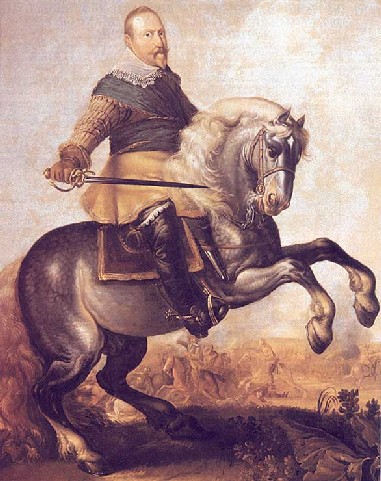
Gustav II Adolf played a large role in the Time of Troubles in Russia and the Europe wide Catholic vs Protestant Thirty Years War.
His daughter, Christina, succeeded him but caused a huge scandal when she rejected Protestantism, abdicated and ended up in Rome (via France.)
Her tomb is in St Peter’s Basilica. I’ve seen it :o)
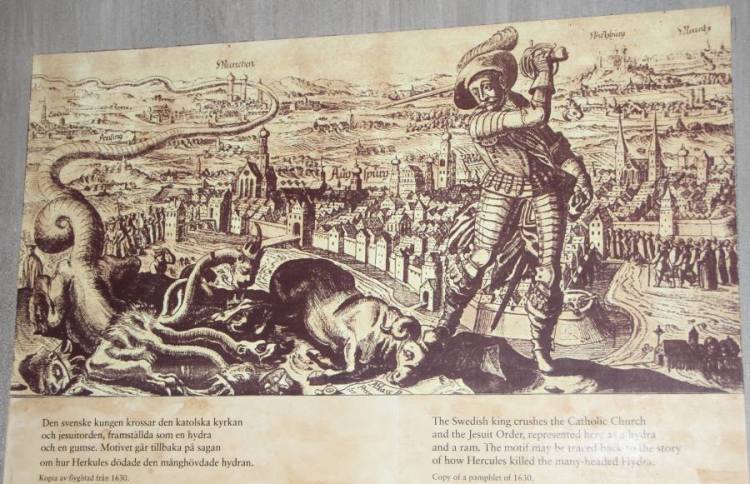
An old 17th-century Swedish engraving showing how Gustav Adolf confidently defeats the bad Hydra – a symbol of the Catholic Church. Recall that before the so-called catholic came the orthodox church. Here, however, the authors of the pamphlet refrained from depicting Aries the Lamb, that is, Christ, struck by the fair sword of the good Protestant king. (Gustav II Adolf)
 Hidden History Research
About the so called “Gotomania”
A piece of my paper
Табов, Й. Легенды о происхождении славян. В: Цивилизация знаний: проблемы и смыслы образования. Труды Четырнадцатой Международной научной конференции, г. Москва, 26-27 апреля 2013 г. Часть ІІ. РосНОУ, Москва, 2013, 265-281.
Tabov, J. Legends about the origin of the Slavs. In: The civilization of knowledge: problems and meanings of education. Proceedings of the Fourteenth International Scientific Conference, Moscow, April 26-27, 2013. Part II. RosNOU, Moscow, 2013, 265-281. (In Russian)
https://www.academia.edu/29307704/%D0%9B%D0%B5%D0%B3%D0%B5%D0%BD%D0%B4%D1%8B_%D0%BE_%D0%BF%D1%80%D0%BE%D0%B8%D1%81%D1%85%D0%BE%D0%B6%D0%B4%D0%B5%D0%BD%D0%B8%D0%B8_%D1%81%D0%BB%D0%B0%D0%B2%D1%8F%D0%BD
Summing up the above information, we can distinguish in them 2 types of theories about the “homeland of the Slavs”: Scandinavian, which put this homeland in Scandinavia, and Danube, according to which it is near the middle and lower reaches of the Danube.
Why Scandinavia?
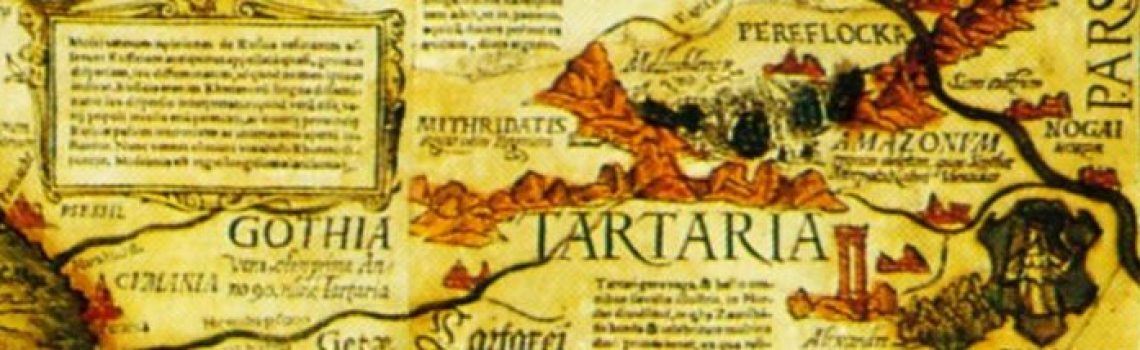
The search for the answer to this question must begin with a consideration of an interesting phenomenon that took place in the 15th-17th centuries. in Europe, for which the eloquent term “gotomania” is sometimes used.
Its beginning can be traced back to Basel Cathedral in 1431. Representatives of Sweden and the Spanish Habsburgs presented claims to provide them with first places in the hall. These places belonged to them, since, according to their statements, they came from the glorious and victorious Goths. Sweden was represented at the cathedral by Nicolaus Ragvaldi, Bishop of Växjö and Ulrich, Bishop of Arhus.
In his speech at the Council, Bishop Ragvaldson draws Sweden as the center of world history. Countless nations have come from the Goths homeland, which today is called Sweden – assures Ragvaldson. The first among them are the Goths and the West Goths. These two nations have done wonderful and glorious deeds. They conquered Europe, Asia and Egypt. The Amazons were Gothic women, and the Gothic king Euriphilus, a cousin or nephew of the Trojan king Priam, fought in the Trojan War, where he died gloriously …
After Ragvaldson’s speech at the Cathedral in Basel (1431) and especially after he became bishop of Uppsala (1438), Swedish historiography experienced a period of patriotic heyday. Its culmination came in 1554, when the book “The History is Ready” by the Swedish historian and writer John Magnus went out of print in Rome. In it, the author, the last Swedish Catholic Bishop Magnus, claims that more than thirty nations and peoples came from Sweden. By force of arms they settled in Asia, Africa and Europe. The most brilliant among them were the Goths, who in 875 from the Flood were the first to leave Scandinavia. Magnus has 87 East and West Gothic kings who reigned “outside of Sweden”. Magnus calls them “external Gothic rulers” and connects them with the history of Sweden.
Later, the Hubsburg court historian Wolfgang Latsius further developed Magnus’ geopolitical views on the “conquest” of Goths, putting forward the idea of a “great migration of peoples”. In his version, the “Germanic peoples”, led by the Goths, not only conquered territories and ruled over them, but also moved in great numbers, settled them, and there, in the settled territories, they left a common national heritage. All these territories, Lazius believed, should unite the power of the Habsburgs.
And these “Gothic conquests” extend, no less, from Crimea to Spain and Sweden.
Josef Svennung. Zur Geschichte des Goticismus. Uppsala, 1967, S. 34.
Curt Weibull. Die Ausweiderung der Goten aus Schweden. Göteborg, 1958, S. 3.
Johannes Magnus, Historia de omnibus Gothorum Sueonumque regibus.
Hans Messmer. Hispania Idee und Gotenmythos. Zurich, 1960, S. 51. Wolfgang Lazius. De gentium aliquot migrationibus, libri XII, Basel, 1557, p. 4.
(Google translation)
LikeLiked by 1 person
On the Dating of the Silver Codex (Codex Argenteus)
From the paper
Й. Табов. О датировке Серебряного Кодекса (Codex Argenteus). Сборник статей по новой хронологии. Выпуск 6. ноябрь 2007 г. http://new.chronologia.org/volume6/argenteus.html
J. Tabov On the Dating of the Silver Codex (Codex Argenteus). Collection of articles on the new chronology. Issue 6. November 2007. (In Russian). http://new.chronologia.org/volume6/argenteus.html
Abstract. The article analyzes specific details from the history of Codex Argenteus from the mid-16th century, when it came to the attention of the public in the form of a manuscript in the Benedictine monastery in Verdun, until 1669, when it was presented to Uppsala University. On this basis is the hypothesis that Codex Argenteus, stored in the library of the named university, is a copy of the original Verdun manuscript, and that this copy was made in the XVII century, most likely around 1660.
…………
Let us return again to Metzger’s story quoted above about the history of Codex Argenteus.
We learned from it that Vossius showed the manuscript to his uncle Francis Junius, a connoisseur of ancient Teutonic languages. Seeing the translation of the Gospels into the “Gothic language”, Junius considered this a finger of Providence; realizing that the manuscript is a unique document, he began to prepare “The first printed edition of the version of the Gospels of Ulfilah (Dordrecht, 1665).” Here we will not touch upon the problem of whether the versions of the Gospels contained in Codex Argenteus can be considered versions of Ulfilah; it would be more accurate to say that this was the publication of the Gospels from a manuscript in the same “Gothic language”.
As it turns out from the words of Metzger, this edition required a “transcription” of the text of the manuscript. In other words, a copy was made – most likely, more clear and legible. Unraveling the handwriting of the scribe of the manuscript had a scientist named Derrer.
And here in the history of the Codex appears the Swedish Marshal Count de la Guardie. According to Kulundzhich, he bought the manuscript from Vossius, then ordered a silver binding for it (therefore, understood its value) and then presented it to the queen.
Yes, most likely, the marshal gave Queen Christine exactly Codex Argenteus – the manuscript that is now in Uppsala. This is indeed a royal gift.
But what did he buy from Vossius? Verdun manuscript? Apparently not. The logic of facts leads us to the following hypothesis:
The Swedish Marshal Count de la Guardie bought — or rather ordered — a “royal” copy from the Verdun manuscript; high quality parchment copy, made at the best level of calligraphy of that time, using advanced technologies for that era. The copy, which is a real work of art, which is worthy to perpetuate the text of the Verdun manuscript, and which is worthy to become a gift to the queen. This copy is Codex Argenteus.
The further fate of the Silver Codex is also logical. Is Derrer its creator? Perhaps further research will answer this question.
Dating: XVII century
The analysis of the history of the Silver Codex carried out here gives many reasons in favor of the hypothesis formulated above about its creation. However, this analysis does not prove it. It remains likely (according to the author of these lines is very small) that the traditional version attributing the creation of SA to the masters at the court of King Theodorich in Ravenna is true.
In addition, the use of glass vessels in alchemy, which began in the 1620s, created the potential for separate “technological breakthroughs”: someone from the circle of alchemists close to Glauber could create an analogue of ink for “silver letters”, shortly after 1620 . This means that it cannot be ruled out that the “royal copy” of the Verdun manuscript — with silver and gold letters — was made, for example, between the years 1648 and 1654 at the court of Christina in Stockholm, or even somewhat earlier, in Prague, in the Khradchansky castle. But, taking into account the pace of development of alchemical knowledge and alchemical practice, one should evaluate the probability of a manuscript like the Silver Codex at the beginning of the period 1620-1660 as small; it rises sharply towards the end of this period, i.e. by 1660.
Thus, based on these considerations, we propose the following dating of the Silver Codex: the probability that it was created before 1620 is close to zero; starting from 1620, this probability increases and reaches a maximum around 1660, when the existence of the Codex is not in doubt.
(translation: Google). ..
……. ..
LikeLiked by 1 person